Chapter 4 of 14
NCERT Solutions

Quadratic Equations

Rajasthan Board · Class 10 · Mathematics

NCERT Solutions for Quadratic Equations — Rajasthan Board Class 10 Mathematics.

57 questions20 flashcards5 concepts

Interactive on Super Tutor

Studying Quadratic Equations? Get the full interactive chapter.

Quizzes, flashcards, AI doubt-solver and a step-by-step study plan — built for ncert solutions and more.

1,000+ Class 10 students started this chapter today

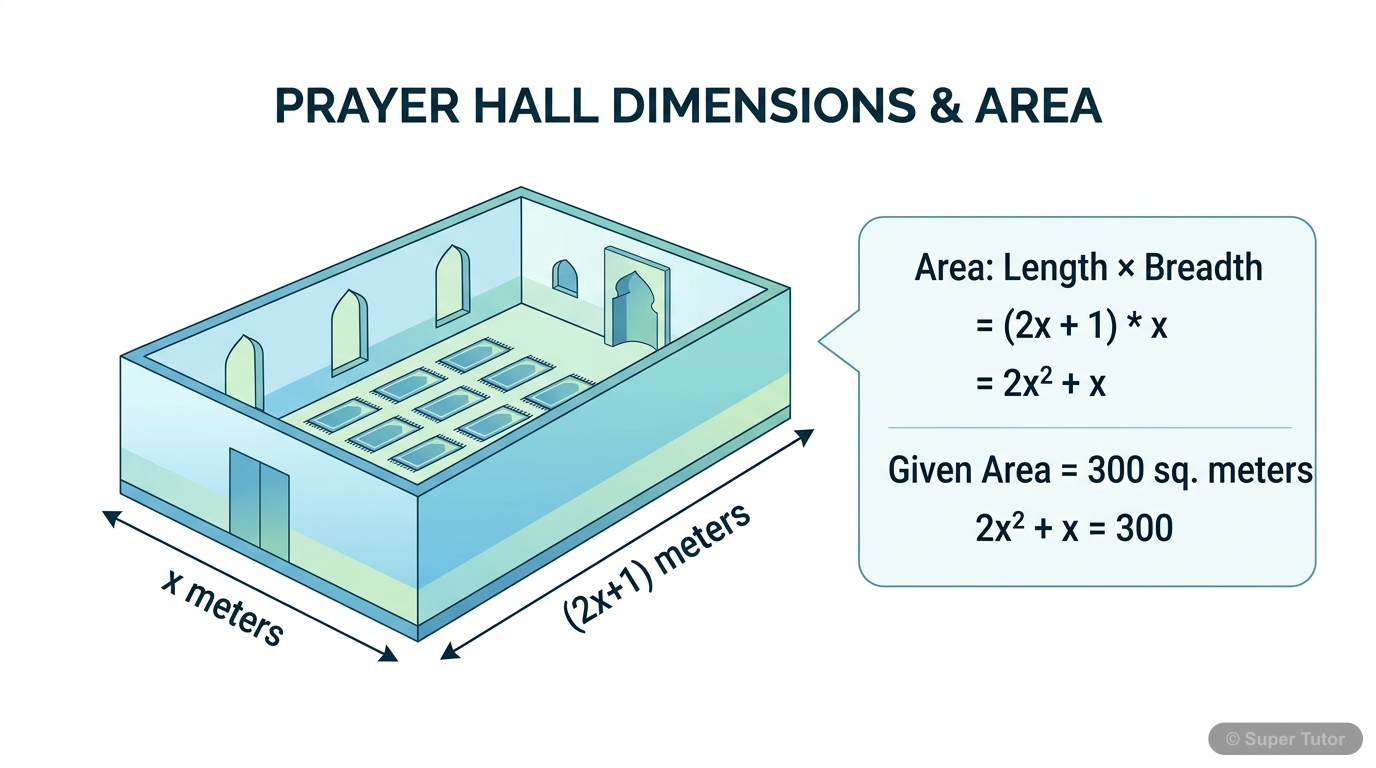
An illustration showing a real-world scenario (like building a prayer hall) that naturally leads to a quadratic equation, with dimensions labeled.
Super Tutor

Learn better with visuals Super Tutor has hundreds of illustrations like this across every chapter — all free to try.

Get started
30 Questions Solved · 3 Sections

Exercise 4.1

1(i)Check whether (x+1)2=2(x3)(x + 1)^2 = 2(x - 3) is a quadratic equation.Show solution
Given: (x+1)2=2(x3)(x + 1)^2 = 2(x - 3)

Simplifying LHS and RHS:
x2+2x+1=2x6x^2 + 2x + 1 = 2x - 6
x2+2x+12x+6=0x^2 + 2x + 1 - 2x + 6 = 0
x2+7=0x^2 + 7 = 0

This is of the form ax2+bx+c=0ax^2 + bx + c = 0 where a=1, b=0, c=7a = 1,\ b = 0,\ c = 7 and a0a \neq 0.

Conclusion: The given equation is a quadratic equation.
1(ii)Check whether x22x=(2)(3x)x^2 - 2x = (-2)(3 - x) is a quadratic equation.Show solution
Given: x22x=(2)(3x)x^2 - 2x = (-2)(3 - x)

Simplifying RHS:
x22x=6+2xx^2 - 2x = -6 + 2x
x22x2x+6=0x^2 - 2x - 2x + 6 = 0
x24x+6=0x^2 - 4x + 6 = 0

This is of the form ax2+bx+c=0ax^2 + bx + c = 0 where a=1, b=4, c=6a = 1,\ b = -4,\ c = 6 and a0a \neq 0.

Conclusion: The given equation is a quadratic equation.
1(iii)Check whether (x2)(x+1)=(x1)(x+3)(x - 2)(x + 1) = (x - 1)(x + 3) is a quadratic equation.Show solution
Given: (x2)(x+1)=(x1)(x+3)(x - 2)(x + 1) = (x - 1)(x + 3)

Expanding LHS:
x2+x2x2=x2x2x^2 + x - 2x - 2 = x^2 - x - 2

Expanding RHS:
x2+3xx3=x2+2x3x^2 + 3x - x - 3 = x^2 + 2x - 3

Setting LHS = RHS:
x2x2=x2+2x3x^2 - x - 2 = x^2 + 2x - 3
x2x2+3=0-x - 2x - 2 + 3 = 0
3x+1=0-3x + 1 = 0

This is not of the form ax2+bx+c=0ax^2 + bx + c = 0 (the x2x^2 terms cancel, so a=0a = 0).

Conclusion: The given equation is not a quadratic equation.
1(iv)Check whether (x3)(2x+1)=x(x+5)(x - 3)(2x + 1) = x(x + 5) is a quadratic equation.Show solution
Given: (x3)(2x+1)=x(x+5)(x - 3)(2x + 1) = x(x + 5)

Expanding LHS:
2x2+x6x3=2x25x32x^2 + x - 6x - 3 = 2x^2 - 5x - 3

Expanding RHS:
x2+5xx^2 + 5x

Setting LHS = RHS:
2x25x3=x2+5x2x^2 - 5x - 3 = x^2 + 5x
2x2x25x5x3=02x^2 - x^2 - 5x - 5x - 3 = 0
x210x3=0x^2 - 10x - 3 = 0

This is of the form ax2+bx+c=0ax^2 + bx + c = 0 where a=1, b=10, c=3a = 1,\ b = -10,\ c = -3 and a0a \neq 0.

Conclusion: The given equation is a quadratic equation.
1(v)Check whether (2x1)(x3)=(x+5)(x1)(2x - 1)(x - 3) = (x + 5)(x - 1) is a quadratic equation.Show solution
Given: (2x1)(x3)=(x+5)(x1)(2x - 1)(x - 3) = (x + 5)(x - 1)

Expanding LHS:
2x26xx+3=2x27x+32x^2 - 6x - x + 3 = 2x^2 - 7x + 3

Expanding RHS:
x2x+5x5=x2+4x5x^2 - x + 5x - 5 = x^2 + 4x - 5

Setting LHS = RHS:
2x27x+3=x2+4x52x^2 - 7x + 3 = x^2 + 4x - 5
2x2x27x4x+3+5=02x^2 - x^2 - 7x - 4x + 3 + 5 = 0
x211x+8=0x^2 - 11x + 8 = 0

This is of the form ax2+bx+c=0ax^2 + bx + c = 0 where a=1, b=11, c=8a = 1,\ b = -11,\ c = 8 and a0a \neq 0.

Conclusion: The given equation is a quadratic equation.
1(vi)Check whether x2+3x+1=(x2)2x^2 + 3x + 1 = (x - 2)^2 is a quadratic equation.Show solution
Given: x2+3x+1=(x2)2x^2 + 3x + 1 = (x - 2)^2

Expanding RHS:
(x2)2=x24x+4(x-2)^2 = x^2 - 4x + 4

Setting LHS = RHS:
x2+3x+1=x24x+4x^2 + 3x + 1 = x^2 - 4x + 4
x2x2+3x+4x+14=0x^2 - x^2 + 3x + 4x + 1 - 4 = 0
7x3=07x - 3 = 0

This is not of the form ax2+bx+c=0ax^2 + bx + c = 0 (the x2x^2 terms cancel).

Conclusion: The given equation is not a quadratic equation.
1(vii)Check whether (x+2)3=2x(x21)(x + 2)^3 = 2x(x^2 - 1) is a quadratic equation.Show solution
Given: (x+2)3=2x(x21)(x + 2)^3 = 2x(x^2 - 1)

Expanding LHS:
(x+2)3=x3+3(x2)(2)+3(x)(4)+8=x3+6x2+12x+8(x+2)^3 = x^3 + 3(x^2)(2) + 3(x)(4) + 8 = x^3 + 6x^2 + 12x + 8

Expanding RHS:
2x(x21)=2x32x2x(x^2 - 1) = 2x^3 - 2x

Setting LHS = RHS:
x3+6x2+12x+8=2x32xx^3 + 6x^2 + 12x + 8 = 2x^3 - 2x
x3+6x2+12x+82x3+2x=0x^3 + 6x^2 + 12x + 8 - 2x^3 + 2x = 0
x3+6x2+14x+8=0-x^3 + 6x^2 + 14x + 8 = 0

This is a polynomial of degree 3 (cubic equation), not of the form ax2+bx+c=0ax^2 + bx + c = 0.

Conclusion: The given equation is not a quadratic equation.
1(viii)Check whether x34x2x+1=(x2)3x^3 - 4x^2 - x + 1 = (x - 2)^3 is a quadratic equation.Show solution
Given: x34x2x+1=(x2)3x^3 - 4x^2 - x + 1 = (x - 2)^3

Expanding RHS:
(x2)3=x33(x2)(2)+3(x)(4)8=x36x2+12x8(x-2)^3 = x^3 - 3(x^2)(2) + 3(x)(4) - 8 = x^3 - 6x^2 + 12x - 8

Setting LHS = RHS:
x34x2x+1=x36x2+12x8x^3 - 4x^2 - x + 1 = x^3 - 6x^2 + 12x - 8
x3x34x2+6x2x12x+1+8=0x^3 - x^3 - 4x^2 + 6x^2 - x - 12x + 1 + 8 = 0
2x213x+9=02x^2 - 13x + 9 = 0

This is of the form ax2+bx+c=0ax^2 + bx + c = 0 where a=2, b=13, c=9a = 2,\ b = -13,\ c = 9 and a0a \neq 0.

Conclusion: The given equation is a quadratic equation.
2(i)The area of a rectangular plot is 528m2528\,\text{m}^2. The length of the plot (in metres) is one more than twice its breadth. Represent this situation as a quadratic equation.Show solution
Let the breadth of the plot =x= x metres.

Then the length of the plot =(2x+1)= (2x + 1) metres.

Given: Area =528m2= 528\,\text{m}^2

Length×Breadth=528\text{Length} \times \text{Breadth} = 528
(2x+1)×x=528(2x + 1) \times x = 528
2x2+x=5282x^2 + x = 528
2x2+x528=02x^2 + x - 528 = 0

This is the required quadratic equation, where xx represents the breadth of the plot.
2(ii)The product of two consecutive positive integers is 306. Represent this situation as a quadratic equation.Show solution
Let the two consecutive positive integers be xx and x+1x + 1.

Given: Their product =306= 306

x(x+1)=306x(x + 1) = 306
x2+x=306x^2 + x = 306
x2+x306=0x^2 + x - 306 = 0

This is the required quadratic equation, where xx is the smaller of the two consecutive integers.
2(iii)Rohan's mother is 26 years older than him. The product of their ages 3 years from now will be 360. Represent this situation as a quadratic equation to find Rohan's present age.Show solution
Let Rohan's present age =x= x years.

Then his mother's present age =(x+26)= (x + 26) years.

3 years from now:
- Rohan's age =(x+3)= (x + 3) years
- Mother's age =(x+26+3)=(x+29)= (x + 26 + 3) = (x + 29) years

Given: Product of their ages 3 years from now =360= 360

(x+3)(x+29)=360(x + 3)(x + 29) = 360
x2+29x+3x+87=360x^2 + 29x + 3x + 87 = 360
x2+32x+87360=0x^2 + 32x + 87 - 360 = 0
x2+32x273=0x^2 + 32x - 273 = 0

This is the required quadratic equation, where xx is Rohan's present age.
2(iv)A train travels a distance of 480km480\,\text{km} at a uniform speed. If the speed had been 8km/h8\,\text{km/h} less, it would have taken 3 hours more to cover the same distance. Represent this situation as a quadratic equation to find the speed of the train.Show solution
Let the speed of the train =xkm/h= x\,\text{km/h}.

Time taken at speed xx:
t1=480xhourst_1 = \frac{480}{x}\,\text{hours}

Time taken at speed (x8)(x - 8):
t2=480x8hourst_2 = \frac{480}{x - 8}\,\text{hours}

Given: t2t1=3t_2 - t_1 = 3

480x8480x=3\frac{480}{x-8} - \frac{480}{x} = 3

480(x(x8)x(x8))=3480\left(\frac{x - (x-8)}{x(x-8)}\right) = 3

480×8x(x8)=3480 \times \frac{8}{x(x-8)} = 3

3840x(x8)=3\frac{3840}{x(x-8)} = 3

3840=3x(x8)3840 = 3x(x - 8)

1280=x28x1280 = x^2 - 8x

x28x1280=0x^2 - 8x - 1280 = 0

This is the required quadratic equation, where xx is the speed of the train in km/h.

Exercise 4.2

1(i)Find the roots of the quadratic equation x23x10=0x^2 - 3x - 10 = 0 by factorisation.Show solution
Given: x23x10=0x^2 - 3x - 10 = 0

Splitting the middle term: We need two numbers whose product is 10-10 and sum is 3-3. These are 5-5 and +2+2.

x25x+2x10=0x^2 - 5x + 2x - 10 = 0
x(x5)+2(x5)=0x(x - 5) + 2(x - 5) = 0
(x5)(x+2)=0(x - 5)(x + 2) = 0

Setting each factor to zero:
x5=0    x=5x - 5 = 0 \implies x = 5
x+2=0    x=2x + 2 = 0 \implies x = -2

The roots of the equation are x=5x = 5 and x=2x = -2.
1(ii)Find the roots of the quadratic equation 2x2+x6=02x^2 + x - 6 = 0 by factorisation.Show solution
Given: 2x2+x6=02x^2 + x - 6 = 0

Splitting the middle term: We need two numbers whose product is 2×(6)=122 \times (-6) = -12 and sum is +1+1. These are +4+4 and 3-3.

2x2+4x3x6=02x^2 + 4x - 3x - 6 = 0
2x(x+2)3(x+2)=02x(x + 2) - 3(x + 2) = 0
(x+2)(2x3)=0(x + 2)(2x - 3) = 0

Setting each factor to zero:
x+2=0    x=2x + 2 = 0 \implies x = -2
2x3=0    x=322x - 3 = 0 \implies x = \frac{3}{2}

The roots of the equation are x=2x = -2 and x=32x = \dfrac{3}{2}.
1(iii)Find the roots of the quadratic equation 2x2+7x+52=0\sqrt{2}\,x^2 + 7x + 5\sqrt{2} = 0 by factorisation.Show solution
Given: 2x2+7x+52=0\sqrt{2}\,x^2 + 7x + 5\sqrt{2} = 0

Splitting the middle term: We need two numbers whose product is 2×52=10\sqrt{2} \times 5\sqrt{2} = 10 and sum is 77. These are 55 and 22.

2x2+5x+2x+52=0\sqrt{2}\,x^2 + 5x + 2x + 5\sqrt{2} = 0
x(2x+5)+2(2x+5)=0x(\sqrt{2}\,x + 5) + \sqrt{2}(\sqrt{2}\,x + 5) = 0
(2x+5)(x+2)=0(\sqrt{2}\,x + 5)(x + \sqrt{2}) = 0

Setting each factor to zero:
2x+5=0    x=52=522\sqrt{2}\,x + 5 = 0 \implies x = -\frac{5}{\sqrt{2}} = -\frac{5\sqrt{2}}{2}
x+2=0    x=2x + \sqrt{2} = 0 \implies x = -\sqrt{2}

The roots of the equation are x=522x = -\dfrac{5\sqrt{2}}{2} and x=2x = -\sqrt{2}.
1(iv)Find the roots of the quadratic equation 2x2x+18=02x^2 - x + \dfrac{1}{8} = 0 by factorisation.Show solution
Given: 2x2x+18=02x^2 - x + \dfrac{1}{8} = 0

Multiplying throughout by 8 to clear the fraction:
16x28x+1=016x^2 - 8x + 1 = 0

Splitting the middle term: We need two numbers whose product is 16×1=1616 \times 1 = 16 and sum is 8-8. These are 4-4 and 4-4.

16x24x4x+1=016x^2 - 4x - 4x + 1 = 0
4x(4x1)1(4x1)=04x(4x - 1) - 1(4x - 1) = 0
(4x1)(4x1)=0(4x - 1)(4x - 1) = 0
(4x1)2=0(4x - 1)^2 = 0

Setting the factor to zero:
4x1=0    x=144x - 1 = 0 \implies x = \frac{1}{4}

The equation has two equal roots: x=14x = \dfrac{1}{4} and x=14x = \dfrac{1}{4}.
1(v)Find the roots of the quadratic equation 100x220x+1=0100x^2 - 20x + 1 = 0 by factorisation.Show solution
Given: 100x220x+1=0100x^2 - 20x + 1 = 0

Splitting the middle term: We need two numbers whose product is 100×1=100100 \times 1 = 100 and sum is 20-20. These are 10-10 and 10-10.

100x210x10x+1=0100x^2 - 10x - 10x + 1 = 0
10x(10x1)1(10x1)=010x(10x - 1) - 1(10x - 1) = 0
(10x1)(10x1)=0(10x - 1)(10x - 1) = 0
(10x1)2=0(10x - 1)^2 = 0

Setting the factor to zero:
10x1=0    x=11010x - 1 = 0 \implies x = \frac{1}{10}

The equation has two equal roots: x=110x = \dfrac{1}{10} and x=110x = \dfrac{1}{10}.
2Solve the problems given in Example 1 (i.e., find the dimensions of the rectangular plot with area 528m2528\,\text{m}^2 where length is one more than twice the breadth, and find two consecutive integers whose product is 306).Show solution
Problem (a): Rectangular plot (from Exercise 4.1, Q2(i))

We formed the equation: 2x2+x528=02x^2 + x - 528 = 0, where xx = breadth.

Splitting the middle term: Product =2×(528)=1056= 2 \times (-528) = -1056, sum =1= 1. Numbers: 3333 and 32-32.

2x2+33x32x528=02x^2 + 33x - 32x - 528 = 0
x(2x+33)16(2x+33)=0x(2x + 33) - 16(2x + 33) = 0
(2x+33)(x16)=0(2x + 33)(x - 16) = 0

x=16orx=332x = 16 \quad \text{or} \quad x = -\frac{33}{2}

Since breadth cannot be negative, x=16mx = 16\,\text{m}.

Breadth=16m,Length=2(16)+1=33m\text{Breadth} = 16\,\text{m}, \quad \text{Length} = 2(16) + 1 = 33\,\text{m}

---

Problem (b): Two consecutive integers (from Exercise 4.1, Q2(ii))

We formed the equation: x2+x306=0x^2 + x - 306 = 0.

Splitting the middle term: Product =306= -306, sum =1= 1. Numbers: 1818 and 17-17.

x2+18x17x306=0x^2 + 18x - 17x - 306 = 0
x(x+18)17(x+18)=0x(x + 18) - 17(x + 18) = 0
(x+18)(x17)=0(x + 18)(x - 17) = 0

x=17orx=18x = 17 \quad \text{or} \quad x = -18

Since the integers are positive, x=17x = 17.

The two consecutive positive integers are 1717 and 1818.
3Find two numbers whose sum is 27 and product is 182.Show solution
Let the two numbers be xx and 27x27 - x.

Given: Their product =182= 182
x(27x)=182x(27 - x) = 182
27xx2=18227x - x^2 = 182
x227x+182=0x^2 - 27x + 182 = 0

Splitting the middle term: Product =182= 182, sum =27= -27. Numbers: 13-13 and 14-14.

x213x14x+182=0x^2 - 13x - 14x + 182 = 0
x(x13)14(x13)=0x(x - 13) - 14(x - 13) = 0
(x13)(x14)=0(x - 13)(x - 14) = 0

x=13orx=14x = 13 \quad \text{or} \quad x = 14

If x=13x = 13: the other number =2713=14= 27 - 13 = 14.
If x=14x = 14: the other number =2714=13= 27 - 14 = 13.

The two numbers are 1313 and 1414.
4Find two consecutive positive integers, sum of whose squares is 365.Show solution
Let the two consecutive positive integers be xx and x+1x + 1.

Given: x2+(x+1)2=365x^2 + (x+1)^2 = 365

x2+x2+2x+1=365x^2 + x^2 + 2x + 1 = 365
2x2+2x+1365=02x^2 + 2x + 1 - 365 = 0
2x2+2x364=02x^2 + 2x - 364 = 0
x2+x182=0x^2 + x - 182 = 0

Splitting the middle term: Product =182= -182, sum =1= 1. Numbers: 1414 and 13-13.

x2+14x13x182=0x^2 + 14x - 13x - 182 = 0
x(x+14)13(x+14)=0x(x + 14) - 13(x + 14) = 0
(x+14)(x13)=0(x + 14)(x - 13) = 0

x=13orx=14x = 13 \quad \text{or} \quad x = -14

Since xx is a positive integer, x=13x = 13.

The two consecutive positive integers are 1313 and 1414.

Verification: 132+142=169+196=36513^2 + 14^2 = 169 + 196 = 365
5The altitude of a right triangle is 7cm7\,\text{cm} less than its base. If the hypotenuse is 13cm13\,\text{cm}, find the other two sides.Show solution
Let the base of the right triangle =xcm= x\,\text{cm}.

Then the altitude =(x7)cm= (x - 7)\,\text{cm}.

Using Pythagoras' theorem:
base2+altitude2=hypotenuse2\text{base}^2 + \text{altitude}^2 = \text{hypotenuse}^2
x2+(x7)2=132x^2 + (x - 7)^2 = 13^2
x2+x214x+49=169x^2 + x^2 - 14x + 49 = 169
2x214x+49169=02x^2 - 14x + 49 - 169 = 0
2x214x120=02x^2 - 14x - 120 = 0
x27x60=0x^2 - 7x - 60 = 0

Splitting the middle term: Product =60= -60, sum =7= -7. Numbers: 12-12 and 55.

x212x+5x60=0x^2 - 12x + 5x - 60 = 0
x(x12)+5(x12)=0x(x - 12) + 5(x - 12) = 0
(x12)(x+5)=0(x - 12)(x + 5) = 0

x=12orx=5x = 12 \quad \text{or} \quad x = -5

Since the side of a triangle cannot be negative, x=12cmx = 12\,\text{cm}.

Base=12cm,Altitude=127=5cm\text{Base} = 12\,\text{cm}, \quad \text{Altitude} = 12 - 7 = 5\,\text{cm}

The base is 12cm12\,\text{cm} and the altitude is 5cm5\,\text{cm}.
6A cottage industry produces a certain number of pottery articles in a day. The cost of production of each article (in rupees) was 3 more than twice the number of articles produced. If the total cost of production was ₹90, find the number of articles produced and the cost of each article.Show solution
Let the number of articles produced in a day =x= x.

Then the cost of production of each article =(2x+3)= ₹(2x + 3).

Given: Total cost =90= ₹90
x(2x+3)=90x(2x + 3) = 90
2x2+3x=902x^2 + 3x = 90
2x2+3x90=02x^2 + 3x - 90 = 0

Splitting the middle term: Product =2×(90)=180= 2 \times (-90) = -180, sum =3= 3. Numbers: 1515 and 12-12.

2x2+15x12x90=02x^2 + 15x - 12x - 90 = 0
x(2x+15)6(2x+15)=0x(2x + 15) - 6(2x + 15) = 0
(2x+15)(x6)=0(2x + 15)(x - 6) = 0

x=6orx=152x = 6 \quad \text{or} \quad x = -\frac{15}{2}

Since the number of articles cannot be negative or a fraction, x=6x = 6.

Number of articles=6\text{Number of articles} = 6
Cost of each article=2(6)+3=15\text{Cost of each article} = 2(6) + 3 = ₹15

The number of articles produced is 66 and the cost of each article is ₹1515.

Exercise 4.3

1(i)Find the nature of the roots of the quadratic equation 2x23x+5=02x^2 - 3x + 5 = 0. If real roots exist, find them.Show solution
Given: 2x23x+5=02x^2 - 3x + 5 = 0

Here a=2, b=3, c=5a = 2,\ b = -3,\ c = 5.

Discriminant:
D=b24ac=(3)24(2)(5)=940=31D = b^2 - 4ac = (-3)^2 - 4(2)(5) = 9 - 40 = -31

Since D = -31 < 0,

The equation has no real roots.
1(ii)Find the nature of the roots of the quadratic equation 3x243x+4=03x^2 - 4\sqrt{3}\,x + 4 = 0. If real roots exist, find them.Show solution
Given: 3x243x+4=03x^2 - 4\sqrt{3}\,x + 4 = 0

Here a=3, b=43, c=4a = 3,\ b = -4\sqrt{3},\ c = 4.

Discriminant:
D=b24ac=(43)24(3)(4)=4848=0D = b^2 - 4ac = (-4\sqrt{3})^2 - 4(3)(4) = 48 - 48 = 0

Since D=0D = 0, the equation has two equal (coincident) real roots.

Finding the roots:
x=b±D2a=43±02×3=436=233=23x = \frac{-b \pm \sqrt{D}}{2a} = \frac{4\sqrt{3} \pm 0}{2 \times 3} = \frac{4\sqrt{3}}{6} = \frac{2\sqrt{3}}{3} = \frac{2}{\sqrt{3}}

The two equal roots are x=233x = \dfrac{2\sqrt{3}}{3} and x=233x = \dfrac{2\sqrt{3}}{3}.
1(iii)Find the nature of the roots of the quadratic equation 2x26x+3=02x^2 - 6x + 3 = 0. If real roots exist, find them.Show solution
Given: 2x26x+3=02x^2 - 6x + 3 = 0

Here a=2, b=6, c=3a = 2,\ b = -6,\ c = 3.

Discriminant:
D=b24ac=(6)24(2)(3)=3624=12D = b^2 - 4ac = (-6)^2 - 4(2)(3) = 36 - 24 = 12

Since D = 12 > 0, the equation has two distinct real roots.

Finding the roots:
x=b±D2a=6±122×2=6±234=3±32x = \frac{-b \pm \sqrt{D}}{2a} = \frac{6 \pm \sqrt{12}}{2 \times 2} = \frac{6 \pm 2\sqrt{3}}{4} = \frac{3 \pm \sqrt{3}}{2}

x1=3+32,x2=332x_1 = \frac{3 + \sqrt{3}}{2}, \qquad x_2 = \frac{3 - \sqrt{3}}{2}

The two distinct real roots are x=3+32x = \dfrac{3 + \sqrt{3}}{2} and x=332x = \dfrac{3 - \sqrt{3}}{2}.
2(i)Find the value of kk for the quadratic equation 2x2+kx+3=02x^2 + kx + 3 = 0 so that it has two equal roots.Show solution
Given: 2x2+kx+3=02x^2 + kx + 3 = 0

Here a=2, b=k, c=3a = 2,\ b = k,\ c = 3.

Condition for two equal roots: D=0D = 0
b24ac=0b^2 - 4ac = 0
k24(2)(3)=0k^2 - 4(2)(3) = 0
k224=0k^2 - 24 = 0
k2=24k^2 = 24
k=±24=±26k = \pm\sqrt{24} = \pm 2\sqrt{6}

The values of kk are k=26k = 2\sqrt{6} or k=26k = -2\sqrt{6}.
2(ii)Find the value of kk for the quadratic equation kx(x2)+6=0kx(x - 2) + 6 = 0 so that it has two equal roots.Show solution
Given: kx(x2)+6=0kx(x - 2) + 6 = 0

Expanding:
kx22kx+6=0kx^2 - 2kx + 6 = 0

Here a=k, b=2k, c=6a = k,\ b = -2k,\ c = 6.

Condition for two equal roots: D=0D = 0
b24ac=0b^2 - 4ac = 0
(2k)24(k)(6)=0(-2k)^2 - 4(k)(6) = 0
4k224k=04k^2 - 24k = 0
4k(k6)=04k(k - 6) = 0
k=0ork=6k = 0 \quad \text{or} \quad k = 6

Since k=0k = 0 would make the equation non-quadratic (coefficient of x2x^2 becomes 0), we reject k=0k = 0.

The value of kk is k=6k = 6.
3Is it possible to design a rectangular mango grove whose length is twice its breadth, and the area is 800m2800\,\text{m}^2? If so, find its length and breadth.Show solution
Let the breadth of the rectangular mango grove =xm= x\,\text{m}.

Then the length =2xm= 2x\,\text{m}.

Given: Area =800m2= 800\,\text{m}^2
Length×Breadth=800\text{Length} \times \text{Breadth} = 800
2x×x=8002x \times x = 800
2x2=8002x^2 = 800
x2=400x^2 = 400
x2400=0x^2 - 400 = 0

Here a=1, b=0, c=400a = 1,\ b = 0,\ c = -400.

Discriminant:
D = b^2 - 4ac = 0 - 4(1)(-400) = 1600 > 0

Since D > 0, the equation has two distinct real roots, so it is possible to design such a grove.

Finding xx:
x2=400    x=±20x^2 = 400 \implies x = \pm 20

Since breadth cannot be negative, x=20mx = 20\,\text{m}.

Breadth=20m,Length=2×20=40m\text{Breadth} = 20\,\text{m}, \quad \text{Length} = 2 \times 20 = 40\,\text{m}

Yes, it is possible. The breadth is 20m20\,\text{m} and the length is 40m40\,\text{m}.
4Is the following situation possible? The sum of the ages of two friends is 20 years. Four years ago, the product of their ages was 48. Determine their present ages if possible.Show solution
Let the present age of one friend =x= x years.

Then the present age of the other friend =(20x)= (20 - x) years.

Four years ago:
- Age of first friend =(x4)= (x - 4) years
- Age of second friend =(20x4)=(16x)= (20 - x - 4) = (16 - x) years

Given: Product of their ages four years ago =48= 48
(x4)(16x)=48(x - 4)(16 - x) = 48
16xx264+4x=4816x - x^2 - 64 + 4x = 48
x2+20x64=48-x^2 + 20x - 64 = 48
x2+20x6448=0-x^2 + 20x - 64 - 48 = 0
x2+20x112=0-x^2 + 20x - 112 = 0
x220x+112=0x^2 - 20x + 112 = 0

Here a=1, b=20, c=112a = 1,\ b = -20,\ c = 112.

Discriminant:
D=b24ac=(20)24(1)(112)=400448=48D = b^2 - 4ac = (-20)^2 - 4(1)(112) = 400 - 448 = -48

Since D = -48 < 0, the equation has no real roots.

The given situation is not possible.
5Is it possible to design a rectangular park of perimeter 80m80\,\text{m} and area 400m2400\,\text{m}^2? If so, find its length and breadth.Show solution
Let the length of the rectangular park =xm= x\,\text{m}.

Given: Perimeter =80m= 80\,\text{m}
2(length+breadth)=802(\text{length} + \text{breadth}) = 80
length+breadth=40\text{length} + \text{breadth} = 40
breadth=(40x)m\text{breadth} = (40 - x)\,\text{m}

Given: Area =400m2= 400\,\text{m}^2
x(40x)=400x(40 - x) = 400
40xx2=40040x - x^2 = 400
x240x+400=0x^2 - 40x + 400 = 0

Here a=1, b=40, c=400a = 1,\ b = -40,\ c = 400.

Discriminant:
D=b24ac=(40)24(1)(400)=16001600=0D = b^2 - 4ac = (-40)^2 - 4(1)(400) = 1600 - 1600 = 0

Since D=0D = 0, the equation has two equal real roots, so it is possible to design such a park.

Finding xx:
x=b±D2a=40±02=20mx = \frac{-b \pm \sqrt{D}}{2a} = \frac{40 \pm 0}{2} = 20\,\text{m}

Length=20m,Breadth=4020=20m\text{Length} = 20\,\text{m}, \quad \text{Breadth} = 40 - 20 = 20\,\text{m}

Yes, it is possible. The park is a square with length == breadth =20m= 20\,\text{m}.

Stuck on a step?

Ask Super Tutor AI to explain any solution on this page in a simpler way — free, 24x7.

Ask a Doubt Free

Frequently Asked Questions

What are the important topics in Quadratic Equations for Rajasthan Board Class 10 Mathematics?
Quadratic Equations covers several key topics that are frequently asked in Rajasthan Board Class 10 board exams. Focus on the core concepts listed on this page and practise related questions to build confidence.
How to score full marks in Quadratic Equations — Rajasthan Board Class 10 Mathematics?
Understand the core concepts first, then work through the 57 practice questions available for this chapter. Revise formulas and definitions regularly, and use flashcards for quick recall before the exam.
Where can I get free NCERT Solutions for Quadratic Equations Class 10 Mathematics?
This page has free step-by-step NCERT Solutions for every exercise question in Quadratic Equations (Rajasthan Board Class 10 Mathematics) — written the way examiners award marks: given, formula, working, answer.

Sources & Official References

Content is aligned to the official syllabus. Refer to the board website for the latest curriculum.

For serious students

Get the full Quadratic Equations chapter — for free.

Quizzes, flashcards, AI doubt-solver and a step-by-step study plan for Rajasthan Board Class 10 Mathematics.