Water Resources
Rajasthan Board · Class 10 · Social Science
NCERT Solutions for Water Resources — Rajasthan Board Class 10 Social Science.
Interactive on Super Tutor
Studying Water Resources? Get the full interactive chapter.
Quizzes, flashcards, AI doubt-solver and a step-by-step study plan — built for ncert solutions and more.
1,000+ Class 10 students started this chapter today
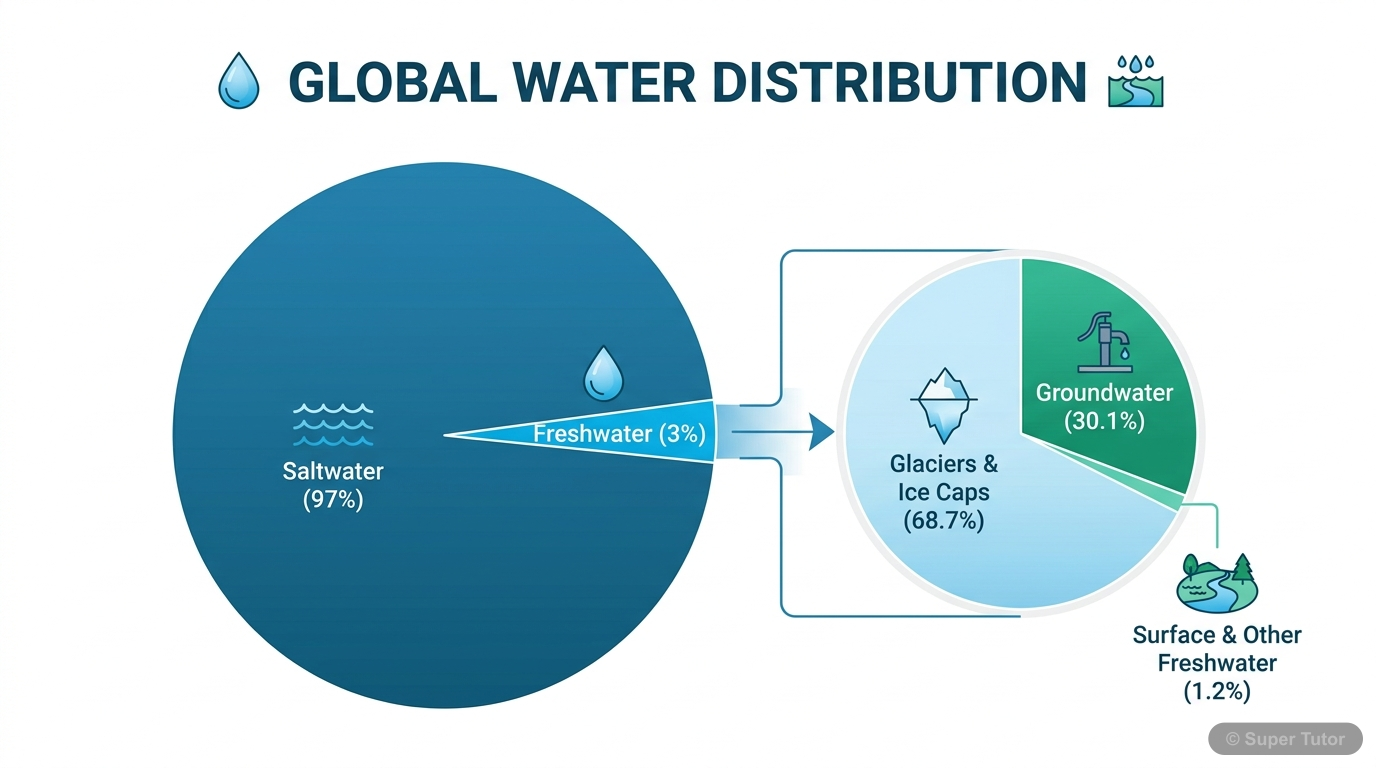
Super Tutor has 12+ illustrations like this for Water Resources alone — flashcards, concept maps, and step-by-step visuals.
See them allEXERCISES — Water Resources (Class 10 Geography)
1(i)Based on the information given below classify each of the situations as 'suffering from water scarcity' or 'not suffering from water scarcity'.
(a) Region with high annual rainfall.
(b) Region having high annual rainfall and large population.
(c) Region having high annual rainfall but water is highly polluted.
(d) Region having low rainfall and low population.Show solution
(a) Region with high annual rainfall:
➤ Not suffering from water scarcity.
High rainfall means abundant water availability and the population pressure is not mentioned, so water is sufficient.
(b) Region having high annual rainfall and large population:
➤ Suffering from water scarcity.
Even though rainfall is high, the very large population creates excessive demand, leading to over-exploitation and scarcity.
(c) Region having high annual rainfall but water is highly polluted:
➤ Suffering from water scarcity.
Polluted water is unfit for use. Despite high rainfall, the lack of clean/usable water means the region effectively suffers from water scarcity.
(d) Region having low rainfall and low population:
➤ Not suffering from water scarcity.
Although rainfall is low, the population is also low, so the demand is minimal and the available water is sufficient to meet needs.
1(ii)Which one of the following statements is not an argument in favour of multi-purpose river projects?
(a) Multi-purpose projects bring water to those areas which suffer from water scarcity.
(b) Multi-purpose projects by regulating water flow helps to control floods.
(c) Multi-purpose projects lead to large scale displacements and loss of livelihood.
(d) Multi-purpose projects generate electricity for our industries and our homes.Show solution
Justification: Options (a), (b), and (d) are all benefits/arguments *in favour* of multi-purpose river projects. Option (c) is actually a disadvantage (argument *against*) such projects — large-scale displacement of local communities and loss of their livelihoods is a major criticism, not a point in favour.
1(iii)Here are some false statements. Identify the mistakes and rewrite them correctly.
(a) Multiplying urban centres with large and dense populations and urban lifestyles have helped in proper utilisation of water resources.
(b) Regulating and damming of rivers does not affect the river's natural flow and its sediment flow.
(c) Today in Rajasthan, the practice of rooftop rainwater harvesting has gained popularity despite high water availability due to the Indira Gandhi Canal.Show solution
Corrected Statement: Multiplying urban centres with large and dense populations and urban lifestyles have led to over-exploitation and mismanagement of water resources, creating water scarcity in many regions.
---
(b) False Statement: Regulating and damming of rivers does not affect the river's natural flow and its sediment flow.
Corrected Statement: Regulating and damming of rivers does affect the river's natural flow and its sediment flow — it fragments rivers, reduces sediment transport downstream, and disrupts aquatic ecosystems.
---
(c) False Statement: Today in Rajasthan, the practice of rooftop rainwater harvesting has gained popularity despite high water availability due to the Indira Gandhi Canal.
Corrected Statement: Today in Rajasthan, the practice of rooftop rainwater harvesting has declined (lost popularity) because of the availability of water through the Indira Gandhi Canal, as people now depend on canal water instead of traditional harvesting methods.
2(i)Explain how water becomes a renewable resource.Show solution
Concept: The Water Cycle (Hydrological Cycle)
Answer:
Water is a renewable resource because of the continuous hydrological (water) cycle. Solar energy heats surface water in oceans, rivers, and lakes, causing evaporation. Water vapour rises, cools, and condenses to form clouds (condensation). This water returns to the Earth's surface as precipitation (rain, snow, etc.). It then flows into rivers, lakes, and groundwater reserves, replenishing them. This endless cycle of evaporation → condensation → precipitation continuously renews the Earth's water supply, making it a renewable resource.
2(ii)What is water scarcity and what are its main causes?Show solution
Water scarcity means the lack of sufficient available freshwater resources to meet the water demands of a region or population.
Main Causes of Water Scarcity:
1. Over-population: Large and growing populations increase demand for water beyond available supply.
2. Over-exploitation: Excessive use of water for agriculture (especially irrigation), industries, and domestic purposes depletes water sources.
3. Unequal distribution: Water may be abundant in one region but scarce in another due to uneven rainfall and poor management.
4. Pollution: Industrial effluents, agricultural chemicals, and untreated sewage pollute freshwater bodies, making water unfit for use.
5. Urbanisation: Rapid urban growth increases water demand and leads to mismanagement of water resources.
2(iii)Compare the advantages and disadvantages of multi-purpose river projects.Show solution
1. They provide irrigation to water-scarce areas, boosting agricultural production.
2. They generate hydroelectric power, meeting industrial and domestic energy needs.
3. They help in flood control by regulating river flow.
4. They facilitate inland navigation and water supply for drinking and domestic use.
5. They promote tourism and recreational activities.
Disadvantages of Multi-purpose River Projects:
1. They cause large-scale displacement of local communities, especially tribal and rural populations.
2. They disrupt the river's natural flow and sediment transport, affecting downstream ecosystems.
3. Submergence of forests and biodiversity leads to ecological damage.
4. They cause fragmentation of rivers, harming aquatic life and fish migration.
5. They lead to waterlogging and soil salinity in irrigated areas over time.
6. They create conflicts among states over sharing of river water.
3(i)Discuss how rainwater harvesting in semi-arid regions of Rajasthan is carried out.Show solution
Rajasthan is a semi-arid to arid state with low and erratic rainfall. Historically, people here developed ingenious traditional methods to harvest and store rainwater.
Traditional Methods of Rainwater Harvesting in Rajasthan:
1. Khadins and Johads:
- In the western arid districts of Rajasthan (like Jaisalmer), khadins (also called dhoras) are embankments built across hill slopes to collect rainwater runoff. The collected water is used for agriculture.
- Johads are small earthen check dams that collect and conserve rainwater, allowing it to percolate and recharge groundwater.
2. Kunds (or Kundis):
- These are covered underground tanks (cisterns) built in the courtyard of houses or near fields.
- Rainwater from rooftops or a specially prepared catchment area flows through a pipe into the kund.
- The water stored in kunds is used for drinking purposes throughout the dry season.
- Kunds are found widely in the Thar Desert region.
3. Tanka System:
- A tanka is a cylindrical underground tank traditionally built inside the main house or courtyard.
- Rooftop rainwater is channelled into the tanka through pipes.
- It can store enough water to last a family through the dry summer months.
- The first spell of rain is usually not collected (to wash the roof); subsequent rains fill the tanka.
Significance:
These methods ensured water security in a region with scarce rainfall. They represent the wisdom of local communities in adapting to their environment. However, with the arrival of the Indira Gandhi Canal, these practices have declined in some areas as people shifted to canal water.
3(ii)Describe how modern adaptations of traditional rainwater harvesting methods are being carried out to conserve and store water.Show solution
Traditional rainwater harvesting methods developed over centuries are now being revived and modernised across India to address growing water scarcity.
Modern Adaptations of Traditional Rainwater Harvesting:
1. Rooftop Rainwater Harvesting (Urban Areas):
- In cities like Chennai, rooftop rainwater harvesting has been made compulsory by law for all buildings.
- Rainwater collected from rooftops is channelled through pipes into underground storage tanks or used to recharge groundwater through bore wells.
- This has significantly raised the groundwater level in many urban areas.
2. Revival of Stepwells (Baoris/Baolis):
- Ancient stepwells are being restored and maintained to collect and store rainwater.
- In Rajasthan and Gujarat, NGOs and government agencies are reviving these structures.
3. Check Dams and Percolation Tanks:
- Modern check dams are built across streams and gullies to slow runoff and allow water to percolate into the ground, recharging aquifers — a modern adaptation of the traditional johad.
4. Bamboo Drip Irrigation (Meghalaya):
- In Meghalaya, the 200-year-old tradition of bamboo drip irrigation channels spring and rainwater through bamboo pipes to irrigate fields. This traditional system is now being studied and adapted for wider use.
5. Guls and Kuls (Himachal Pradesh):
- Traditional guls (diversion channels from glacial streams) are being modernised with better lining and management to supply water to fields.
Conclusion:
These modern adaptations combine traditional ecological knowledge with contemporary engineering to ensure sustainable water conservation, reduce dependence on large dams, and empower local communities to manage their own water resources.
Stuck on a step?
Ask Super Tutor AI to explain any solution on this page in a simpler way — free, 24x7.
Ask a Doubt FreeFrequently Asked Questions
What are the important topics in Water Resources for Rajasthan Board Class 10 Social Science?
How to score full marks in Water Resources — Rajasthan Board Class 10 Social Science?
Where can I get free NCERT Solutions for Water Resources Class 10 Social Science?
Sources & Official References
Content is aligned to the official syllabus. Refer to the board website for the latest curriculum.
More resources for Water Resources
Important Questions
Practice with board exam-style questions
Syllabus
What topics to cover
Revision Notes
Key points for last-minute revision
Study Plan
Step-by-step plan to ace this chapter
Flashcards
Quick-fire cards for active recall
Formula Sheet
All formulas in one place
Chapter Summary
Understand the chapter at a glance
Practice Quiz
Test yourself with a quick quiz
Concept Maps
See how topics connect visually
For serious students
Get the full Water Resources chapter — for free.
Quizzes, flashcards, AI doubt-solver and a step-by-step study plan for Rajasthan Board Class 10 Social Science.