A Question of Trust — NCERT Solutions
Tripura Board · Class 10 · English
NCERT Solutions for A Question of Trust, Tripura Board Class 10 English: 6 textbook questions solved step by step. Covers Think about it and Talk about it.
Interactive on Super Tutor
Studying A Question of Trust? Get the full interactive chapter.
Quizzes, flashcards, AI doubt-solver and a step-by-step study plan — built for NCERT solutions and more.
Free trial, no card needed.
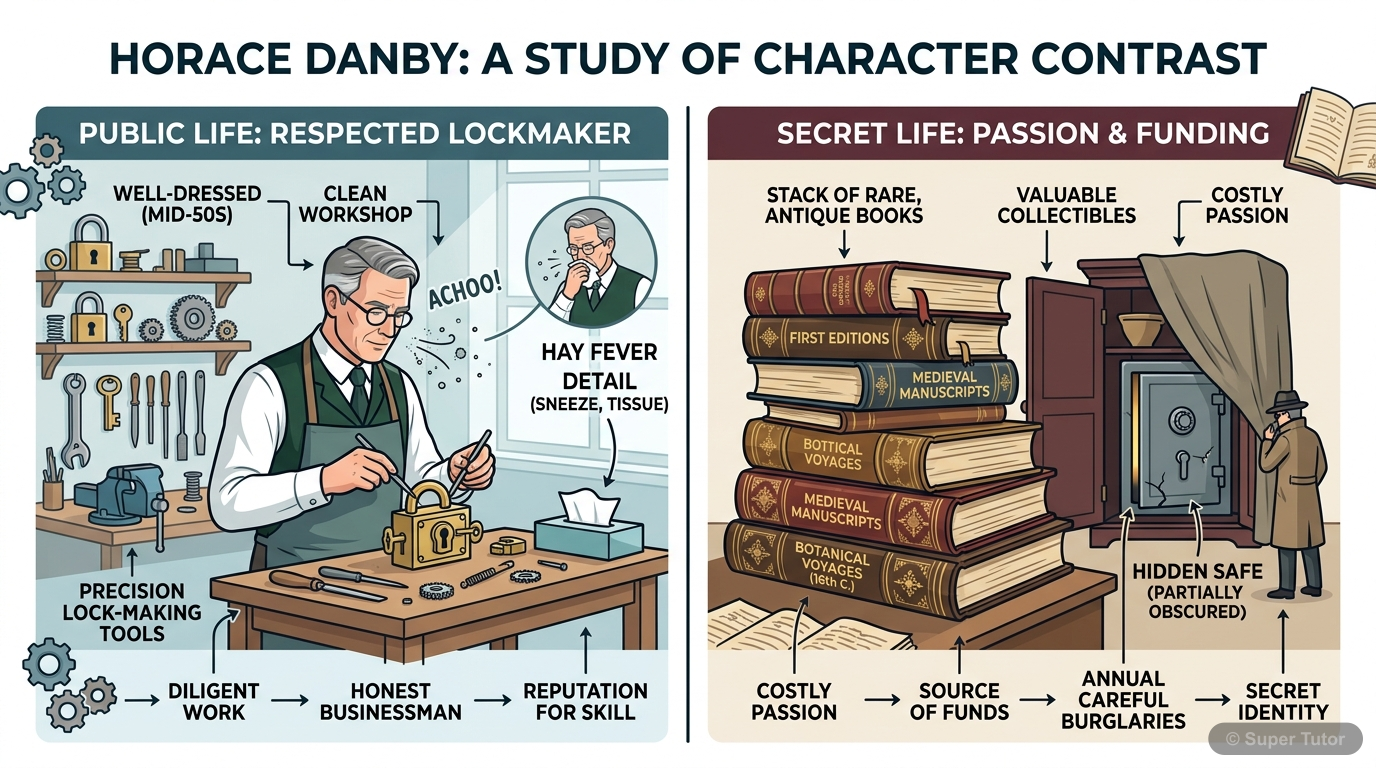
One of 7 illustrations for A Question of Trust in Super Tutor — alongside flashcards, concept maps and practice questions.
The first 3 solutions are open to read. The other 3 are free with a Super Tutor account.
Think about it
1Did you begin to suspect, before the end of the story, that the lady was not the person Horace Danby took her to be? If so, at what point did you realise this, and how?Show solution
Given/Context: The story involves Horace Danby, a careful thief, who is tricked by a young woman who pretends to be the mistress of Shotover Grange.
Answer:
Yes, a careful reader can begin to suspect that the lady is not who she claims to be at several points in the story.
Clues that raise suspicion:
- Her confident, commanding manner: A genuine mistress of the house who finds a burglar would normally be frightened or would call the police immediately. Instead, the lady remains completely calm and takes charge of the situation in a very bold and clever way — this is unusual behaviour for a homeowner.
- Her knowledge of Horace's background: She seems to know a great deal about Horace — his hay fever, his love of rare books — almost as if she had done her research beforehand, which is suspicious.
- She does not call the police: Instead of reporting him, she strikes a deal with him, which suggests she herself has something to hide or has an ulterior motive.
- She asks him to open the safe without gloves: A real lady of the house would want the thief caught, not helped. Her insistence that he open the safe without gloves (so his fingerprints would be left behind) is the strongest hint that she is setting him up.
- She claims to have forgotten the combination: This is a convenient excuse to make Horace do the actual breaking-in, which would implicate him fully.
Conclusion: The point at which suspicion becomes strongest is when she asks Horace to crack the safe and take the jewels for her, saying she has forgotten the combination. A real owner would know the combination or would have other means to access it. This strongly suggests she is not the lady of the house but rather another thief — which is confirmed at the end when Horace is arrested and the real owners return from London.
2What are the subtle ways in which the lady manages to deceive Horace Danby into thinking she is the lady of the house? Why doesn't Horace suspect that something is wrong?Show solution
Given/Context: A young, well-dressed woman encounters Horace Danby while he is about to rob Shotover Grange. She successfully convinces him she is the mistress of the house.
The subtle ways in which the lady deceives Horace:
- Her appearance and dress: She is young, pretty, and dressed in red, which gives her an air of authority and belonging. Her confident appearance makes Horace assume she is the lady of the house.
- Her calm and commanding tone: Instead of panicking, she speaks to Horace in a firm, authoritative manner — exactly as a homeowner would speak to an intruder. This confidence reinforces Horace's belief that she belongs there.
- She threatens to call the police: By threatening to report him, she puts Horace on the defensive. This is a classic move of someone who feels they have the right and authority to do so.
- She uses his personal information against him: She mentions his previous conviction and his love of rare books, making it seem as though she knows him well and has the upper hand. This makes Horace feel vulnerable and more willing to comply.
- She plays the role of a lenient, understanding mistress: She pretends to be sympathetic and offers him a way out — if he opens the safe for her, she will not report him. This generosity seems natural coming from the 'lady of the house.'
- She mentions the family and their habits: She speaks casually about the family being in London, which gives her story credibility.
Why Horace does not suspect anything:
- Horace is caught off guard and is in a panic. His hay fever had already made him careless.
- He is so relieved at not being handed over to the police that he does not think critically.
- He is blinded by her beauty and charm.
- He assumes that only the owner of a house would behave with such authority and confidence.
- His own guilt makes him submissive — he is in no position to question her.
Conclusion: The lady's psychological manipulation, confident demeanour, and use of Horace's personal weaknesses combine to create a completely convincing deception.
3"Horace Danby was good and respectable — but not completely honest". Why do you think this description is apt for Horace? Why can't he be categorised as a typical thief?Show solution
Given/Context: Horace Danby is a fifty-year-old man who makes locks and is considered a good, law-abiding citizen, yet he robs a house every year.
Why the description is apt for Horace:
The description is perfectly apt because Horace Danby leads a double life:
- Good and respectable side: He is a successful businessman who makes locks. He is well-regarded in society, pays his taxes, and lives a quiet, orderly life. He is kind to people and does not harm anyone physically. He has a genuine passion for rare and expensive books.
- Not completely honest side: Despite his respectable exterior, he robs one house every year — carefully and methodically — to fund his love of rare books. He is, therefore, a thief, which makes him less than completely honest.
The phrase captures the contradiction in his character: he is not evil or malicious, but he is not entirely virtuous either. He occupies a moral grey area.
Why he cannot be categorised as a typical thief:
- He does not steal for greed or personal luxury: He steals only to buy rare books, which is an intellectual and cultural pursuit, not a materialistic one.
- He steals only once a year: Unlike professional criminals who steal repeatedly and recklessly, Horace plans one careful robbery per year — just enough to satisfy his book-buying needs.
- He is meticulous and non-violent: He never harms anyone, never carries weapons, and plans his robberies with great care to avoid confrontation.
- He has a conscience: He is not proud of his thieving; it is a compulsion driven by his passion for books, not a chosen criminal lifestyle.
- He is otherwise law-abiding: In every other aspect of his life, he is honest and respectable.
Conclusion: Horace is a complex character — a fundamentally decent man with one significant moral flaw. He is more of a 'reluctant thief' than a typical criminal, which is why the description is both accurate and thought-provoking.
Free with a Super Tutor account
Talk about it
Free with a Super Tutor account
Free with a Super Tutor account
3 more solved questions in A Question of Trust
They are free with a Super Tutor account, along with practice quizzes and flashcards for this chapter. Free to start, no card needed.
Frequently Asked Questions
What are the important topics in A Question of Trust for Tripura Board Class 10 English?
Are these NCERT Solutions for A Question of Trust free?
How should I revise A Question of Trust for the Tripura Board Class 10 board exam?
Sources & Official References
Content is aligned to the official syllabus. Refer to the board website for the latest curriculum.
More resources for A Question of Trust
Practice Quiz
Test yourself with a quick quiz
Important Questions
Exam-style questions with answers
Revision Notes
Key points for last-minute revision
Chapter Summary
Understand the chapter at a glance
Concept Maps
See how topics connect
Study Plan
Step-by-step plan for this chapter
Flashcards
Quick-fire cards for active recall
Syllabus
What topics to cover
For serious students
Get the full A Question of Trust chapter — start free.
Quizzes, flashcards, an AI doubt solver and a study plan for Tripura Board Class 10 English. Free to start, no card needed.