Nelson Mandela : Long Walk to Freedom — NCERT Solutions
Tripura Board · Class 10 · English
NCERT Solutions for Nelson Mandela : Long Walk to Freedom, Tripura Board Class 10 English: 40 textbook questions solved step by step.
Interactive on Super Tutor
Studying Nelson Mandela : Long Walk to Freedom? Get the full interactive chapter.
Quizzes, flashcards, AI doubt-solver and a step-by-step study plan — built for NCERT solutions and more.
Free trial, no card needed.
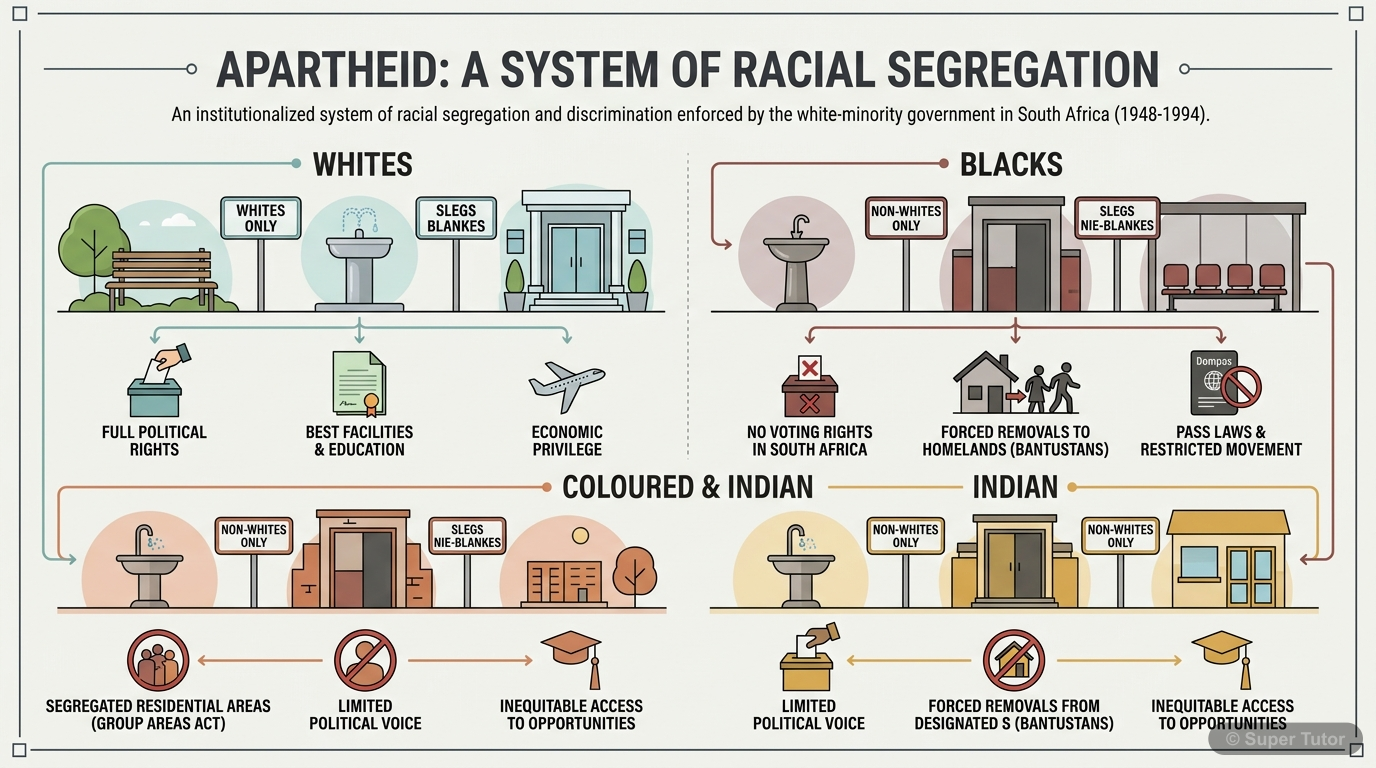
One of 11 illustrations for Nelson Mandela : Long Walk to Freedom in Super Tutor — alongside flashcards, concept maps and practice questions.
The first 20 solutions are open to read. The other 20 are free with a Super Tutor account.
Before You Read
1'Apartheid' is a political system that separates people according to their race. Can you say which of the three countries named below had such a political system until very recently?Show solution
South Africa had the apartheid system until very recently, as stated in the chapter.
2In this extract from his autobiography, Long Walk to Freedom, Mandela speaks about a historic occasion, 'the inauguration'. Can you guess what the occasion might be? Check your guess with this news item (from the BBC) of 10 May 1994.Show solution
The inauguration refers to the historic ceremony when Nelson Mandela took oath as South Africa’s first Black President after the country’s first democratic elections in 1994.
Activity
1In Column A are some expressions you will find in the text. Make a guess and match each expression with an appropriate meaning from Column B.Show solution
The correct matches are:
- (i) A rainbow gathering of different colours and nations → A beautiful coming together of various peoples, like the colours in a rainbow
- (ii) The seat of white supremacy → The centre of racial superiority
- (iii) Be overwhelmed with a sense of history → Feel deeply emotional, remembering and understanding all the past events that have led up to the moment
- (iv) Resilience that defies the imagination → A great ability (almost unimaginable) to remain unchanged by suffering
- (v) A glimmer of humanity → A sign of human feeling
- (vi) A twilight existence → A half-secret life, like a life lived in the fading light between sunset and darkness
Oral Comprehension Check
1Where did the ceremonies take place? Can you name any public buildings in India that are made of sandstone?Show solution
The ceremonies took place in the Union Buildings amphitheatre in Pretoria. In India, some public buildings made of sandstone are the Red Fort and the Parliament House.
2Can you say how 10 May is an 'autumn day' in South Africa?Show solution
South Africa is in the southern hemisphere, so the seasons are opposite to those in India. Therefore, 10 May falls in autumn there.
3At the beginning of his speech, Mandela mentions “an extraordinary human disaster”. What does he mean by this? What is the “glorious ... human achievement” he speaks of at the end?Show solution
By “an extraordinary human disaster”, Mandela means the long years of apartheid, racial oppression, and suffering in South Africa. The “glorious human achievement” is the end of apartheid and the establishment of a free, democratic, non-racial South Africa.
4What does Mandela thank the international leaders for?Show solution
Mandela thanks the international leaders for coming to South Africa and sharing in what he calls a common victory for justice, peace and human dignity.
5What ideals does he set out for the future of South Africa?Show solution
Mandela sets out these ideals for South Africa’s future: liberty, justice, peace, human dignity, and freedom from poverty, deprivation, suffering, gender discrimination and other discrimination. He also says that never again should one person oppress another.
Oral Comprehension Check
1What do the military generals do? How has their attitude changed, and why?Show solution
The military generals salute Mandela and pledge their loyalty to the new democratic government. Their attitude has changed from one of supporting apartheid rule to one of respecting democracy, because the country now has a freely and fairly elected government.
2Why were two national anthems sung?Show solution
Two national anthems were sung because the ceremony symbolised a new democratic South Africa in which whites and blacks were now part of one nation. The singing of both anthems showed unity and reconciliation.
3How does Mandela describe the systems of government in his country (i) in the first decade, and (ii) in the final decade, of the twentieth century?Show solution
Mandela says that in the first decade of the twentieth century, the white-skinned people of South Africa patched up their differences and created a system of racial domination against the dark-skinned people. In the final decade of the twentieth century, that system was overturned forever and replaced by one that recognised the rights and freedoms of all people regardless of skin colour.
5Which does he think is natural, to love or to hate?Show solution
Mandela says love comes more naturally to the human heart than hatred. So, according to him, it is more natural to love than to hate.
Oral Comprehension Check
1What "twin obligations" does Mandela mention?Show solution
Given: Mandela reflects on the duties every man has in life.
Answer: Mandela mentions that every man has twin obligations — the first is to his family, his parents, his wife, and his children; and the second is to his people, his community, and his country. He says that in a civil and humane society, each person is able to fulfil both obligations freely. However, in South Africa under apartheid, a Black man could not fulfil even his most basic obligations without coming into conflict with the law. This made it impossible for Black men to lead normal family lives while also serving their community.
2What did being free mean to Mandela as a boy, and as a student? How does he contrast these "transitory freedoms" with "the basic and honourable freedoms"?Show solution
Given: Mandela describes how his understanding of freedom evolved over time.
As a boy: Freedom meant being able to run in the fields near his mother's hut, to swim in the clear stream that ran through his village, to roast mealies under the stars, and to ride the broad backs of slow-moving bulls. These were simple, physical, sensory freedoms.
As a student: Freedom meant the right to stay out at night, to read what he pleased, and to go where he chose. These were personal freedoms of choice and movement.
Contrast with basic and honourable freedoms: Mandela calls the above "transitory freedoms" — temporary and limited. He contrasts them with the "basic and honourable freedoms" such as achieving his potential, earning his keep, marrying and having a family, and the freedom not to be obstructed in a lawful life. These are fundamental human rights that were denied to Black South Africans under apartheid.
3Does Mandela think the oppressor is free? Why/Why not?Show solution
Given: Mandela reflects on the nature of freedom for both the oppressed and the oppressor.
Answer: No, Mandela does not think the oppressor is free. He argues that the oppressor is a prisoner of hatred, just as the oppressed is a prisoner of apartheid. The oppressor is robbed of his humanity when he dehumanises others. Mandela says that a man who takes away another man's freedom is a prisoner of hatred; he is locked behind the bars of prejudice and narrow-mindedness. Therefore, both the oppressed and the oppressor are not truly free. True freedom, according to Mandela, is indivisible — it cannot exist for one group while being denied to another.
Thinking about the Text
1Why did such a large number of international leaders attend the inauguration? What did it signify the triumph of?Show solution
Given: The inauguration of Nelson Mandela as South Africa's first Black President was attended by dignitaries from around the world.
Reason for large attendance: The inauguration was a historic event — it marked the end of apartheid, one of the most oppressive and unjust systems of racial discrimination in modern history. Leaders from all over the world came to pay their respects and to celebrate this momentous occasion.
What it signified: It signified the triumph of justice, of the human spirit, and of the long struggle against racial oppression. It was a victory not just for South Africa but for all of humanity — a demonstration that the forces of good could overcome the forces of evil, that oppression could be defeated, and that democracy and equality could prevail.
2What does Mandela mean when he says he is "simply the sum of all those African patriots" who had gone before him?Show solution
Given: Mandela makes this statement during his inauguration speech.
Meaning: By saying he is "simply the sum of all those African patriots," Mandela means that he does not see himself as a lone hero or a self-made man. He acknowledges that his strength, courage, and vision were shaped and inspired by the countless freedom fighters who came before him — men like Oliver Tambo, Walter Sisulu, Chief Luthuli, Yusuf Dadoo, Bram Fischer, and many others who sacrificed their lives for the freedom of their people.
In other words, Mandela is saying that he is the product of all those who struggled before him. Their sacrifices, their courage, and their ideals live on in him. He is their collective legacy, and the honour of becoming President belongs to all of them, not to him alone.
3Would you agree that the "depths of oppression" create "heights of character"? How does Mandela illustrate this? Can you add your own examples to this argument?Show solution
Given: Mandela makes this observation about the effect of oppression on human character.
Agreement and Illustration by Mandela: Yes, this is a profound truth that Mandela illustrates through the lives of great South African freedom fighters. He says that the decades of oppression and brutality produced men of extraordinary moral courage — the Oliver Tambos, the Walter Sisulus, the Chief Luthulis, and the Yusuf Dadoos. These men, forged in the furnace of oppression, developed extraordinary courage, wisdom, and generosity of spirit. Mandela himself is the greatest example — 27 years in prison only deepened his resolve and broadened his vision.
Own Examples:
- Mahatma Gandhi: The racial discrimination he faced in South Africa transformed a shy lawyer into the Father of the Nation who led India's freedom struggle through non-violence.
- Anne Frank: Living in hiding under Nazi oppression, she wrote a diary that became one of the most powerful testimonies of the human spirit.
- Harriet Tubman: Born into slavery in America, she escaped and then risked her life repeatedly to free hundreds of other enslaved people through the Underground Railroad.
Thus, adversity and oppression, while deeply unjust, can forge extraordinary human character.
4How did Mandela's understanding of freedom change with age and experience?Show solution
Given: Mandela traces the evolution of his concept of freedom throughout his life.
As a boy: Freedom was simple and personal — the freedom to run in the fields, swim in streams, and enjoy the pleasures of rural life. He was not yet aware of the curtailment of his freedom.
As a young man/student: Freedom meant personal rights — the right to stay out at night, read what he pleased, and go where he chose. He slowly became aware that he was not free.
As a young adult: He began to hunger for the basic and honourable freedoms — the right to earn a living, to marry, to have a family, and to live a lawful life without obstruction.
As a mature man and freedom fighter: His understanding of freedom expanded beyond himself. He realised that his personal freedom was inseparably bound to the freedom of his people. He could not be truly free while his people were oppressed. This led him to join the African National Congress and dedicate his life to the freedom of all South Africans.
Conclusion: Mandela's understanding of freedom grew from a narrow, personal concept to a broad, universal one — freedom not just for himself, but for every person, regardless of race or colour.
5How did Mandela's 'hunger for freedom' change his life?Show solution
Given: Mandela describes how his desire for freedom transformed him completely.
Answer: Mandela's hunger for freedom brought about a complete transformation in his life:
- From a frightened young man to a bold one: His desire for freedom gave him courage he did not know he possessed.
- From a law-abiding citizen to a 'criminal': The apartheid government declared his freedom activities illegal, making him a criminal in the eyes of the law. He was arrested, tried, and imprisoned for 27 years.
- From a family man to a man without a home: His commitment to the freedom struggle meant he could not be a normal husband and father. He was forced to leave his family and live the life of an outlaw.
- From personal to collective freedom: His hunger for his own freedom became inseparably linked to the freedom of his people. He could not rest until all South Africans — Black and white — were free.
In short, the hunger for freedom cost Mandela his comfort, his family life, his freedom, and nearly his life — but it also made him one of the greatest leaders in human history.
Thinking about Language — I (Noun-Verb Pairs)
Free with a Super Tutor account
Martin Luther King's __________ (contribute) to our history as an outstanding leader began when he came to the __________ (assist) of Rosa Parks, a seamstress who refused to give up her seat on a bus to a white passenger. In those days American Blacks were confined to positions of second class citizenship by restrictive laws and customs. To break these laws would mean __________ (subjugate) and __________ (humiliate) by the police and the legal system. Beatings, __________ (imprison) and sometimes death awaited those who defied the System. Martin Luther King's tactics of protest involved non-violent __________ (resist) to racial injustice.
Free with a Super Tutor account
Thinking about Language
Free with a Super Tutor account
Free with a Super Tutor account
Free with a Super Tutor account
Writing
Free with a Super Tutor account
Homophones
Free with a Super Tutor account
Thinking about the Poem
Free with a Super Tutor account
(i) On pads of velvet quiet,
In his quiet rage.
(ii) And stares with his brilliant eyes
At the brilliant stars.
What do you think is the effect of this repetition?
Free with a Super Tutor account
Are zoos necessary for the protection or conservation of some species of animals? Are they useful for educating the public? Are there alternatives to zoos?
Free with a Super Tutor account
Thinking about Language — II (Using the Definite Article with Names)
Free with a Super Tutor account
Free with a Super Tutor account
Free with a Super Tutor account
Thinking about Language — III (Idiomatic Expressions)
Free with a Super Tutor account
Free with a Super Tutor account
Free with a Super Tutor account
Free with a Super Tutor account
Writing — I (Looking at Contrasts)
1. It requires such depths of oppression _________________
2. Courage was not the absence of fear _________________
3. The brave man is not he who does not feel afraid _________________
4. If people can learn to hate _________________
5. I was not born with a hunger to be free. _________________
Free with a Super Tutor account
Writing — II (Contrasting Past with Present/Future)
1. For decades the Union Buildings had been the seat of white supremacy, and now ...
2. Only moments before, the highest generals ... saluted me and pledged their loyalty. ... not so many years before they would not have saluted _________________
3. Although that day neither group knew the lyrics of the anthem ..., they would soon _________________
4. My country is rich in the minerals and gems that lie beneath its soil, _________________
5. The Air Show was not only a display of pinpoint precision and military force, but _________________
6. It was this desire for the freedom of my people ... that transformed _________________ into a bold one, that drove _________________ to become a criminal, that turned _________________ into a man without a home.
Free with a Super Tutor account
Writing — III (Expressing Your Opinion)
Free with a Super Tutor account
20 more solved questions in Nelson Mandela : Long Walk to Freedom
They are free with a Super Tutor account, along with practice quizzes and flashcards for this chapter. Free to start, no card needed.
Frequently Asked Questions
What are the important topics in Nelson Mandela : Long Walk to Freedom for Tripura Board Class 10 English?
Are these NCERT Solutions for Nelson Mandela : Long Walk to Freedom free?
How should I revise Nelson Mandela : Long Walk to Freedom for the Tripura Board Class 10 board exam?
Sources & Official References
Content is aligned to the official syllabus. Refer to the board website for the latest curriculum.
More resources for Nelson Mandela : Long Walk to Freedom
Practice Quiz
Test yourself with a quick quiz
Important Questions
Exam-style questions with answers
Revision Notes
Key points for last-minute revision
Chapter Summary
Understand the chapter at a glance
Concept Maps
See how topics connect
Study Plan
Step-by-step plan for this chapter
Flashcards
Quick-fire cards for active recall
Syllabus
What topics to cover
For serious students
Get the full Nelson Mandela : Long Walk to Freedom chapter — start free.
Quizzes, flashcards, an AI doubt solver and a study plan for Tripura Board Class 10 English. Free to start, no card needed.