Chapter 4 of 22
NCERT Solutions

Forest and Wildlife Resources

Uttarakhand Board · Class 10 · Social Science

NCERT Solutions for Forest and Wildlife Resources — Uttarakhand Board Class 10 Social Science.

51 questions20 flashcards5 concepts

Interactive on Super Tutor

Studying Forest and Wildlife Resources? Get the full interactive chapter.

Quizzes, flashcards, AI doubt-solver and a step-by-step study plan — built for ncert solutions and more.

1,000+ Class 10 students started this chapter today

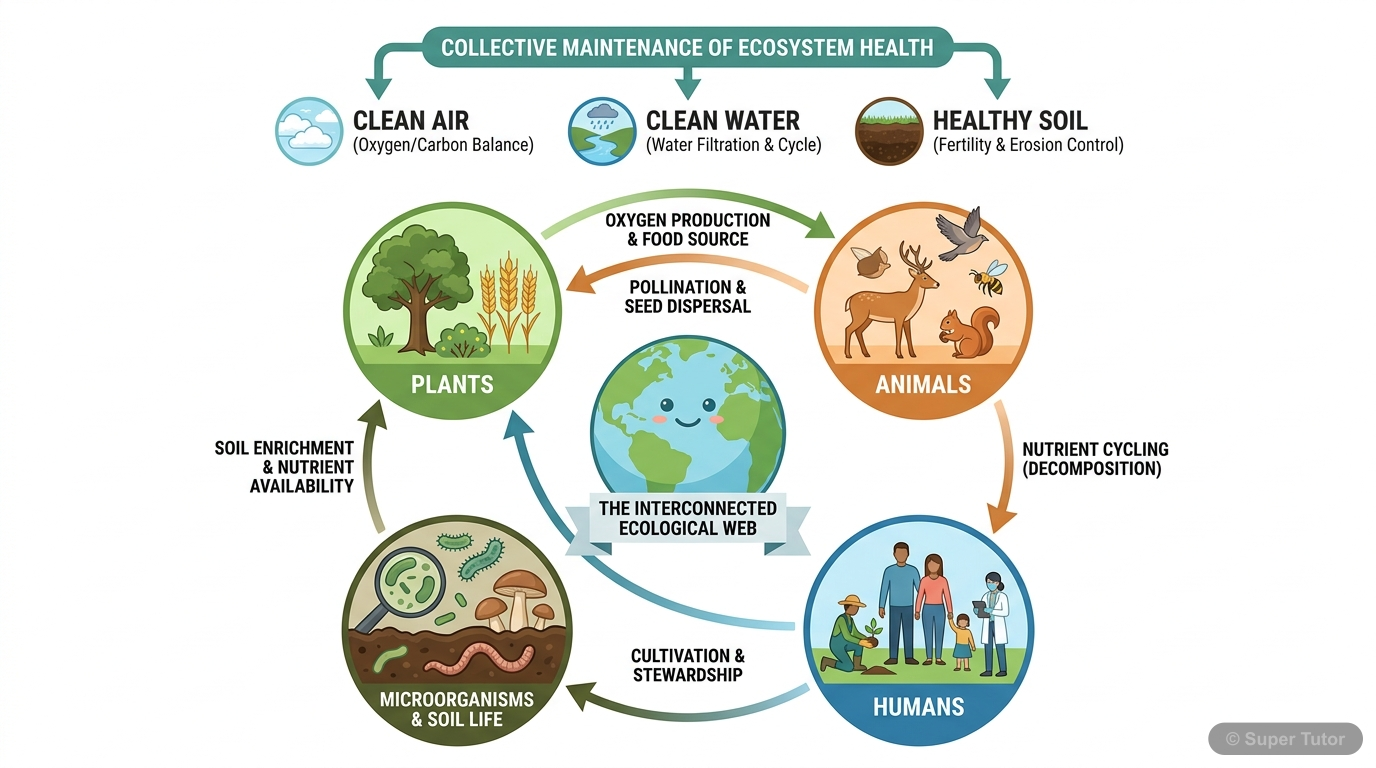
A diagram illustrating the concept of biodiversity and how humans and other living organisms form a complex, interdependent ecological web, highlighting the role of plants, animals, and microorganisms
Super Tutor

Learn better with visuals Super Tutor has hundreds of illustrations like this across every chapter — all free to try.

Get started
6 Questions Solved · 1 Section

EXERCISES

1(i)Which of the following conservation strategies do not directly involve community participation?
(a) Joint forest management
(b) Beej Bachao Andolan
(c) Chipko Movement
(d) Demarcation of Wildlife sanctuaries
Show solution
Correct Answer: (d) Demarcation of Wildlife sanctuaries

Justification: Demarcation (marking boundaries) of Wildlife Sanctuaries is carried out by the government/state authorities as an administrative and legal process. It does not directly involve local communities in decision-making or participation. In contrast, Joint Forest Management, Beej Bachao Andolan, and the Chipko Movement are all community-driven or community-participatory conservation initiatives.
2Match the following:
- Reserved forests
- Protected forests
- Unclassed forests
Show solution
Correct Matching:

| Term | Description |
|---|---|
| Reserved forests | Forests are regarded as most valuable as far as the conservation of forest and wildlife resources. |
| Protected forests | Forest lands are protected from any further depletion. |
| Unclassed forests | Other forests and wastelands belonging to both government and private individuals and communities. |

Explanation:
- Reserved Forests are the most protected category under the Indian Forest Act; no rights are allowed to local people and they are considered most valuable for conservation.
- Protected Forests are those where the government has declared that no further depletion will be allowed; some rights of local people may be permitted.
- Unclassed Forests include all other forest and wasteland areas owned by the government, private individuals, or communities and are the least regulated category.
3(i)What is biodiversity? Why is biodiversity important for human lives?Show solution
Given/Concept: Biodiversity refers to the variety of life on Earth.

Definition: Biodiversity (or biological diversity) is the variety of all living organisms — plants, animals, micro-organisms — found in a particular habitat or on Earth as a whole, including the diversity within species, between species, and of ecosystems.

Importance for Human Lives:
1. Food and nutrition: A large variety of crops, fruits, and animals provide food to humans.
2. Medicine: Many life-saving medicines are derived from plants and animals (e.g., quinine from cinchona bark).
3. Ecological balance: Biodiversity maintains the food chain, nutrient cycling, and climate regulation, all of which support human survival.
4. Economic value: Forests and diverse species support livelihoods through timber, tourism, and agriculture.
5. Cultural and aesthetic value: Biodiversity enriches human culture, recreation, and spiritual well-being.

Conclusion: Loss of biodiversity threatens the very foundation of human existence, making its conservation essential.
3(ii)How have human activities affected the depletion of flora and fauna? Explain.Show solution
Given: Human activities have caused large-scale destruction of natural flora and fauna.

Key Human Activities Responsible for Depletion:

1. Agricultural expansion: Large tracts of forests have been cleared to bring land under cultivation, destroying natural habitats.
2. Large-scale development projects: Construction of dams, roads, and industries has led to massive deforestation (e.g., Narmada Dam project displaced forests and wildlife).
3. Mining operations: Mining in forest areas destroys vegetation and disturbs wildlife habitats (e.g., Buxa Tiger Reserve in West Bengal is threatened by dolomite mining).
4. Overgrazing: Excessive grazing by livestock degrades forest land and reduces plant diversity.
5. Hunting and poaching: Illegal hunting for ivory, skin, and bones has pushed many species to the brink of extinction.
6. Firewood and timber collection: Over-exploitation of forests for fuel and commercial timber has reduced forest cover.
7. Pollution and urbanisation: Industrial effluents, pesticides, and urban sprawl have degraded natural ecosystems.

Conclusion: These activities have led to habitat loss, species extinction, and a drastic reduction in India's rich biodiversity.
4(i)Describe how communities have conserved and protected forests and wildlife in India?Show solution
Introduction: Across India, local communities have played a vital role in conserving forests and wildlife, often more effectively than government agencies.

Examples of Community Conservation:

1. Chipko Movement (Himalayas): In the 1970s, villagers — especially women — in the Garhwal Himalayas hugged trees to prevent contractors from felling them. This grassroots movement successfully halted deforestation in several areas.

2. Beej Bachao Andolan (Tehri, Uttarakhand): Farmers and activists worked to save traditional crop varieties (seeds) without the use of chemical fertilisers, preserving agricultural biodiversity.

3. Joint Forest Management (JFM): Introduced formally in 1988, JFM involves local village communities working together with the Forest Department to protect and manage degraded forests. In return, communities receive a share of forest produce. Odisha was the first state to introduce JFM in 1988.

4. Sacred Groves (Dev Vans): Many communities across India — in Rajasthan, Meghalaya, Karnataka, Maharashtra — have traditionally protected patches of forest as sacred. These 'sacred groves' are left untouched and serve as biodiversity refuges. The Mundas and Santals of Jharkhand worship mahua and kadamba trees.

5. Bishnoi Community (Rajasthan): The Bishnoi community has long protected blackbucks, peacocks, and trees around their villages. The famous Amrita Devi Bishnoi sacrificed her life in 1731 to protect khejri trees.

6. Sariska Tiger Reserve (Rajasthan): Villagers of Bhairodev Dakav 'Sonchuri' in Alwar district have declared 1,200 hectares of forest as a wildlife reserve, following traditional rules that ban hunting and outside interference.

Conclusion: These community-led efforts demonstrate that local people, when empowered, are the most effective guardians of biodiversity.
4(ii)Write a note on good practices towards conserving forest and wildlife.Show solution
Introduction: Conserving forests and wildlife requires a combination of government policies, community action, and individual responsibility.

Good Practices for Conservation:

1. Establishment of Protected Areas: The government has set up National Parks, Wildlife Sanctuaries, and Biosphere Reserves to provide safe habitats for flora and fauna. India has 14 Biosphere Reserves, 90 National Parks, and 448 Wildlife Sanctuaries.

2. Project Tiger and Project Elephant: Launched in 1973, Project Tiger aims to protect tigers from extinction by creating tiger reserves across India. Similar projects exist for elephants, rhinos, and other endangered species.

3. Legal Protection: The Wildlife Protection Act (1972) and the Forest Conservation Act (1980) provide a legal framework to prevent poaching, illegal trade, and deforestation.

4. Community Participation through JFM: Involving local communities in forest management ensures sustainable use of resources and reduces pressure on forests.

5. Sacred Groves: Respecting and reviving the tradition of sacred groves helps protect biodiversity at the local level.

6. Afforestation and Social Forestry: Planting trees on degraded lands and involving people in growing trees on community and private lands helps restore forest cover.

7. Reducing Consumption and Pollution: Individuals can contribute by reducing the use of forest products, avoiding single-use plastics, and minimising pollution that harms ecosystems.

8. Awareness and Education: Spreading awareness about the importance of biodiversity among citizens, especially youth, encourages responsible behaviour towards nature.

Conclusion: A combination of strict laws, community involvement, traditional knowledge, and individual responsibility forms the foundation of effective forest and wildlife conservation in India.

Stuck on a step?

Ask Super Tutor AI to explain any solution on this page in a simpler way — free, 24x7.

Ask a Doubt Free

Frequently Asked Questions

What are the important topics in Forest and Wildlife Resources for Uttarakhand Board Class 10 Social Science?
Key topics in Forest and Wildlife Resources include Forest and Wildlife Resources — Complete Concept Map, Forest and Wildlife Resources - Chapter Overview, Forest and Wildlife Resources - Full Chapter Concept Map. These are the concepts Uttarakhand Board Class 10 examiners draw on most — study them first, then practise related questions.
How to score full marks in Forest and Wildlife Resources — Uttarakhand Board Class 10 Social Science?
Understand the core concepts first, then work through the 51 practice questions available for this chapter. Revise formulas and definitions regularly, and use flashcards for quick recall before the exam.
Where can I get free NCERT Solutions for Forest and Wildlife Resources Class 10 Social Science?
This page has free step-by-step NCERT Solutions for every exercise question in Forest and Wildlife Resources (Uttarakhand Board Class 10 Social Science) — written the way examiners award marks: given, formula, working, answer.

Sources & Official References

Content is aligned to the official syllabus. Refer to the board website for the latest curriculum.

For serious students

Get the full Forest and Wildlife Resources chapter — for free.

Quizzes, flashcards, AI doubt-solver and a step-by-step study plan for Uttarakhand Board Class 10 Social Science.