Resources and Development
Uttarakhand Board · Class 10 · Social Science
NCERT Solutions for Resources and Development — Uttarakhand Board Class 10 Social Science.
Interactive on Super Tutor
Studying Resources and Development? Get the full interactive chapter.
Quizzes, flashcards, AI doubt-solver and a step-by-step study plan — built for ncert solutions and more.
1,000+ Class 10 students started this chapter today

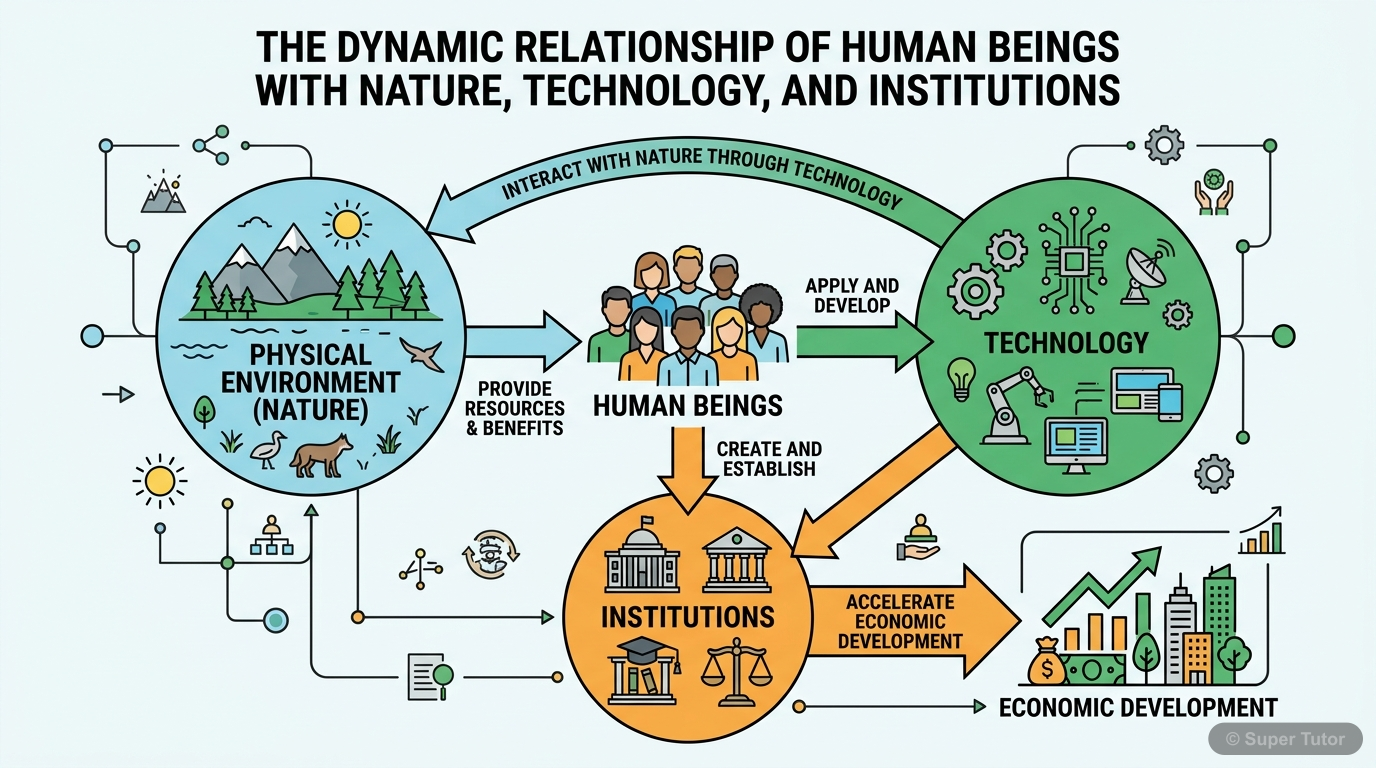
Super Tutor has 23+ illustrations like this for Resources and Development alone — flashcards, concept maps, and step-by-step visuals.
See them allEXERCISES
1(i)Which one of the following is the main cause of land degradation in Punjab?
(a) Intensive cultivation
(b) Deforestation
(c) Over irrigation
(d) OvergrazingShow solution
Justification: In Punjab, the excessive use of irrigation water has led to waterlogging and salinisation of the soil. The accumulation of salts on the surface makes the land unfit for cultivation, making over irrigation the main cause of land degradation in Punjab.
1(ii)In which one of the following states is terrace cultivation practised?
(a) Punjab
(b) Plains of Uttar Pradesh
(c) Haryana
(d) UttarakhandShow solution
Justification: Terrace cultivation is practised in hilly and mountainous regions where slopes are cut into step-like terraces to create flat land for farming and to reduce surface run-off and soil erosion. Uttarakhand, being a hilly state in the Himalayas, is well known for this practice.
1(iii)In which of the following states black soil is predominantly found?
(a) Uttar Pradesh
(b) Maharashtra
(c) Rajasthan
(d) JharkhandShow solution
Justification: Black soil (also called Regur soil) is predominantly found in the Deccan Plateau region, which includes Maharashtra, Madhya Pradesh, and parts of Gujarat. Maharashtra has the largest coverage of black soil, which is ideal for cotton cultivation.
EXERCISES — Short Answer Questions (About 30 words)
2(i)Name three states having black soil and the crop which is mainly grown in it.Show solution
Answer:
Three states having black soil are:
1. Maharashtra
2. Madhya Pradesh
3. Gujarat
Black soil has high moisture-retaining capacity and is rich in calcium carbonate, magnesium, potash, and lime. The crop mainly grown in black soil is cotton. It is therefore also called 'Black Cotton Soil' or Regur soil.
2(ii)What type of soil is found in the river deltas of the eastern coast? Give three main features of this type of soil.Show solution
Answer:
Alluvial soil is found in the river deltas of the eastern coast (e.g., deltas of Mahanadi, Godavari, Krishna, and Cauvery rivers).
Three main features of alluvial soil:
1. It is very fertile and rich in potash, phosphoric acid, and lime, making it ideal for the growth of sugarcane, paddy, wheat, and other crops.
2. It has a high water-retaining capacity and is found in different textures — sandy loam to clay.
3. It is the most widely spread soil in India, covering the entire Indo-Gangetic Plain and coastal deltas, and is constantly renewed by river deposits (newer alluvium is called Khadar and older alluvium is called Bhangar).
2(iii)What steps can be taken to control soil erosion in the hilly areas?Show solution
Answer:
The following steps can be taken to control soil erosion in hilly areas:
1. Terrace farming / Contour ploughing: Ploughing along the contour lines reduces the speed of water flow down the slopes, thereby checking soil erosion.
2. Planting trees / Afforestation: Roots of trees bind the soil and reduce the impact of rain and wind on the soil surface.
3. Construction of stone walls / Check dams: These slow down the flow of water and prevent gully erosion on steep slopes.
4. Strip cropping: Strips of grass are left to grow between the crops to break the force of wind and water.
EXERCISES — Long Answer Questions (About 120 words)
3(i)Explain land use pattern in India and why has the land under forest not increased much since 1960-61?Show solution
Land Use Pattern in India:
Land in India is used for various purposes. The total geographical area of India is 3.28 million sq. km, but land use data is available for only about 93% of it. The major categories of land use are:
| Category | Description |
|---|---|
| Forests | Land under forest cover |
| Land not available for cultivation | Barren, rocky, desert land and land used for buildings, roads, etc. |
| Fallow lands | Land left uncultivated temporarily |
| Net sown area | Land actually under cultivation |
| Permanent pastures and grazing land | Land used for grazing |
| Land under miscellaneous tree crops | Orchards, groves, etc. |
- The net sown area is about 54% of the total reporting area.
- Forests cover about 23% of the total area, which is less than the desired 33% recommended for maintaining ecological balance.
- Fallow lands and culturable waste lands indicate the potential for future agricultural expansion.
Why has forest area not increased much since 1960–61?
The land under forest has not increased significantly since 1960–61 due to the following reasons:
1. Increasing population pressure has led to the conversion of forest land into agricultural land to meet the growing demand for food.
2. Developmental activities such as construction of dams, roads, industries, and urban expansion have encroached upon forest land.
3. Overgrazing and illegal felling of trees have degraded existing forests.
4. Demand for firewood and timber by local communities has led to deforestation.
5. Government policies have not been effectively implemented to protect and expand forest cover.
Thus, despite the constitutional directive to maintain 33% of land under forests, the actual forest cover remains far below this target.
3(ii)How have technical and economic development led to more consumption of resources?Show solution
Answer:
Technical and economic development have led to a massive increase in the consumption of resources in the following ways:
1. Industrialisation: With the growth of industries, the demand for raw materials such as minerals, coal, petroleum, and water has increased enormously. Machines and factories consume large quantities of energy and natural resources.
2. Modernisation of Agriculture: The use of chemical fertilisers, pesticides, modern machinery (tractors, harvesters), and irrigation systems has increased the consumption of land, water, and energy resources.
3. Urbanisation: Economic development has led to rapid urbanisation. Cities require large amounts of land, water, energy, and building materials, putting pressure on natural resources.
4. Improved Standard of Living: As incomes rise due to economic development, people consume more goods — automobiles, electronic appliances, packaged food — all of which require more resources to produce.
5. Transportation and Communication: Development of road, rail, air, and sea networks requires steel, petroleum, and other materials in large quantities.
6. Technological Advancements: New technologies have made it possible to exploit resources that were previously inaccessible (e.g., deep-sea mining, shale gas extraction), leading to greater extraction and consumption.
Conclusion: While technical and economic development has improved human welfare, it has also led to the over-exploitation of resources. This makes it essential to adopt sustainable development practices so that resources are available for future generations as well.
PROJECT/ACTIVITY — Puzzle Solutions
PuzzleSolve the puzzle by finding the hidden answers horizontally and vertically:
(i) Natural endowments in the form of land, water, vegetation and minerals.
(ii) A type of non-renewable resource.
(iii) Soil with high water retaining capacity.
(iv) Intensively leached soils of the monsoon climate.
(v) Plantation of trees on a large scale to check soil erosion.
(vi) The Great Plains of India are made up of these soils.Show solution
(i) Natural endowments in the form of land, water, vegetation and minerals.
→ RESOURCES (found horizontally/vertically in the grid)
(ii) A type of non-renewable resource.
→ MINERALS (found horizontally in Row 6: M-I-N-E-R-A-L-S)
(iii) Soil with high water retaining capacity.
→ BLACK (Black soil has the highest water-retaining capacity; found vertically in the grid)
(iv) Intensively leached soils of the monsoon climate.
→ LATERITE (found horizontally in Row 8: L-A-T-E-R-I-T-E)
(v) Plantation of trees on a large scale to check soil erosion.
→ AFFORESTATION (found horizontally in Row 2: A-F-F-O-R-E-S-T-A-T-I-O-N)
(vi) The Great Plains of India are made up of these soils.
→ ALLUVIAL (found vertically/horizontally in the grid)
Summary Table:
| Clue | Answer |
|---|---|
|(i) Natural endowments | RESOURCES |
|(ii) Non-renewable resource | MINERALS |
|(iii) High water retaining soil | BLACK |
|(iv) Intensively leached soil | LATERITE |
|(v) Large-scale tree plantation | AFFORESTATION |
|(vi) Soils of the Great Plains | ALLUVIAL |
Stuck on a step?
Ask Super Tutor AI to explain any solution on this page in a simpler way — free, 24x7.
Ask a Doubt FreeFrequently Asked Questions
What are the important topics in Resources and Development for Uttarakhand Board Class 10 Social Science?
How to score full marks in Resources and Development — Uttarakhand Board Class 10 Social Science?
Where can I get free NCERT Solutions for Resources and Development Class 10 Social Science?
Sources & Official References
Content is aligned to the official syllabus. Refer to the board website for the latest curriculum.
More resources for Resources and Development
Important Questions
Practice with board exam-style questions
Syllabus
What topics to cover
Revision Notes
Key points for last-minute revision
Study Plan
Step-by-step plan to ace this chapter
Flashcards
Quick-fire cards for active recall
Formula Sheet
All formulas in one place
Chapter Summary
Understand the chapter at a glance
Practice Quiz
Test yourself with a quick quiz
Concept Maps
See how topics connect visually
For serious students
Get the full Resources and Development chapter — for free.
Quizzes, flashcards, AI doubt-solver and a step-by-step study plan for Uttarakhand Board Class 10 Social Science.