Agriculture — NCERT Solutions
Uttar Pradesh Board · Class 10 · Social Science
NCERT Solutions for Agriculture, Uttar Pradesh Board Class 10 Social Science: 14 textbook questions solved step by step.
Interactive on Super Tutor
Studying Agriculture? Get the full interactive chapter.
Quizzes, flashcards, AI doubt-solver and a step-by-step study plan — built for NCERT solutions and more.
Free trial, no card needed.
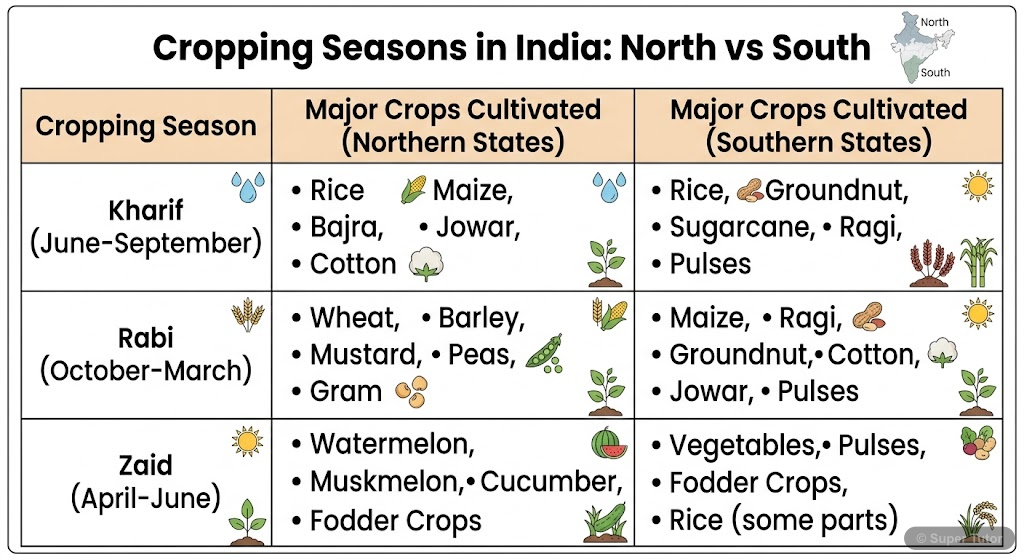
One of 20 illustrations for Agriculture in Super Tutor — alongside flashcards, concept maps and practice questions.
The first 7 solutions are open to read. The other 7 are free with a Super Tutor account.
Exercises
1(i)Which one of the following describes a system of agriculture where a single crop is grown on a large area?
(a) Shifting Agriculture
(b) Plantation Agriculture
(c) Horticulture
(d) Intensive AgricultureShow solution
Correct Option: (b) Plantation Agriculture
Plantation agriculture is a type of commercial farming where a single crop (such as tea, coffee, rubber, sugarcane, or banana) is grown on a large area of land. It is capital-intensive and the produce is mainly used as raw material for industries.
1(ii)Which one of the following is a rabi crop?
(a) Rice
(b) Gram
(c) Millets
(d) CottonShow solution
Correct Option: (b) Gram
Rabi crops are sown in winter (October–November) and harvested in spring (March–April). Gram (chickpea) is a rabi crop. Rice, millets, and cotton are kharif crops, sown in the summer/monsoon season.
1(iii)Which one of the following is a leguminous crop?
(a) Pulses
(b) Jawar
(c) Millets
(d) SesamumShow solution
Correct Option: (a) Pulses
Pulses (such as arhar, moong, urad, gram) are leguminous crops. They have the ability to fix atmospheric nitrogen in the soil through nitrogen-fixing bacteria in their root nodules, thereby enhancing soil fertility. Jowar and millets are cereals, while sesamum is an oilseed crop.
Answer in 30 Words
2(i)Name one important beverage crop and specify the geographical conditions required for its growth.Show solution
Beverage Crop: Tea
Geographical Conditions Required for Tea:
- Temperature: Cool climate with temperatures between 20°C–30°C.
- Rainfall: Well-distributed rainfall of 150–300 cm throughout the year.
- Soil: Well-drained, loamy soil rich in humus and organic matter.
- Relief: Hilly slopes that allow water to drain away (stagnant water is harmful).
- Labour: Cheap and abundant labour is required for plucking tender leaves.
Tea is mainly grown in Assam, West Bengal (Darjeeling, Jalpaiguri), Tamil Nadu, and Kerala.
2(ii)Name one staple crop of India and the regions where it is produced.Show solution
Staple Crop: Rice (Paddy)
Rice is the most important staple food crop of India.
Major Producing Regions:
- West Bengal, Uttar Pradesh, Andhra Pradesh, Telangana, Punjab, Tamil Nadu, Bihar, Chhattisgarh, Odisha, and Assam are the leading rice-producing states.
- It is grown mainly in the plains of north and north-eastern India, coastal areas, and the deltaic regions.
2(iii)Enlist the various institutional reform programmes introduced by the government in the interest of farmers.Show solution
Institutional Reform Programmes for Farmers:
- Land Reforms – Abolition of zamindari system and redistribution of land to the landless.
- Consolidation of Holdings – Merging of fragmented land holdings.
- Cooperative Farming – Encouraging farmers to form cooperatives.
- Minimum Support Price (MSP) – Government announces MSP to protect farmers from price fluctuations.
- Crop Insurance – Pradhan Mantri Fasal Bima Yojana to protect against crop failure.
- Kissan Credit Card (KCC) – Providing easy credit to farmers.
- Personal Accident Insurance Scheme – For farmers.
- Provision of loans at lower rates of interest through rural banks and cooperatives.
Answer in about 120 Words
3(i)Suggest the initiative taken by the government to ensure the increase in agricultural production.Show solution
Government Initiatives to Increase Agricultural Production:
The Indian government has taken several important steps to boost agricultural production:
- Land Reforms: Abolition of the zamindari system and redistribution of land ensured that farmers owned the land they tilled, motivating them to produce more.
- Green Revolution: Introduction of High Yielding Variety (HYV) seeds, especially for wheat and rice, along with increased use of fertilisers and irrigation, led to a significant increase in food grain production.
- Irrigation Facilities: Expansion of canal networks, tube wells, and drip/sprinkler irrigation to bring more land under cultivation.
- Minimum Support Price (MSP): The government announces MSP before the sowing season to assure farmers of a fair price for their produce.
- Subsidies: Subsidies on seeds, fertilisers, and electricity to reduce the cost of farming.
- Crop Insurance: Schemes like Pradhan Mantri Fasal Bima Yojana protect farmers against losses due to natural calamities, pests, and diseases.
- Kissan Credit Card (KCC) and Institutional Credit: Easy and affordable credit is provided to farmers through rural banks, cooperatives, and the KCC scheme.
- Agricultural Research: Establishment of institutions like ICAR (Indian Council of Agricultural Research) to develop better seeds, farming techniques, and pest control methods.
- Infrastructure Development: Improvement of rural roads, cold storage, and market facilities to reduce post-harvest losses and connect farmers to markets.
These measures have collectively helped India achieve self-sufficiency in food grain production.
Free with a Super Tutor account
Activity — Puzzle Answers
Free with a Super Tutor account
Free with a Super Tutor account
Free with a Super Tutor account
Free with a Super Tutor account
Free with a Super Tutor account
Free with a Super Tutor account
7 more solved questions in Agriculture
They are free with a Super Tutor account, along with practice quizzes and flashcards for this chapter. Free to start, no card needed.
Frequently Asked Questions
What are the important topics in Agriculture for Uttar Pradesh Board Class 10 Social Science?
Are these NCERT Solutions for Agriculture free?
How should I revise Agriculture for the Uttar Pradesh Board Class 10 board exam?
Sources & Official References
Content is aligned to the official syllabus. Refer to the board website for the latest curriculum.
More resources for Agriculture
Practice Quiz
Test yourself with a quick quiz
Important Questions
Exam-style questions with answers
Revision Notes
Key points for last-minute revision
Chapter Summary
Understand the chapter at a glance
Concept Maps
See how topics connect
Study Plan
Step-by-step plan for this chapter
Flashcards
Quick-fire cards for active recall
Syllabus
What topics to cover
For serious students
Get the full Agriculture chapter — start free.
Quizzes, flashcards, an AI doubt solver and a study plan for Uttar Pradesh Board Class 10 Social Science. Free to start, no card needed.