Chapter 2 of 22
NCERT Solutions

Development

Uttar Pradesh Board · Class 10 · Social Science

NCERT Solutions for Development — Uttar Pradesh Board Class 10 Social Science.

57 questions20 flashcards5 concepts

Interactive on Super Tutor

Studying Development? Get the full interactive chapter.

Quizzes, flashcards, AI doubt-solver and a step-by-step study plan — built for ncert solutions and more.

1,000+ Class 10 students started this chapter today

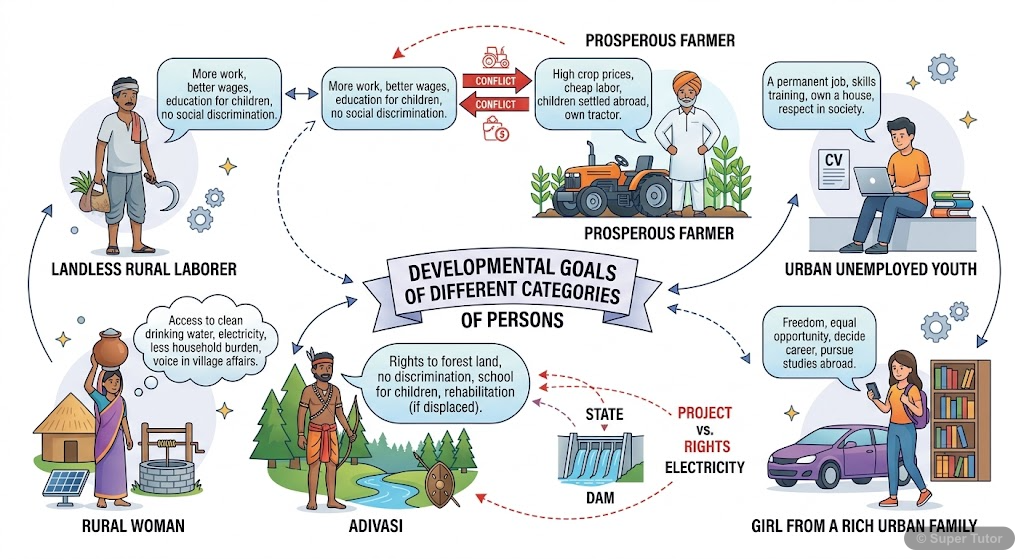
An infographic illustrating how different individuals or groups (e.g., landless rural laborers, prosperous farmers, urban youth, girls from rich families, Adivasis) have varied and sometimes conflicti
Super Tutor

Learn better with visuals Super Tutor has hundreds of illustrations like this across every chapter — all free to try.

Get started
13 Questions Solved · 1 Section

EXERCISES

1Development of a country can generally be determined by
(i) its per capita income
(ii) its average literacy level
(iii) health status of its people
(iv) all the above
Show solution
Correct Option: (iv) all the above

Justification: Development of a country cannot be measured by a single indicator alone. Per capita income tells us about the average economic well-being, literacy level reflects educational attainment, and health status indicates the physical well-being of citizens. Together, these indicators give a more comprehensive and accurate picture of a country's development. Hence, all the above criteria are used.
2Which of the following neighbouring countries has better performance in terms of human development than India?
(i) Bangladesh
(ii) Sri Lanka
(iii) Nepal
(iv) Pakistan
Show solution
Correct Option: (ii) Sri Lanka

Justification: Among India's neighbouring countries, Sri Lanka has a significantly higher Human Development Index (HDI) rank than India. Sri Lanka performs better on indicators such as life expectancy, literacy rate, and per capita income compared to India. Bangladesh, Nepal, and Pakistan all rank lower than India on the HDI.
3Assume there are four families in a country. The average per capita income of these families is Rs 5000. If the income of three families is Rs 4000, Rs 7000 and Rs 3000 respectively, what is the income of the fourth family?
(i) Rs 7500
(ii) Rs 3000
(iii) Rs 2000
(iv) Rs 6000
Show solution
Correct Option: (iv) Rs 6000

Given:
- Number of families = 4
- Average per capita income = Rs 5000
- Income of three families = Rs 4000, Rs 7000, Rs 3000

Formula:
Average=Sum of all incomesNumber of families\text{Average} = \frac{\text{Sum of all incomes}}{\text{Number of families}}

Step 1: Find the total income of all four families.
Total income=Average×Number of families=5000×4=Rs 20000\text{Total income} = \text{Average} \times \text{Number of families} = 5000 \times 4 = \text{Rs } 20000

Step 2: Find the sum of the three known incomes.
4000+7000+3000=Rs 140004000 + 7000 + 3000 = \text{Rs } 14000

Step 3: Find the income of the fourth family.
Income of fourth family=2000014000=Rs 6000\text{Income of fourth family} = 20000 - 14000 = \text{Rs } 6000

Answer: The income of the fourth family is Rs 6000.
4What is the main criterion used by the World Bank in classifying different countries? What are the limitations of this criterion, if any?Show solution
Main Criterion used by the World Bank:

The World Bank classifies countries on the basis of per capita income (i.e., the total income of a country divided by its total population). Countries with a per capita income of US13,205perannumorabove(asperrecentdata)arecalledhighincomeorrichcountries,andthosewithapercapitaincomeofUS 13,205 per annum or above (as per recent data) are called high-income or rich countries, and those with a per capita income of US 1,085 or less are called low-income countries. India falls in the category of lower-middle-income countries.

Limitations of Per Capita Income as a Criterion:

1. Ignores distribution of income: Per capita income is an average figure. It does not tell us how income is distributed among the people. A country may have a high per capita income but extreme inequality, where a few are very rich and the majority are very poor.

*Example:* If in a group of 5 people, one person earns Rs 1,00,000 and the other four earn Rs 5,000 each, the average income appears high but most people are actually poor.

2. Does not reflect quality of life: Per capita income does not capture important aspects of human well-being such as health, education, life expectancy, access to clean water, and social security.

3. Non-monetary factors ignored: Factors like freedom, security, equal treatment, and environmental quality, which contribute to a good life, are not reflected in per capita income.

4. Misleading comparisons: Two countries with the same per capita income may have very different standards of living if one has better public services (health, education) than the other.

Conclusion: While per capita income is a useful starting point, it is an incomplete measure of development and must be supplemented with other indicators.
5In what respects is the criterion used by the UNDP for measuring development different from the one used by the World Bank?Show solution
Criterion used by the World Bank:
The World Bank uses per capita income (average income per person per year) as the sole criterion to classify and compare countries in terms of development.

Criterion used by the UNDP:
The United Nations Development Programme (UNDP) uses the Human Development Index (HDI) to measure and compare development. The HDI is a composite index based on three dimensions:

| Dimension | Indicator |
|---|---|
| 1. Long and healthy life | Life expectancy at birth |
| 2. Knowledge/Education | Mean years of schooling and expected years of schooling |
| 3. Decent standard of living | Gross National Income (GNI) per capita |

Key Differences:

| Basis | World Bank | UNDP |
|---|---|---|
| Criterion | Per capita income only | HDI — income + health + education |
| Focus | Economic growth | Human well-being |
| Scope | Narrow | Broader and more comprehensive |
| Reflects quality of life? | No | Yes |

Conclusion: The UNDP's approach is more comprehensive because it recognises that development is not just about income but also about people's health, education, and overall quality of life. It treats people as the real wealth of a nation.
6Why do we use averages? Are there any limitations to their use? Illustrate with your own examples related to development.Show solution
Why do we use Averages?

Averages are used because they provide a single representative value for a large set of data, making it easier to compare different groups, regions, or countries.

- When comparing the income levels of different countries with millions of people, it is not possible to compare individual incomes. The per capita income (average income) allows a quick and simple comparison.
- Averages help in summarising complex data and identifying general trends.

Limitations of Averages:

1. Hides inequality/disparity: The average does not show how the data is distributed. It can be misleading if there is a wide gap between the highest and lowest values.

*Example related to development:* Suppose in a village of 5 families, the monthly incomes are Rs 500, Rs 500, Rs 500, Rs 500, and Rs 48,000. The average income = 500+500+500+500+480005=500005=\frac{500+500+500+500+48000}{5} = \frac{50000}{5} = Rs 10,000. This average suggests the village is relatively prosperous, but in reality, four out of five families are very poor.

2. Does not reflect the actual situation of the majority: A country may have a high per capita income due to a small number of very wealthy people, while the majority of the population may be living in poverty.

*Example:* Two states A and B both have an average per capita income of Rs 20,000. In State A, most people earn between Rs 18,000–22,000 (fairly equal distribution). In State B, a few people earn Rs 1,00,000 and the rest earn only Rs 5,000. The average is the same, but the standard of living is very different.

3. Ignores non-income factors: Averages of income do not capture health, education, or social equality.

Conclusion: Averages are useful tools for comparison but must be used carefully. They should be supplemented with information about distribution and other qualitative indicators to get a true picture of development.
7Kerala, with lower per capita income has a better human development ranking than Haryana. Hence, per capita income is not a useful criterion at all and should not be used to compare states. Do you agree? Discuss.Show solution
Answer: No, I do not fully agree with this statement.

Explanation:

It is true that Kerala has a lower per capita income than Haryana, yet Kerala ranks much higher on human development indicators such as:
- Life expectancy (Kerala ≈ 75 years vs Haryana ≈ 68 years)
- Literacy rate (Kerala ≈ 94% vs Haryana ≈ 76%)
- Infant mortality rate (Kerala has one of the lowest in India)

This clearly shows that per capita income alone is not sufficient to measure development or the quality of life of people.

However, this does not mean per capita income is useless:

1. Per capita income is still an important indicator of the economic resources available to a country or state. Higher income generally means more resources for public spending on health and education.

2. It is a simple and easily measurable criterion that allows quick comparisons.

3. It serves as a starting point for development analysis.

The real lesson from Kerala vs Haryana:

The comparison shows that how income is used matters more than the level of income. Kerala has invested heavily in public health and education, leading to better human development outcomes despite lower per capita income. Haryana, despite higher income, has not translated it equally into human well-being.

Conclusion: Per capita income is a useful but incomplete criterion. It should not be discarded but must be used alongside other indicators like health, education, and life expectancy (as in the HDI) to get a complete picture of development.
8Find out the present sources of energy that are used by the people in India. What could be the other possibilities fifty years from now?Show solution
Present Sources of Energy used in India:

| Category | Sources |
|---|---|
| Non-renewable (Conventional) | Coal, petroleum (oil), natural gas, firewood, cow dung cakes |
| Renewable | Hydroelectric power, solar energy, wind energy, biogas |
| Nuclear | Uranium (used in nuclear power plants) |

- In rural areas, firewood, cow dung cakes, and agricultural waste are still widely used for cooking.
- In urban areas, LPG (liquefied petroleum gas), electricity (from coal/hydro/nuclear), and CNG (compressed natural gas) are commonly used.
- Coal is the dominant source for electricity generation in India.

Possible Energy Sources Fifty Years from Now:

Given that fossil fuels (coal, petroleum, natural gas) are non-renewable and are being rapidly depleted, India will need to shift to alternative and sustainable sources of energy. Possibilities include:

1. Solar energy — India receives abundant sunlight; solar panels and solar farms can meet large energy needs.
2. Wind energy — Wind farms, especially in coastal and high-altitude areas.
3. Hydrogen fuel — Green hydrogen produced using renewable energy is a promising future fuel.
4. Tidal and wave energy — Harnessing energy from ocean tides and waves.
5. Advanced nuclear energy — Thorium-based nuclear reactors (India has large thorium reserves).
6. Geothermal energy — Energy from the Earth's internal heat.
7. Biofuels — Ethanol and biodiesel from agricultural waste.

Conclusion: The future of energy in India lies in renewable and sustainable sources. Transitioning away from fossil fuels is essential for both environmental sustainability and long-term energy security.
9Why is the issue of sustainability important for development?Show solution
Meaning of Sustainability in Development:

Sustainability means meeting the needs of the present generation without compromising the ability of future generations to meet their own needs. Sustainable development ensures that economic growth does not come at the cost of environmental destruction.

Why Sustainability is Important for Development:

1. Non-renewable resources are finite: Resources like coal, petroleum, and natural gas took millions of years to form. Once exhausted, they cannot be replenished. If we use them recklessly today, future generations will have no access to them.

*Example:* At the current rate of consumption, known oil reserves may last only a few more decades.

2. Environmental degradation threatens future growth: Deforestation, soil erosion, water pollution, and air pollution reduce the productive capacity of the Earth. This directly harms agriculture, health, and economic activity.

3. Groundwater depletion: Over-extraction of groundwater for irrigation and industry is depleting aquifers. If groundwater is exhausted, future generations will face severe water scarcity.

4. Climate change: Burning fossil fuels releases greenhouse gases, causing global warming and climate change. This threatens food security, coastal areas, and biodiversity worldwide.

5. Intergenerational equity: Development should be fair not just to people living today but also to those who will live in the future. Leaving a degraded environment is a form of injustice to future generations.

6. Consequences cross boundaries: Environmental degradation does not respect national or state borders. Problems like climate change, ozone depletion, and loss of biodiversity are global issues requiring collective responsibility.

Conclusion: Development that ignores sustainability is self-defeating in the long run. True development must balance economic growth with the conservation of natural resources and the environment, ensuring a good quality of life for both present and future generations.
10"The Earth has enough resources to meet the needs of all but not enough to satisfy the greed of even one person". How is this statement relevant to the discussion of development? Discuss.Show solution
Explanation of the Statement:

This statement, attributed to Mahatma Gandhi, draws a distinction between need and greed. It suggests that:
- The Earth's natural resources are sufficient to provide a decent standard of living to every person on the planet.
- However, if individuals or nations consume resources far beyond their basic needs — driven by greed and excessive consumption — the Earth's resources will fall short even for one such person.

Relevance to Development:

1. Unsustainable consumption patterns: Developed and wealthy nations consume a disproportionately large share of the world's resources. For example, the per capita energy consumption of a person in the USA is many times higher than that of a person in India or Africa. If every person on Earth consumed at that level, the planet's resources would be exhausted very quickly.

2. Inequality in resource use: While millions of people in developing countries lack access to clean water, food, and electricity, wealthy individuals and corporations waste enormous amounts of resources. This inequality is both unjust and unsustainable.

3. Environmental degradation due to greed: Over-mining, deforestation, over-fishing, and industrial pollution are largely driven by the desire for profit beyond necessity. This degrades the environment and reduces resources available for future generations.

4. Need-based vs. greed-based development: The statement calls for a model of development that is need-based — ensuring that every person's basic needs (food, water, shelter, health, education) are met — rather than greed-based, which leads to overconsumption by a few at the expense of many.

5. Sustainable development: If all countries pursue development by exploiting resources without restraint, the Earth's ecological balance will be destroyed. Sustainable development requires that we use resources wisely and equitably.

Conclusion: This statement is a powerful reminder that the goal of development should be to fulfil the basic needs of all people, not to enable unlimited accumulation by a few. Equitable and sustainable use of the Earth's resources is the foundation of true development.
11List a few examples of environmental degradation that you may have observed around you.Show solution
Examples of Environmental Degradation:

The following are common examples of environmental degradation that can be observed in everyday life:

1. Air pollution: Smoke and harmful gases emitted by vehicles, factories, and the burning of crop stubble (as seen in Delhi-NCR during winter) cause severe air pollution, leading to respiratory diseases.

2. Water pollution: Discharge of industrial effluents, sewage, and plastic waste into rivers (e.g., the Yamuna and Ganga rivers are heavily polluted) makes water unfit for drinking and harms aquatic life.

3. Deforestation: Cutting down of forests for agriculture, construction, and fuel wood reduces forest cover, leading to soil erosion, loss of biodiversity, and disruption of the water cycle.

4. Soil degradation: Excessive use of chemical fertilisers and pesticides in agriculture depletes soil fertility and contaminates groundwater.

5. Groundwater depletion: Over-extraction of groundwater for irrigation (especially in Punjab and Haryana) has led to a sharp fall in the water table.

6. Solid waste and plastic pollution: Improper disposal of garbage and single-use plastics clogs drains, pollutes land and water bodies, and harms animals.

7. Noise pollution: Excessive noise from traffic, loudspeakers, and construction activities causes stress and hearing problems.

8. Loss of biodiversity: Destruction of natural habitats due to urbanisation and industrialisation has led to the extinction or endangerment of many plant and animal species.

Conclusion: Environmental degradation is a serious threat to sustainable development. It affects not only the present generation but also the ability of future generations to live a healthy and productive life.
12For each of the items given in Table 1.6, find out which country is at the top and which is at the bottom.Show solution
Note: Table 1.6 referred to in this question is the comparative data table from the NCERT textbook (Chapter 1 — Development) showing indicators for various countries including India, Sri Lanka, China, Nepal, Bangladesh, Pakistan, and others. The key indicators typically included are: Per Capita Income (GNI), Life Expectancy at Birth, Mean Years of Schooling, and HDI Rank.

Based on the standard NCERT Table 1.6 (Comparative Development Indicators):

| Indicator | Country at the Top | Country at the Bottom |
|---|---|---|
| Per Capita GNI (US$) | Sri Lanka (highest among listed South Asian neighbours relative to India) / or as per table data | Nepal or Bangladesh (lowest) |
| Life Expectancy at Birth (years) | Sri Lanka | Nepal or Pakistan |
| Mean Years of Schooling | Sri Lanka | Nepal |
| HDI Rank | Sri Lanka (best/lowest number rank) | Nepal or Pakistan (worst/highest number rank) |

General Observation:
- Sri Lanka consistently appears at the top (best performance) among India's neighbouring countries on most human development indicators.
- Nepal or Bangladesh generally appears at the bottom (lowest performance) on most indicators.

*Students are advised to refer to the actual Table 1.6 in their NCERT textbook and fill in the exact figures for each indicator to give a precise answer, as the table values are updated periodically.*
13The following table shows the proportion of adults (aged 15-49 years) whose BMI is below normal (BMI < 18.5 kg/m²) in India. It is based on a survey of various states for the year 2019-21.

| State | Male (%) | Female (%) |
|---|---|---|
| Kerala | 8.5 | 10 |
| Karnataka | 17 | 21 |
| Madhya Pradesh | 28 | 28 |
| All States | 20 | 23 |

(i) Compare the nutritional level of people in Kerala and Madhya Pradesh.
(ii) Can you guess why around one-fifth of people in the country are undernourished even though it is argued that there is enough food in the country? Describe in your own words.
Show solution
(i) Comparison of Nutritional Level of People in Kerala and Madhya Pradesh:

Given Data:
- Kerala: 8.5% of males and 10% of females have BMI below normal.
- Madhya Pradesh: 28% of males and 28% of females have BMI below normal.

Analysis:

A BMI below 18.5 kg/m² indicates undernutrition. The higher the percentage of people with below-normal BMI, the worse the nutritional status.

- In Kerala, only 8.5% of males and 10% of females are undernourished. This is significantly below the national average (20% males, 23% females), indicating a good nutritional status.

- In Madhya Pradesh, 28% of both males and females are undernourished. This is well above the national average, indicating a poor nutritional status.

Conclusion: The nutritional level of people in Kerala is far better than in Madhya Pradesh. Madhya Pradesh has more than three times the proportion of undernourished males compared to Kerala. This reflects Kerala's better public health infrastructure, higher literacy (especially female literacy), and more effective implementation of food security programmes.

---

(ii) Why are around one-fifth of people in India undernourished despite enough food being available?

This is a paradox — India produces enough food grain to feed its entire population, yet a large proportion of people remain undernourished. The reasons are:

1. Poverty and lack of purchasing power: Many people, especially daily wage labourers and marginal farmers, do not earn enough to buy adequate nutritious food. Having food available in the market does not help if people cannot afford it.

2. Unequal distribution of food: Food production may be sufficient at the national level, but it is not distributed equally. Food surpluses in some regions coexist with shortages and hunger in others.

3. Inefficiency in the Public Distribution System (PDS): The government's food distribution system (ration shops) suffers from corruption, leakages, and poor implementation. Food meant for the poor often does not reach them.

4. Lack of awareness about nutrition: Even when food is available, people may not consume a balanced diet due to lack of nutritional awareness. They may eat enough calories but lack proteins, vitamins, and minerals.

5. Social inequalities: Marginalised groups such as Scheduled Castes, Scheduled Tribes, and women (especially in rural areas) often have less access to food due to social discrimination and gender inequality.

6. Unemployment and irregular income: Seasonal unemployment and irregular wages mean that many families cannot afford two square meals a day throughout the year.

7. Food wastage: A significant amount of food is wasted due to poor storage facilities, lack of cold chains, and wastage at the consumer level.

Conclusion: The problem of undernutrition in India is not primarily a problem of food production but of access, distribution, poverty, and governance. Ensuring that every person has the economic means and physical access to adequate and nutritious food is essential for eliminating undernutrition.

Stuck on a step?

Ask Super Tutor AI to explain any solution on this page in a simpler way — free, 24x7.

Ask a Doubt Free

Frequently Asked Questions

What are the important topics in Development for Uttar Pradesh Board Class 10 Social Science?
Key topics in Development include Development - Complete Chapter Concept Map, How Development is Measured - From Income to HDI, Sustainability of Development - Resources and Future. These are the concepts Uttar Pradesh Board Class 10 examiners draw on most — study them first, then practise related questions.
How to score full marks in Development — Uttar Pradesh Board Class 10 Social Science?
Understand the core concepts first, then work through the 57 practice questions available for this chapter. Revise formulas and definitions regularly, and use flashcards for quick recall before the exam.
Where can I get free NCERT Solutions for Development Class 10 Social Science?
This page has free step-by-step NCERT Solutions for every exercise question in Development (Uttar Pradesh Board Class 10 Social Science) — written the way examiners award marks: given, formula, working, answer.

Sources & Official References

Content is aligned to the official syllabus. Refer to the board website for the latest curriculum.

For serious students

Get the full Development chapter — for free.

Quizzes, flashcards, AI doubt-solver and a step-by-step study plan for Uttar Pradesh Board Class 10 Social Science.