Motion — Study Plan
Uttar Pradesh Board · Class 9 · Science
A step-by-step study plan for Motion, Uttar Pradesh Board Class 9 Science: what to learn first, what to practise and when to revise.
Interactive on Super Tutor
Studying Motion? Get the full interactive chapter.
Quizzes, flashcards, AI doubt-solver and a step-by-step study plan — built for study plan and more.
Free trial, no card needed.
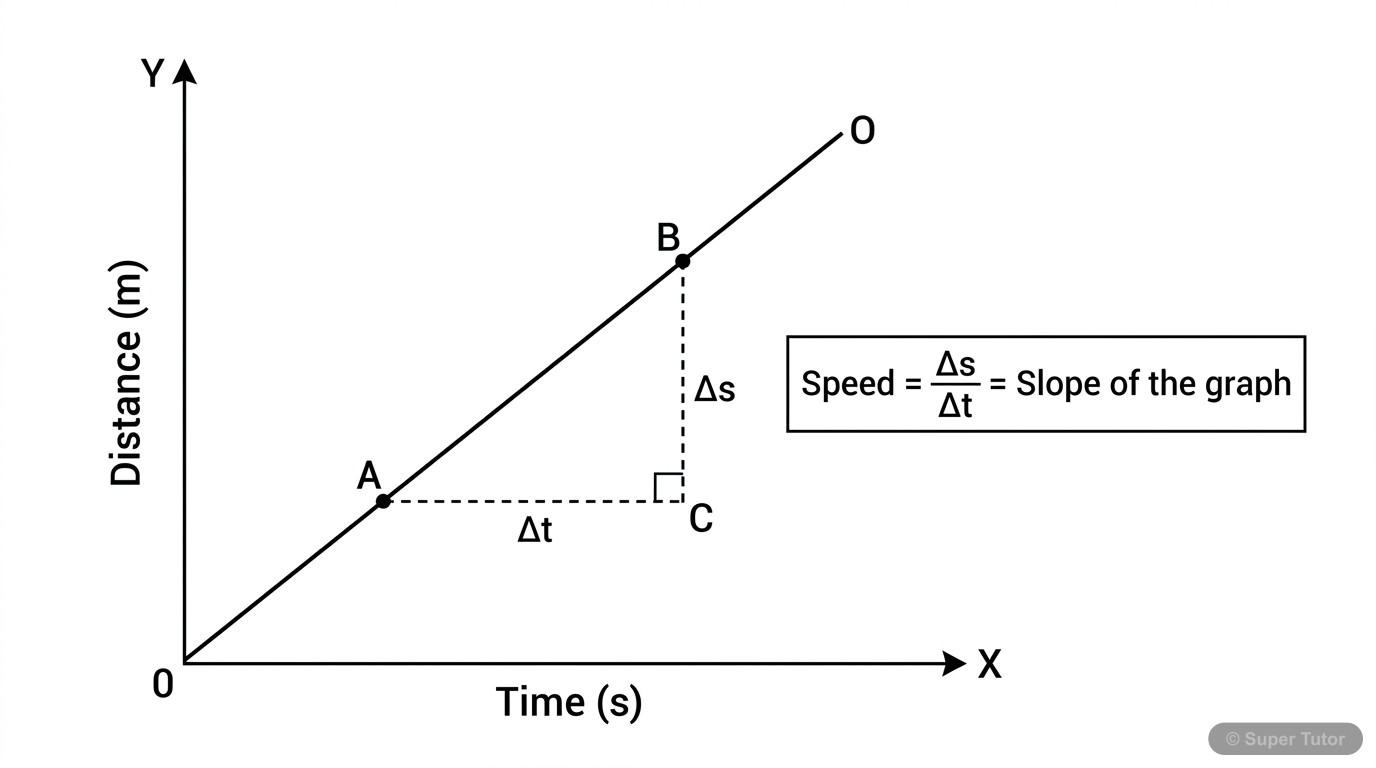
One of 4 illustrations for Motion in Super Tutor — alongside flashcards, concept maps and practice questions.
Study Plan
Learn the Theory
Read the textbook chapter carefully. Note down definitions, formulas and key ideas. Focus on: 7.1 Describing Motion, 7.1.2 Uniform and Non-uniform Motion, 7.2 Measuring Rate of Motion - Speed.
Practise
Solve the textbook exercises and extra practice questions. There are 31 questions available for this chapter.
Revise & Test
Revise key points without looking at your notes. Take a practice quiz and mark weak areas for another pass.
Spaced Revision
Come back to Motion after a week. Use flashcards for quick recall and try past exam questions on this chapter.
What to Focus On
- Motion is always described with respect to a reference point (origin).
- Distance = total path length covered (scalar quantity).
- Displacement = shortest distance from initial to final position (vector quantity).
- Speed = Distance / Time (scalar — no direction needed).
- Velocity = Displacement / Time (vector — direction must be specified).
- Average speed = Total distance / Total time (used for non-uniform motion).
- Acceleration = Change in velocity / Time = (v − u) / t
- SI unit of acceleration is m/s² (m s⁻²).
- Acceleration is a vector quantity.
Common Mistakes to Avoid
Distance and Displacement are the same thing — both just measure 'how far' an object has travelled.
Average velocity is always calculated as (initial velocity + final velocity) ÷ 2, in all situations.
An object moving with uniform speed can never be accelerating.
Memory Tips
Distance vs Displacement
Uniform vs Non-Uniform Motion
Speed Formula — Speed = Distance/Time
Velocity includes direction, Speed does not
Want a personalised study plan?
Super Tutor builds a day-by-day plan for Uttar Pradesh Board Class 9 Science that fits your exam date and pace.
Create My Study PlanFrequently Asked Questions
What are the important topics in Motion for Uttar Pradesh Board Class 9 Science?
How should I revise Motion for Class 9 exams?
Sources & Official References
Content is aligned to the official syllabus. Refer to the board website for the latest curriculum.
More resources for Motion
Practice Quiz
Test yourself with a quick quiz
Important Questions
Exam-style questions with answers
Revision Notes
Key points for last-minute revision
Formula Sheet
The chapter's formulas in one place
Chapter Summary
Understand the chapter at a glance
Concept Maps
See how topics connect
Flashcards
Quick-fire cards for active recall
Syllabus
What topics to cover
NCERT Solutions
Every textbook question solved step by step
For serious students
Get the full Motion chapter — start free.
Quizzes, flashcards, an AI doubt solver and a study plan for Uttar Pradesh Board Class 9 Science. Free to start, no card needed.