Chapter 3 of 15
NCERT Solutions

Contemporary Centers of Power

Assam Board · Class 12 · Political Science

NCERT Solutions for Contemporary Centers of Power — Assam Board Class 12 Political Science.

47 questions22 flashcards5 concepts

Interactive on Super Tutor

Studying Contemporary Centers of Power? Get the full interactive chapter.

Quizzes, flashcards, AI doubt-solver and a step-by-step study plan — built for ncert solutions and more.

1,000+ Class 12 students started this chapter today

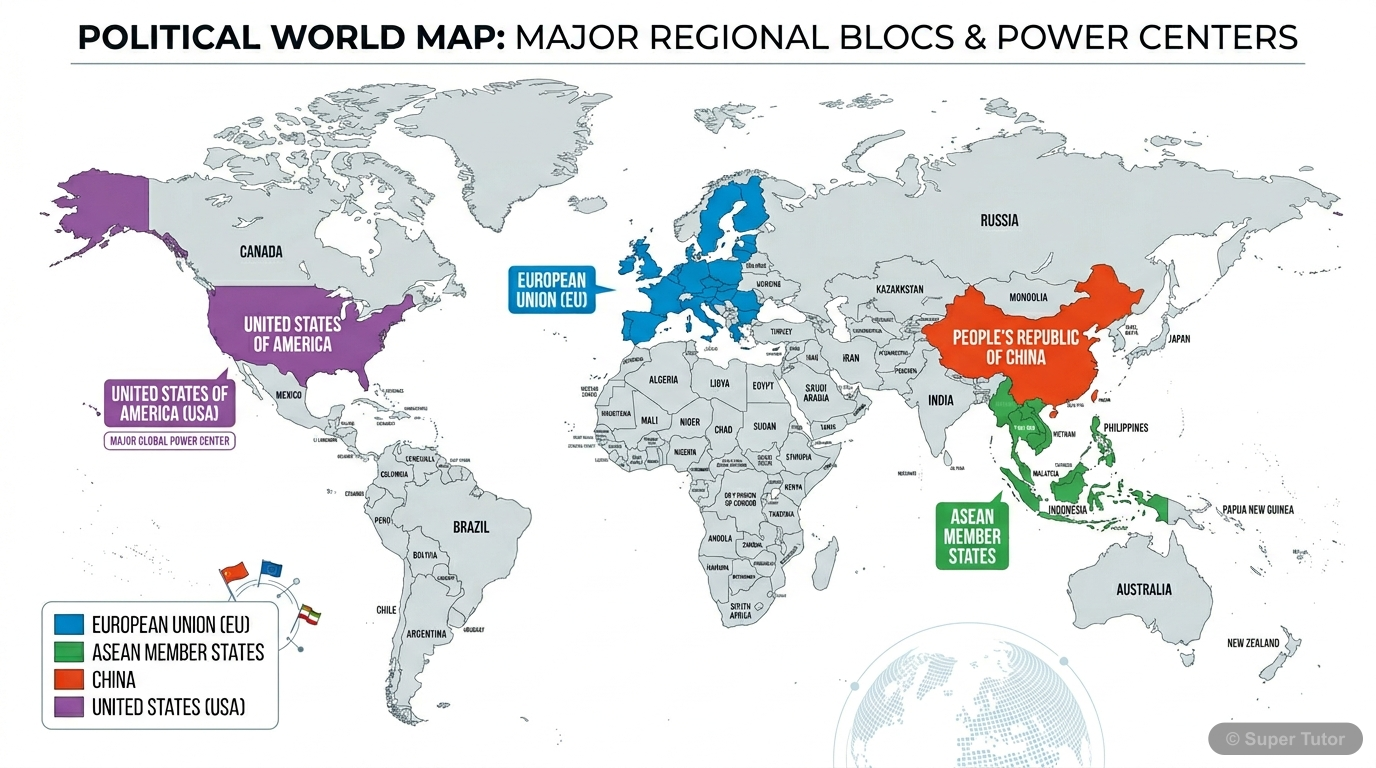
A world map highlighting the key contemporary centers of power: European Union, ASEAN, and China, showing their geographical locations and relative sizes.
Super Tutor

Learn better with visuals Super Tutor has hundreds of illustrations like this across every chapter — all free to try.

Get started
14 Questions Solved · 1 Section

Contemporary Centers of Power — Exercise Questions

1Arrange the following in chronological order.
a. China's accession to WTO
b. Establishment of the EEC
c. Establishment of the EU
d. Birth of ARF
Show solution
Given: Four events related to regional and global organisations.

Concept: Chronological arrangement means ordering events from the earliest to the latest by year.

Working:
- Establishment of the EEC (European Economic Community) — 1957 (Treaty of Rome)
- Birth of ARF (ASEAN Regional Forum) — 1994
- Establishment of the EU (European Union) — 1992/1993 (Maastricht Treaty signed 1992, came into force 1993)
- China's accession to WTO — 2001

Correct Chronological Order:
bdca\text{b} \rightarrow \text{d} \rightarrow \text{c} \rightarrow \text{a}

That is:
1. (b) Establishment of the EEC — 1957
2. (d) Birth of ARF — 1994
3. (c) Establishment of the EU — 1992–93
4. (a) China's accession to WTO — 2001

*(Note: The EU (c) formally came into force in 1993, while ARF (d) was established in 1994, so the correct order places EU before ARF.)*

Final Answer: b → c → d → a
2The 'ASEAN Way'
a. Reflects the life style of ASEAN members
b. A form of interaction among ASEAN members that is informal and cooperative
c. The defence policy followed by the ASEAN members
d. The road that connects all the ASEAN members
Show solution
Correct Option: (b) A form of interaction among ASEAN members that is informal and cooperative.

Justification: The 'ASEAN Way' refers to the style of interaction among ASEAN member nations that is characterised by informality, consensus-building, and non-confrontational bargaining. It emphasises respect for national sovereignty, non-interference in internal affairs, and preference for quiet diplomacy over formal or legalistic procedures. It is not a lifestyle, a defence policy, or a physical road.
3Which of the following nations adopted an 'open door' policy?
a. China
b. South Korea
c. Japan
d. USA
Show solution
Correct Option: (a) China.

Justification: China adopted the 'Open Door' policy under the leadership of Deng Xiaoping in 1978. This policy opened China to foreign investment, technology, and global markets, transforming its command economy into a socialist market economy. It led to Special Economic Zones (SEZs) and rapid economic growth, making China one of the largest economies in the world.
4Fill in the blanks:
a. The border conflict between China and India in 1962 was principally over __________ and __________ region.
b. ARF was established in the year __________.
c. China entered into bilateral relations with __________ (a major country) in 1972.
d. __________ Plan influenced the establishment of the Organisation for European Economic Cooperation in 1948.
e. __________ is the organisation of ASEAN that deals with security.
Show solution
Given: Statements related to China, India, ASEAN, and European organisations.

Answers:

a. The border conflict between China and India in 1962 was principally over Aksai Chin and Arunachal Pradesh region.

b. ARF (ASEAN Regional Forum) was established in the year 1994.

c. China entered into bilateral relations with USA (United States of America) in 1972. *(President Nixon visited China in 1972, normalising Sino-American relations.)*

d. Marshall Plan influenced the establishment of the Organisation for European Economic Cooperation (OEEC) in 1948. *(The Marshall Plan was the US-sponsored economic recovery programme for post-war Europe.)*

e. ARF (ASEAN Regional Forum) is the organisation of ASEAN that deals with security.
5What are the objectives of establishing regional organisations?Show solution
Given: Question about the objectives of regional organisations.

Concept: Regional organisations are formed by geographically proximate countries to achieve common goals through collective effort.

Objectives of Establishing Regional Organisations:

1. Economic Development: To promote trade, investment, and economic cooperation among member nations, leading to collective growth and prosperity.

2. Political Cooperation: To resolve political disputes peacefully through dialogue and diplomacy, reducing the chances of conflict.

3. Security and Peace: To maintain regional peace and stability by creating a platform for collective security arrangements.

4. Social and Cultural Exchange: To promote cultural understanding, people-to-people contact, and social development among member nations.

5. Collective Bargaining: To strengthen the collective voice of member nations in international forums like the UN, WTO, etc., giving them greater bargaining power.

6. Reducing Dependence: To reduce dependence on external powers and superpowers by building self-reliance within the region.

7. Addressing Common Problems: To collectively tackle shared challenges such as terrorism, environmental degradation, poverty, and health crises.

Conclusion: Regional organisations serve as platforms for cooperation, enabling member states to achieve goals that would be difficult to accomplish individually.
6How does geographical proximity influence the formation of regional organisations?Show solution
Given: Question on the role of geographical proximity in forming regional organisations.

Concept: Geographical proximity means countries that are located close to each other in the same region.

Influence of Geographical Proximity:

1. Shared Interests: Countries in the same region often share common economic, political, and security interests, making cooperation natural and beneficial.

2. Common Challenges: Neighbouring countries face similar challenges such as natural disasters, cross-border terrorism, environmental issues, and refugee crises, which require collective responses.

3. Trade and Commerce: Geographically close nations can trade more easily due to lower transportation costs, shared infrastructure, and complementary economies, encouraging economic integration.

4. Cultural and Historical Ties: Neighbouring countries often share historical, linguistic, and cultural bonds that facilitate trust and cooperation.

5. Security Concerns: Countries in the same region face similar security threats. A conflict in one country can spill over into neighbouring states, making collective security arrangements necessary.

6. Examples: ASEAN (Southeast Asia), EU (Europe), SAARC (South Asia), and the African Union (Africa) are all examples where geographical proximity played a key role in the formation of regional organisations.

Conclusion: Geographical proximity creates a natural foundation for regional cooperation by generating shared interests, common problems, and mutual interdependence among neighbouring nations.
7What are the components of the ASEAN Vision 2020?Show solution
Given: Question about ASEAN Vision 2020.

Concept: ASEAN Vision 2020 was adopted in 1997 and outlines the long-term goals of ASEAN for the region.

Components of ASEAN Vision 2020:

1. Outward-looking Role: ASEAN aims to play an active and outward-looking role in the international community and the Asia-Pacific region, promoting peace, stability, and prosperity.

2. A Community of Caring Societies: ASEAN envisions a community where the well-being, livelihood, and welfare of the people are at the centre of the development process.

3. Peaceful and Stable Region: The vision emphasises maintaining peace, stability, and security in the region through dialogue, cooperation, and the peaceful settlement of disputes.

4. Competitive Economic Region: ASEAN aims to create a highly competitive economic region with equitable economic development, reduced poverty, and socio-economic disparities.

5. Zone of Peace, Freedom, and Neutrality (ZOPFAN): The vision reaffirms ASEAN's commitment to making Southeast Asia a zone free from external interference and nuclear weapons.

6. Partnership for Dynamic Development: ASEAN seeks to build a partnership based on dynamic development, with emphasis on science, technology, and human resource development.

7. Interconnected Region: The vision includes building better connectivity through infrastructure, communication, and transport links among member states.

Conclusion: ASEAN Vision 2020 is a comprehensive blueprint for making Southeast Asia a peaceful, prosperous, and people-centred community by the year 2020.
8Name the pillars and the objectives of the ASEAN Community.Show solution
Given: Question about the pillars and objectives of the ASEAN Community.

Concept: The ASEAN Community rests on three pillars, each with specific objectives.

Three Pillars of the ASEAN Community:

1. ASEAN Political-Security Community (APSC)
- *Objective:* To ensure that countries in the region live at peace with one another and with the world in a just, democratic, and harmonious environment.
- It aims to resolve disputes peacefully, promote democracy, human rights, and good governance.

2. ASEAN Economic Community (AEC)
- *Objective:* To create a stable, prosperous, and highly competitive ASEAN economic region in which there is a free flow of goods, services, investment, and skilled labour.
- It aims to reduce poverty and economic disparities and achieve equitable economic development.
- It seeks to integrate ASEAN into the global economy.

3. ASEAN Socio-Cultural Community (ASCC)
- *Objective:* To build a community of caring societies and promote a common regional identity.
- It focuses on human development, social welfare, environmental sustainability, and cultural cooperation.
- It aims to address issues like education, health, labour, and disaster management.

Conclusion: The three pillars — political-security, economic, and socio-cultural — together form the foundation of the ASEAN Community, aiming to create a region that is peaceful, prosperous, and people-centred.
9In what ways does the present Chinese economy differ from its command economy?Show solution
Given: Question comparing China's present economy with its earlier command economy.

Concept: A command economy is one where the state controls all economic decisions. China shifted from this model after 1978 under Deng Xiaoping's reforms.

Differences Between China's Present Economy and Its Command Economy:

| Aspect | Command Economy (Before 1978) | Present Economy (After 1978) |
|---|---|---|
| Ownership | All means of production owned by the state | Mix of state and private ownership |
| Decision Making | Centralised state planning | Market forces determine production and prices |
| Foreign Investment | Prohibited or severely restricted | Welcomed through Special Economic Zones (SEZs) |
| Trade | State-controlled foreign trade | Open to global trade; member of WTO since 2001 |
| Agriculture | Collectivised farming (communes) | Decollectivisation; farmers allowed to sell surplus |
| Industry | Only state-owned enterprises | Private enterprises and foreign companies allowed |
| Growth Rate | Slow and stagnant | One of the fastest-growing economies in the world |

Key Reforms Introduced:
- 1978: Deng Xiaoping introduced the 'Open Door Policy' and economic reforms.
- Special Economic Zones (SEZs) were established to attract foreign investment.
- Dual pricing system was introduced — goods could be sold at both state-fixed and market prices.
- China joined the WTO in 2001, integrating further into the global economy.

Conclusion: China's present economy is a socialist market economy — it retains political control by the Communist Party but allows market forces, private enterprise, and foreign investment to drive economic growth, making it fundamentally different from the earlier rigid command economy.
10How did the European countries resolve their post-Second World War problem? Briefly outline the attempts that led to the formation of the European Union.Show solution
Given: Question about post-WWII European recovery and the formation of the EU.

Post-Second World War Problems Faced by Europe:
- Massive destruction of infrastructure, industry, and cities.
- Millions of deaths and displacement of people.
- Economic collapse and food shortages.
- Political instability and the threat of communism spreading from the Soviet Union.
- Deep-seated rivalries between nations, especially France and Germany.

How European Countries Resolved These Problems:

1. Marshall Plan (1948): The United States provided massive economic aid to rebuild Western European economies under the Marshall Plan. This helped revive industries and stabilise economies.

2. Organisation for European Economic Cooperation (OEEC) — 1948: Established to administer Marshall Plan aid and promote economic cooperation among Western European nations.

3. Council of Europe (1949): Established for political cooperation among European nations, promoting democracy and human rights.

4. European Coal and Steel Community (ECSC) — 1951: France, West Germany, Italy, Belgium, Netherlands, and Luxembourg pooled their coal and steel resources. This was the first step towards economic integration and also helped reconcile France and Germany.

5. European Economic Community (EEC) — 1957: The Treaty of Rome created the EEC (also called the Common Market), which aimed at a customs union, free movement of goods, services, capital, and labour among member states.

6. European Community (EC) — 1967: The ECSC, EEC, and Euratom merged to form the European Community, deepening integration.

7. Maastricht Treaty and Formation of the EU (1992–93): The Treaty of Maastricht transformed the EC into the European Union in 1993. It introduced a common currency (Euro), common foreign and security policy, and cooperation in justice and home affairs.

Conclusion: European countries resolved post-war problems through a gradual process of economic cooperation, reconciliation, and political integration, culminating in the formation of the European Union — a unique supranational organisation that has ensured peace and prosperity in Europe for decades.
11What makes the European Union a highly influential regional organisation?Show solution
Given: Question about the factors that make the EU a highly influential regional organisation.

The European Union as an Influential Organisation:

The EU is considered one of the most powerful and influential regional organisations in the world due to the following reasons:

1. Economic Strength:
- The EU has the world's largest single market with free movement of goods, services, capital, and labour.
- The Euro is one of the most important currencies in the world, used by 19 member states.
- The EU's combined GDP makes it one of the largest economies globally, comparable to the USA.
- It is the world's largest trading bloc and a major player in the WTO.

2. Political Influence:
- The EU speaks with one voice in many international forums, giving it enormous diplomatic clout.
- It has a common foreign and security policy, allowing it to act collectively on global issues.
- EU membership is seen as a mark of democratic legitimacy, encouraging reforms in aspiring member states.

3. Military Capability:
- Two EU members — France and the UK (before Brexit) — are permanent members of the UN Security Council with nuclear weapons.
- The EU has been developing its own defence and security identity, including rapid reaction forces.

4. Institutional Framework:
- The EU has well-developed institutions: the European Parliament, European Commission, European Court of Justice, and European Central Bank.
- The European Court of Justice can override national laws, giving the EU supranational authority.

5. Soft Power:
- The EU exercises significant soft power through its promotion of democracy, human rights, rule of law, and environmental standards globally.
- It provides development aid and humanitarian assistance worldwide.

6. Enlargement:
- The EU has expanded from 6 to 27 members, demonstrating its attractiveness and influence across the European continent.

Conclusion: The EU's combination of economic size, political unity, institutional strength, and soft power makes it a highly influential actor in global politics, capable of shaping international norms, trade rules, and diplomatic outcomes.
12The emerging economies of China and India have great potential to challenge the unipolar world. Do you agree with the statement? Substantiate your arguments.Show solution
Given: Statement about China and India challenging the unipolar world order.

Position: Yes, I agree with the statement. Both China and India have the potential to challenge the US-dominated unipolar world and contribute to a multipolar world order.

Arguments in Favour:

China's Potential:
1. Economic Power: China is the world's second-largest economy (by GDP) and the largest by purchasing power parity (PPP). Its rapid economic growth has made it a global economic powerhouse.
2. Military Strength: China has the world's largest standing army and is rapidly modernising its military, including nuclear capabilities and a growing navy.
3. Global Influence: Through initiatives like the Belt and Road Initiative (BRI), China is expanding its economic and political influence across Asia, Africa, and Europe.
4. Permanent UN Security Council Member: China's veto power gives it significant influence in global governance.
5. Technological Growth: China is emerging as a global leader in technology, artificial intelligence, and manufacturing.

India's Potential:
1. Economic Growth: India is one of the fastest-growing major economies and is projected to become the third-largest economy in the world.
2. Demographic Dividend: India has the world's largest youth population, which can drive economic growth and innovation.
3. Nuclear Power: India is a recognised nuclear power with a credible minimum deterrence policy.
4. Soft Power: India's democracy, culture, diaspora, and IT sector give it significant soft power globally.
5. Strategic Location: India's position in the Indian Ocean gives it strategic importance in global trade and security.

Limitations to Consider:
- Both countries still face significant challenges: poverty, inequality, internal conflicts, and governance issues.
- China and India have their own bilateral tensions (border disputes, trade competition) that may limit their ability to jointly challenge unipolarity.
- The USA still maintains overwhelming military, technological, and financial dominance.

Conclusion: While neither China nor India alone can immediately replace the USA as the sole superpower, their combined economic weight, military capabilities, and growing global influence are gradually shifting the world towards multipolarity. The rise of these two Asian giants is indeed challenging the unipolar world order and reshaping global politics in the 21st century.
13The Peace and prosperity of countries lay in the establishment and strengthening of regional economic organisations. Justify this statement.Show solution
Given: Statement linking peace and prosperity to regional economic organisations.

Justification:

The statement is well-supported by historical evidence and the functioning of regional organisations worldwide. The following points justify it:

1. Prevention of Conflict:
- Regional organisations create platforms for dialogue and peaceful resolution of disputes, reducing the likelihood of armed conflict.
- The EU is the best example — after centuries of devastating wars, European nations have maintained peace since 1945 through economic integration and cooperation.
- ASEAN has helped manage tensions in Southeast Asia through its principle of non-interference and consensus-based decision-making.

2. Economic Development and Prosperity:
- Regional organisations promote free trade, remove tariff barriers, and encourage investment, leading to economic growth for all members.
- The ASEAN Free Trade Area (AFTA) has boosted intra-regional trade and attracted foreign investment, raising living standards.
- The EU's single market has created enormous economic benefits for member states.

3. Collective Bargaining Power:
- Member states can negotiate better trade deals and represent their interests more effectively in global forums like the WTO when they act collectively.
- This reduces economic exploitation by more powerful nations.

4. Addressing Common Challenges:
- Regional organisations help countries collectively tackle shared problems like terrorism, drug trafficking, climate change, and pandemics, which no single country can address alone.

5. Political Stability:
- Economic interdependence created by regional organisations makes war costly and irrational, as member states have too much to lose economically from conflict.
- This creates a 'peace dividend' — the more countries trade and cooperate, the less likely they are to fight.

6. Examples:
- EU: Transformed war-torn Europe into a zone of peace and one of the world's most prosperous regions.
- ASEAN: Helped Southeast Asia achieve remarkable economic growth while maintaining regional stability.
- SAARC, African Union, MERCOSUR are other examples of regional organisations working towards peace and development.

Conclusion: Regional economic organisations create a virtuous cycle — economic cooperation builds trust, trust reduces conflict, and peace enables further prosperity. Therefore, the establishment and strengthening of regional organisations is indeed essential for the peace and prosperity of member nations.
14Identify the contentious issues between China and India. How could these be resolved for greater cooperation? Give your suggestions.Show solution
Given: Question about contentious issues between China and India and suggestions for resolution.

Contentious Issues Between China and India:

1. Border Disputes:
- The most significant issue is the unresolved boundary between the two countries.
- The 1962 Sino-Indian War was fought over the Aksai Chin (in Ladakh, controlled by China but claimed by India) and the Arunachal Pradesh region (controlled by India but claimed by China as 'South Tibet').
- Frequent stand-offs along the Line of Actual Control (LAC), including recent ones at Doklam (2017) and Galwan Valley (2020), continue to strain relations.

2. Tibet and Dalai Lama:
- India gave asylum to the Dalai Lama and Tibetan refugees in 1959, which China views as interference in its internal affairs.
- The presence of the Tibetan government-in-exile in Dharamsala, India, remains a source of tension.

3. Pakistan Factor:
- China's close strategic and military partnership with Pakistan, including its support for Pakistan on the Kashmir issue, is a major concern for India.
- China's construction of the China-Pakistan Economic Corridor (CPEC) passes through Pakistan-occupied Kashmir (PoK), which India strongly objects to.

4. Trade Imbalance:
- There is a significant trade deficit in favour of China. India imports far more from China than it exports, creating economic dependence and tension.

5. China's Influence in India's Neighbourhood:
- China's growing presence in Nepal, Sri Lanka, Bangladesh, and Myanmar (the 'String of Pearls' strategy) is seen by India as an attempt to encircle it strategically.

6. Nuclear Issues:
- China has opposed India's membership in the Nuclear Suppliers Group (NSG) and has supported Pakistan's nuclear programme.

Suggestions for Resolution and Greater Cooperation:

1. Dialogue and Diplomacy: Both countries should continue high-level diplomatic talks and use existing mechanisms like the Special Representatives talks on the boundary question to find a mutually acceptable solution.

2. Confidence-Building Measures (CBMs): Both sides should strengthen CBMs along the LAC, including agreements on patrolling, buffer zones, and hotlines between military commanders to prevent accidental escalation.

3. Trade Rebalancing: India and China should work towards reducing the trade deficit by increasing Indian exports to China, particularly in IT services, pharmaceuticals, and agricultural products.

4. People-to-People Contact: Increasing cultural exchanges, tourism, and academic cooperation can build mutual understanding and reduce mistrust.

5. Multilateral Cooperation: Both countries can cooperate in multilateral forums like BRICS, SCO (Shanghai Cooperation Organisation), and the G20 on issues of common interest such as climate change, global governance reform, and development finance.

6. Respect for Sovereignty: Both nations must respect each other's core interests and sovereignty concerns. China should acknowledge India's sensitivities regarding Tibet and CPEC, while India should engage constructively on issues important to China.

7. Economic Interdependence: Deepening economic ties can create mutual stakes in maintaining peace, as both countries have too much to lose economically from conflict.

Conclusion: Despite their differences, China and India are both ancient civilisations and emerging powers with enormous potential for cooperation. As the two most populous nations and fastest-growing economies, their cooperation is essential not only for their own development but also for regional and global stability. A pragmatic approach based on dialogue, mutual respect, and economic interdependence can help resolve contentious issues and build a more cooperative relationship.

Stuck on a step?

Ask Super Tutor AI to explain any solution on this page in a simpler way — free, 24x7.

Ask a Doubt Free

Frequently Asked Questions

What are the important topics in Contemporary Centers of Power for Assam Board Class 12 Political Science?
Contemporary Centers of Power covers several key topics that are frequently asked in Assam Board Class 12 board exams. Focus on the core concepts listed on this page and practise related questions to build confidence.
How to score full marks in Contemporary Centers of Power — Assam Board Class 12 Political Science?
Understand the core concepts first, then work through the 47 practice questions available for this chapter. Revise formulas and definitions regularly, and use flashcards for quick recall before the exam.
Where can I get free NCERT Solutions for Contemporary Centers of Power Class 12 Political Science?
This page has free step-by-step NCERT Solutions for every exercise question in Contemporary Centers of Power (Assam Board Class 12 Political Science) — written the way examiners award marks: given, formula, working, answer.

Sources & Official References

Content is aligned to the official syllabus. Refer to the board website for the latest curriculum.

For serious students

Get the full Contemporary Centers of Power chapter — for free.

Quizzes, flashcards, AI doubt-solver and a step-by-step study plan for Assam Board Class 12 Political Science.