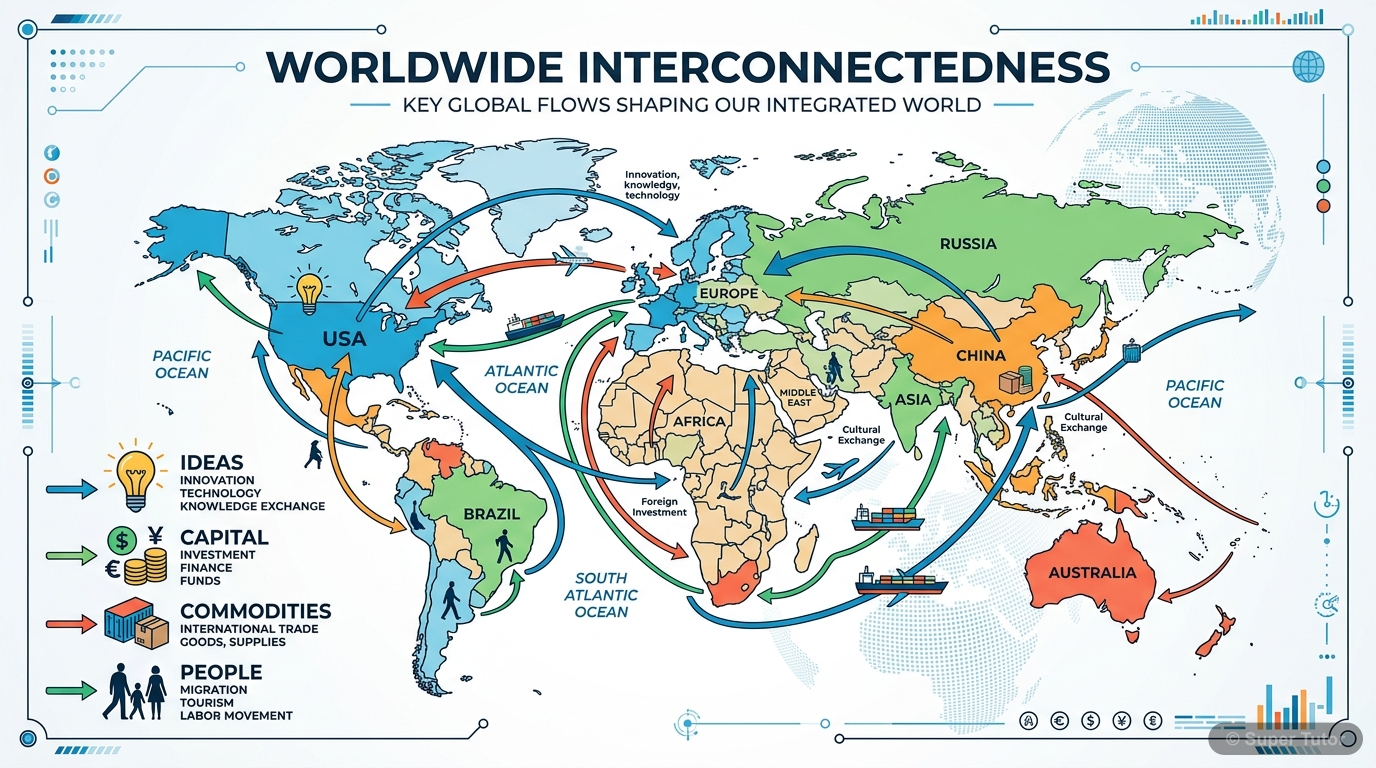
Globalization
Assam Board · Class 12 · Political Science
NCERT Solutions for Globalization — Assam Board Class 12 Political Science.
Interactive on Super Tutor
Studying Globalization? Get the full interactive chapter.
Quizzes, flashcards, AI doubt-solver and a step-by-step study plan — built for ncert solutions and more.
1,000+ Class 12 students started this chapter today

Super Tutor has 13+ illustrations like this for Globalization alone — flashcards, concept maps, and step-by-step visuals.
See them allChapter: Globalisation — Exercise Questions
1Which of the statements are TRUE about globalisation?
a. Globalisation is purely an economic phenomenon.
b. Globalisation began in 1991.
c. Globalisation is the same thing as westernisation.
d. Globalisation is a multi-dimensional phenomenon.Show solution
Justification:
- Option (a) is FALSE: Globalisation is not purely an economic phenomenon. It has political, cultural, social, and technological dimensions as well.
- Option (b) is FALSE: Globalisation did not begin in 1991. Although India's economic liberalisation began in 1991, globalisation as a process has much older roots — the movement of people, goods, and ideas across the world has been happening for centuries.
- Option (c) is FALSE: Globalisation is not the same as westernisation. While western ideas and culture do spread through globalisation, the process also involves the spread of ideas, goods, and cultures from non-western parts of the world.
- Option (d) is TRUE: Globalisation is indeed a multi-dimensional phenomenon encompassing economic, political, cultural, and social dimensions simultaneously.
2Which of the statements are TRUE about the impact of globalisation?
a. Globalisation has been uneven in its impact on states and societies.
b. Globalisation has had a uniform impact on all states and societies.
c. The impact of globalisation has been confined to the political sphere.
d. Globalisation inevitably results in cultural homogeneity.Show solution
Justification:
- Option (a) is TRUE: The impact of globalisation has not been uniform. Developed countries have generally benefited more, while developing and least-developed countries have often faced challenges such as economic marginalisation, job losses, and cultural disruption. Even within countries, the benefits and costs are unevenly distributed.
- Option (b) is FALSE: The impact has been uneven, not uniform, across states and societies.
- Option (c) is FALSE: The impact of globalisation extends far beyond the political sphere — it affects economics, culture, society, environment, and technology.
- Option (d) is FALSE: Globalisation does not inevitably result in cultural homogeneity. It can also lead to cultural heterogeneity, as local cultures interact with global influences and produce new, hybrid cultural forms.
3Which of the statements are TRUE about the causes of globalisation?
a. Technology is an important cause of globalisation.
b. Globalisation is caused by a particular community of people.
c. Globalisation originated in the US.
d. Economic interdependence alone causes globalisation.Show solution
Justification:
- Option (a) is TRUE: Technology — particularly advances in communication (internet, satellite), transportation, and information technology — has been a major driver of globalisation. It has made the movement of ideas, capital, goods, and people faster and cheaper.
- Option (b) is FALSE: Globalisation is not caused by any particular community of people. It is a complex process driven by multiple factors including technology, trade, capital flows, and political decisions.
- Option (c) is FALSE: Globalisation did not originate in the US. It is a worldwide process with roots going back centuries, involving multiple civilisations and regions.
- Option (d) is FALSE: Economic interdependence is one cause of globalisation, but not the only one. Technology, political decisions, cultural exchanges, and migration also contribute to globalisation.
4Which of the statements are TRUE about globalisation?
a. Globalisation is only about movement of commodities.
b. Globalisation does not involve a conflict of values.
c. Services are an insignificant part of globalisation.
d. Globalisation is about worldwide interconnectedness.Show solution
Justification:
- Option (a) is FALSE: Globalisation involves not just the movement of commodities but also the movement of capital, people, ideas, technology, and cultural practices across national boundaries.
- Option (b) is FALSE: Globalisation does involve a conflict of values. For example, there are tensions between global free-market values and local cultural or social values, and between advocates and critics of neo-liberal globalisation.
- Option (c) is FALSE: Services (such as IT, banking, finance, healthcare, education) are a very significant and growing part of globalisation, especially for countries like India.
- Option (d) is TRUE: At its core, globalisation refers to the increasing worldwide interconnectedness of societies, economies, cultures, and political systems across the globe.
5Which of the statements are FALSE about globalisation?
a. Advocates of globalisation argue that it will result in greater economic growth.
b. Critics of globalisation argue that it will result in greater economic disparity.
c. Advocates of globalisation argue that it will result in cultural homogenisation.
d. Critics of globalisation argue that it will result in cultural homogenisation.Show solution
Justification:
- Option (a) is TRUE: Advocates of globalisation do argue that free trade, foreign investment, and open markets will lead to greater economic growth and prosperity for all.
- Option (b) is TRUE: Critics of globalisation do argue that its benefits are unevenly distributed and that it increases economic disparity between rich and poor nations, and within nations.
- Option (c) is FALSE (the answer to the question): It is the critics of globalisation — not its advocates — who argue that it leads to cultural homogenisation (i.e., the dominance of western, particularly American, culture over local cultures). Advocates generally do not highlight this as a positive outcome.
- Option (d) is TRUE: Critics do argue that globalisation results in cultural homogenisation, where local and diverse cultures are replaced by a uniform global (often western) culture, leading to loss of cultural identity and heritage.
Therefore, statement (c) is FALSE because it incorrectly attributes the argument about cultural homogenisation to advocates rather than critics of globalisation.
6What is worldwide interconnectedness? What are its components?Show solution
Worldwide interconnectedness is the central idea behind globalisation. It refers to the growing links and interdependencies among countries, societies, and peoples across the globe.
Definition:
Worldwide interconnectedness means that events, decisions, and activities in one part of the world have significant consequences for people and communities in distant parts of the world. It implies that the world is increasingly becoming a single, integrated space where boundaries between nations are becoming less significant.
Components of Worldwide Interconnectedness:
(i) Economic Interconnectedness:
This involves the flow of goods, services, capital, and investment across national borders. Trade liberalisation, multinational corporations, and global financial markets are key aspects. For example, a financial crisis in one country (like the 2008 US financial crisis) quickly affects economies worldwide.
(ii) Political Interconnectedness:
This involves the growing role of international organisations (like the UN, WTO, IMF), international treaties, and global governance mechanisms. Political decisions in powerful states affect weaker states. Issues like terrorism, climate change, and nuclear proliferation require collective political responses.
(iii) Cultural Interconnectedness:
This involves the spread of ideas, values, lifestyles, music, food, fashion, and media across the world. The global spread of Hollywood films, fast food chains, and social media platforms are examples. This can lead to both cultural homogenisation and cultural heterogeneity.
(iv) Technological Interconnectedness:
Advances in communication technology (internet, mobile phones, satellites) and transportation have dramatically reduced the barriers of time and space, enabling rapid exchange of information and movement of people and goods.
(v) Social Interconnectedness:
This involves the movement of people (migration, tourism), the spread of social movements, and the sharing of knowledge and ideas across borders.
Conclusion:
Worldwide interconnectedness is thus a multi-dimensional concept that encompasses economic, political, cultural, technological, and social linkages among nations and peoples, making the world increasingly interdependent.
7How has technology contributed to globalisation?Show solution
Technology is one of the most important driving forces behind globalisation. Advances in technology have dramatically reduced the costs and barriers associated with the movement of goods, services, capital, people, and ideas across national boundaries.
Ways in which Technology has contributed to Globalisation:
(i) Revolution in Communication Technology:
The development of the internet, email, mobile phones, and satellite communication has made it possible to communicate instantly across the globe at very low cost. This has enabled businesses, governments, and individuals to coordinate activities across vast distances. Social media platforms connect people worldwide in real time.
(ii) Advances in Transportation:
Improvements in air travel, containerisation of shipping, and faster modes of transport have made it cheaper and quicker to move goods and people across the world. This has boosted international trade and tourism enormously.
(iii) Information Technology (IT) Revolution:
The IT revolution has enabled the outsourcing of services across borders. For example, India's IT and Business Process Outsourcing (BPO) industry serves clients in the US, UK, and other countries, which would not have been possible without advances in computing and internet technology.
(iv) Financial Technology:
Electronic banking, online trading platforms, and digital payment systems have enabled the rapid movement of capital across borders, integrating global financial markets.
(v) Media and Entertainment Technology:
Satellite television, streaming services (like Netflix), and digital media have enabled the global spread of cultural products — films, music, news — contributing to cultural globalisation.
(vi) Reduction of Time and Space:
Overall, technology has effectively 'shrunk' the world by reducing the time and cost required to move goods, services, capital, and information. This has made global economic and cultural integration far more feasible.
Conclusion:
In sum, technology — particularly in communication, transportation, and information processing — has been the key enabler of globalisation. Without technological advances, the pace and scale of globalisation would have been far more limited.
8Critically evaluate the impact of the changing role of the state in the developing countries in the light of globalisation.Show solution
Globalisation has significantly altered the role of the state, particularly in developing countries. While the traditional state was expected to be the primary provider of welfare, security, and economic management, globalisation has both constrained and transformed these functions.
Changing Role of the State — Key Dimensions:
(i) Retreat of the Welfare State:
Under the influence of neo-liberal globalisation, developing countries have been pressured (often by international institutions like the IMF and World Bank) to reduce public expenditure on social services such as health, education, and subsidies. This has weakened the welfare state and adversely affected the poor and marginalised sections of society.
(ii) Reduced Economic Sovereignty:
Globalisation has reduced the ability of developing country governments to independently formulate economic policies. They are increasingly bound by WTO rules, bilateral trade agreements, and conditions attached to loans from international financial institutions. This limits their policy space to protect domestic industries or support local farmers.
(iii) Increased Role of Non-State Actors:
Multinational corporations (MNCs), international NGOs, and global financial institutions have gained significant influence over economic and social policies in developing countries, sometimes at the expense of elected governments.
(iv) Positive Aspects — Access to Technology and Capital:
On the positive side, globalisation has enabled developing countries to attract foreign direct investment (FDI), access advanced technology, and integrate into global supply chains, which can accelerate economic growth and development.
(v) Strengthening of Some State Functions:
While some state functions have weakened, others have been strengthened. States still play a crucial role in maintaining law and order, providing infrastructure, regulating markets, and negotiating in international forums to protect national interests.
(vi) Uneven Impact:
The impact has been uneven. Some developing countries (like China, India, Brazil) have managed to use globalisation to their advantage and achieve significant economic growth. Others, particularly the least developed countries, have been marginalised.
Critical Evaluation:
- Critics argue that globalisation has eroded state sovereignty, increased inequality, and forced developing countries to adopt policies that serve the interests of developed nations and MNCs rather than their own citizens.
- Supporters argue that globalisation has brought economic growth, technology transfer, and integration into the global economy, which can ultimately benefit developing countries if managed well.
Conclusion:
The impact of globalisation on the role of the state in developing countries is complex and contradictory. While it has constrained state autonomy in some areas, it has also created new opportunities. The key challenge for developing countries is to manage globalisation in a way that maximises its benefits while minimising its costs, particularly for the most vulnerable sections of society.
9What are the economic implications of globalisation? How has globalisation impacted on India with regard to this particular dimension?Show solution
The economic dimension is the most prominent aspect of globalisation. It involves the integration of national economies into a single global economy through trade, investment, capital flows, and the movement of labour.
Economic Implications of Globalisation:
(i) Free Trade and Removal of Barriers:
Globalisation promotes free trade by reducing tariffs, quotas, and other trade barriers. This increases competition and can lead to greater efficiency and lower prices for consumers.
(ii) Flow of Foreign Direct Investment (FDI):
Globalisation encourages MNCs to invest in countries with lower costs of production, bringing capital, technology, and employment to host countries.
(iii) Growth of Global Financial Markets:
Capital can now move rapidly across borders, enabling countries to access global savings and investment. However, this also makes economies vulnerable to financial crises originating elsewhere.
(iv) Outsourcing and Global Supply Chains:
Companies now source components and services from multiple countries, creating complex global supply chains. This has led to the growth of outsourcing, particularly of services.
(v) Increased Economic Inequality:
Critics argue that globalisation has increased inequality — both between developed and developing countries, and within countries — as the benefits are unevenly distributed.
(vi) Threat to Domestic Industries:
Opening up of markets can threaten domestic industries that cannot compete with cheaper imports, leading to job losses.
Impact of Economic Globalisation on India:
(i) Economic Liberalisation (1991):
India embraced economic globalisation in 1991 by liberalising its economy — reducing import duties, welcoming FDI, and privatising public sector enterprises. This marked a significant shift from the earlier model of a state-controlled economy.
(ii) Growth of IT and Services Sector:
India has greatly benefited from globalisation through the growth of its IT and BPO industries. Cities like Bengaluru, Hyderabad, and Pune have become global IT hubs, generating employment and foreign exchange earnings.
(iii) Increased GDP Growth:
Economic liberalisation and integration with the global economy contributed to higher GDP growth rates in India during the 1990s and 2000s.
(iv) Adverse Impact on Agriculture:
Indian farmers have faced challenges due to the entry of subsidised agricultural products from developed countries, making it difficult for them to compete. The entry of MNCs in agriculture and the patenting of plant varieties (like Neem) have also raised concerns.
(v) Impact on Small Industries:
Small and medium enterprises have faced increased competition from cheaper imported goods, leading to job losses in some sectors.
(vi) Growing Inequality:
While globalisation has created a prosperous middle class in India, it has also widened the gap between the rich and the poor, and between urban and rural areas.
Conclusion:
The economic impact of globalisation on India has been mixed. While it has accelerated growth, created jobs in certain sectors, and integrated India into the global economy, it has also created new challenges for farmers, small industries, and the poor. India needs to manage globalisation strategically to ensure that its benefits are more equitably distributed.
10Do you agree with the argument that globalisation leads to cultural heterogeneity?Show solution
One of the most debated aspects of globalisation is its cultural impact. There are two opposing views: one argues that globalisation leads to cultural homogeneity (uniformity), while the other argues it leads to cultural heterogeneity (diversity). The question asks us to evaluate the argument in favour of cultural heterogeneity.
Arguments in Favour of Cultural Heterogeneity (Agreement):
(i) Cultural Exchange and Hybridisation:
Globalisation does not simply replace local cultures with a single global culture. Instead, it often leads to the mixing and blending of cultures, creating new hybrid cultural forms. For example, Indian music has incorporated western instruments and styles while retaining its classical roots, creating new genres.
(ii) Strengthening of Local Identities:
In many cases, exposure to global cultures has actually strengthened local cultural identities. People become more conscious of their own cultural heritage and work to preserve it in the face of external influences. The revival of folk arts, regional languages, and traditional crafts in many countries is an example.
(iii) Global Spread of Non-Western Cultures:
Globalisation is not a one-way street. Non-western cultures also spread globally. Indian yoga, cuisine, Bollywood films, and classical music have gained worldwide popularity. Similarly, Japanese anime, Korean pop (K-pop), and Latin American music have global audiences.
(iv) Resistance to Cultural Homogenisation:
Many communities actively resist cultural homogenisation and assert their distinct identities. This resistance itself contributes to cultural diversity.
Arguments Against (Cultural Homogeneity View):
(i) Dominance of Western Culture:
Critics argue that globalisation primarily spreads western (especially American) culture — through Hollywood films, fast food chains (McDonald's, KFC), western fashion, and English as a global language — at the expense of local cultures.
(ii) Threat to Local Languages and Traditions:
Many local languages, traditions, and art forms are under threat as younger generations adopt global cultural practices.
Balanced Conclusion:
While there is truth in both arguments, the evidence suggests that globalisation leads to both homogeneity and heterogeneity simultaneously. It creates a complex cultural landscape where global influences interact with local cultures to produce new, diverse cultural forms. Therefore, one can largely agree that globalisation leads to cultural heterogeneity, because local cultures do not simply disappear — they adapt, resist, and create new hybrid identities. However, the threat of cultural homogenisation, particularly the dominance of western culture, cannot be entirely dismissed and must be guarded against through conscious cultural policies.
11How has globalisation impacted on India and how is India in turn impacting on globalisation?Show solution
India's relationship with globalisation is a two-way process. On one hand, globalisation has profoundly transformed India across economic, political, cultural, and social dimensions. On the other hand, India — as one of the world's largest and fastest-growing economies — is increasingly shaping the process of globalisation itself.
Part A: How Globalisation has Impacted India
(i) Economic Impact:
- India's economic liberalisation in 1991 opened the economy to foreign investment, trade, and competition.
- The IT and BPO sectors have grown enormously, making India a global hub for software services and back-office operations.
- GDP growth accelerated, and a large middle class emerged with increased purchasing power.
- However, agriculture has been adversely affected by competition from subsidised imports, and small industries have faced challenges.
- Economic inequality has increased, with benefits of globalisation not reaching all sections of society equally.
(ii) Political Impact:
- India has had to align its policies with international norms and agreements (WTO, climate agreements, etc.), sometimes limiting its policy autonomy.
- India has become more active in international forums and global governance.
- Issues like terrorism, climate change, and nuclear non-proliferation have required India to engage more deeply with the international community.
(iii) Cultural Impact:
- Western cultural influences — in food, fashion, music, films, and lifestyle — have become widespread, especially among urban youth.
- At the same time, Indian culture (Bollywood, yoga, cuisine, classical arts) has gained global recognition.
- There has been resistance from sections of Indian society to perceived westernisation of culture.
(iv) Social Impact:
- Globalisation has created new opportunities for education and employment, particularly for the educated middle class.
- However, it has also led to concerns about the erosion of traditional social values and increased consumerism.
Part B: How India is Impacting on Globalisation
(i) Economic Contribution:
- India is one of the world's largest economies and a major destination for foreign investment. Its large consumer market is increasingly shaping global business strategies.
- India's IT and pharmaceutical industries have made it a key player in global supply chains.
(ii) Diaspora and Cultural Influence:
- The large Indian diaspora across the world — in the US, UK, Canada, Australia, and the Gulf — acts as a bridge between India and the global economy, contributing to trade, investment, and cultural exchange.
- Indian culture — Bollywood, yoga, Indian cuisine, and classical arts — has a significant global presence and is shaping global cultural trends.
(iii) Political Influence:
- India is increasingly asserting itself in international forums (G20, BRICS, UN, WTO) and advocating for the interests of developing countries in global trade and governance negotiations.
- India's stance on issues like climate change, trade rules, and intellectual property rights influences global policy debates.
(iv) Resistance and Reform:
- India's resistance to certain aspects of globalisation (such as demanding fairer trade rules for developing countries, opposing the patenting of traditional knowledge) has contributed to reforming the global economic system.
Conclusion:
Globalisation has transformed India in profound ways — economically, politically, culturally, and socially — with both positive and negative consequences. At the same time, India is no longer merely a passive recipient of globalisation; it is an active participant and shaper of the globalisation process, contributing to it through its economy, culture, diaspora, and political engagement on the world stage.
Stuck on a step?
Ask Super Tutor AI to explain any solution on this page in a simpler way — free, 24x7.
Ask a Doubt FreeFrequently Asked Questions
What are the important topics in Globalization for Assam Board Class 12 Political Science?
How to score full marks in Globalization — Assam Board Class 12 Political Science?
Where can I get free NCERT Solutions for Globalization Class 12 Political Science?
Sources & Official References
Content is aligned to the official syllabus. Refer to the board website for the latest curriculum.
More resources for Globalization
Important Questions
Practice with board exam-style questions
Syllabus
What topics to cover
Revision Notes
Key points for last-minute revision
Study Plan
Step-by-step plan to ace this chapter
Flashcards
Quick-fire cards for active recall
Formula Sheet
All formulas in one place
Chapter Summary
Understand the chapter at a glance
Practice Quiz
Test yourself with a quick quiz
Concept Maps
See how topics connect visually
For serious students
Get the full Globalization chapter — for free.
Quizzes, flashcards, AI doubt-solver and a step-by-step study plan for Assam Board Class 12 Political Science.