Recent developments in Indian politics — NCERT Solutions
Assam Board · Class 12 · Political Science
NCERT Solutions for Recent developments in Indian politics, Assam Board Class 12 Political Science: 10 textbook questions solved step by step.
Interactive on Super Tutor
Studying Recent developments in Indian politics? Get the full interactive chapter.
Quizzes, flashcards, AI doubt-solver and a step-by-step study plan — built for NCERT solutions and more.
Free trial, no card needed.
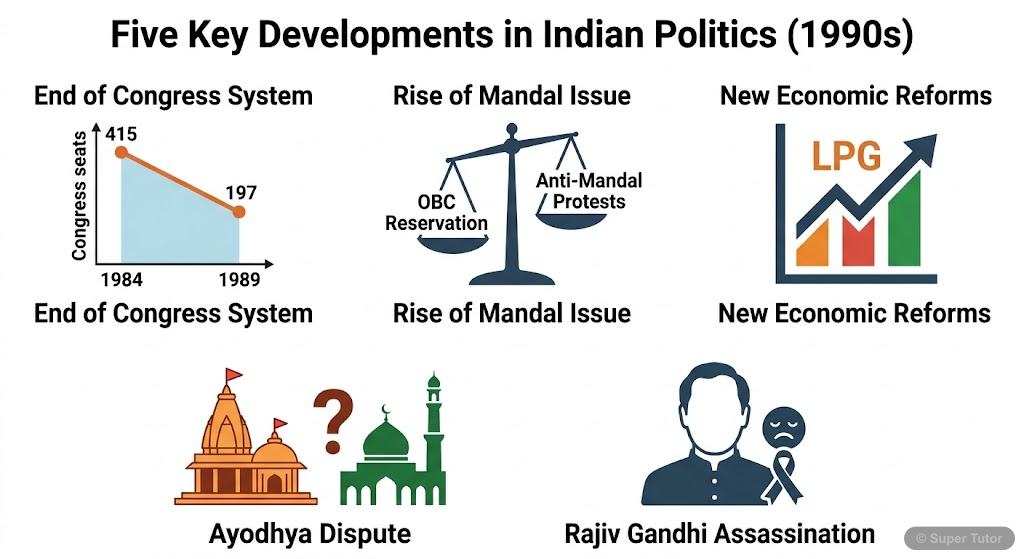
One of 16 illustrations for Recent developments in Indian politics in Super Tutor — alongside flashcards, concept maps and practice questions.
The first 5 solutions are open to read. The other 5 are free with a Super Tutor account.
EXERCISES — Recent Developments in Indian Politics (Class 12 Political Science)
1Unscramble a bunch of disarranged press clipping file of Unni-Munni... and arrange the file chronologically.
(a) Implementation of the recommendation of the Mandal Commission
(b) Formation of the Janata Dal
(c) Supreme Court Judgment on the Ram Janmabhoomi
(d) Assassination of Indira Gandhi
(e) The formation of NDA government
(f) Formation of the UPA governmentShow solution
Given: A set of political events that need to be arranged in chronological order.
Concept: Knowledge of the timeline of major political events in post-Emergency India.
Chronological Arrangement:
- (d) Assassination of Indira Gandhi — 1984: Prime Minister Indira Gandhi was assassinated by her bodyguards on 31 October 1984.
- (b) Formation of the Janata Dal — 1988: The Janata Dal was formed by V.P. Singh by merging several opposition groups before the 1989 general elections.
- (a) Implementation of the recommendation of the Mandal Commission — 1990: V.P. Singh's government announced the implementation of the Mandal Commission recommendations, reserving 27% government jobs for OBCs.
- (c) Supreme Court Judgment on the Ram Janmabhoomi — 1992 (Babri Masjid demolition) / related Supreme Court proceedings; the landmark SC judgment on the Ram Janmabhoomi–Babri Masjid dispute came in 2019, but the major political event (demolition) was 1992. In the context of this chapter, the Ram Janmabhoomi movement peaked around 1992.
- (e) The formation of NDA government — 1998/1999: The National Democratic Alliance (NDA) led by BJP came to power; a stable NDA government was formed in 1999 under Atal Bihari Vajpayee.
- (f) Formation of the UPA government — 2004: The United Progressive Alliance (UPA) led by the Indian National Congress came to power after the 14th Lok Sabha elections.
Final Chronological Order: (d) → (b) → (a) → (c) → (e) → (f)
2Match the following.
(a) Politics of Consensus
(b) Caste based parties
(c) Personal Law and Gender Justice
(d) Growing strength of Regional parties
i. Shah Bano case
ii. Rise of OBCs
iii. Coalition government
iv. Agreement on Economic policiesShow solution
Given: Two columns of political concepts and their related phenomena.
Concept: Understanding of post-1989 political developments in India.
Matching:
| Column A | Column B |
|---|---|
| (a) Politics of Consensus | (iv) Agreement on Economic policies |
| (b) Caste based parties | (ii) Rise of OBCs |
| (c) Personal Law and Gender Justice | (i) Shah Bano case |
| (d) Growing strength of Regional parties | (iii) Coalition government |
Explanation:
- (a) – (iv): In the era of coalition politics, parties with different ideologies had to arrive at a consensus, especially on economic policies (e.g., economic liberalisation was broadly accepted).
- (b) – (ii): The implementation of the Mandal Commission report led to the political mobilisation of OBCs, giving rise to caste-based parties like SP, BSP, RJD.
- (c) – (i): The Shah Bano case (1985) raised the debate between personal law (Muslim Personal Law) and gender justice, as the Supreme Court awarded maintenance to Shah Bano but Parliament reversed it.
- (d) – (iii): The growing strength of regional parties made it impossible for any single national party to form a majority government, leading to coalition governments.
3State the main issues in Indian politics in the period after 1989. What different configurations of political parties these differences lead to?Show solution
Given: The period of Indian politics after 1989.
Main Issues in Indian Politics after 1989:
1. Mandal Issue (OBC Reservations):
The V.P. Singh government's decision to implement the Mandal Commission recommendations (27% reservation for OBCs) in 1990 created a major social and political upheaval. It led to the political mobilisation of backward castes and the rise of parties like SP, BSP, and RJD.
2. Mandir Issue (Ram Janmabhoomi Movement):
The BJP's Ram Janmabhoomi movement and the demolition of the Babri Masjid in 1992 polarised Hindu and Muslim communities. This issue gave BJP a strong political base among Hindu voters.
3. Economic Liberalisation (Market Issue):
The 1991 economic crisis led to the adoption of LPG (Liberalisation, Privatisation, Globalisation) policies. While there was broad consensus on economic reforms, debates arose about their social impact.
4. Coalition Politics:
No single party could win a majority, leading to the era of coalition governments. This raised issues of political stability and governance.
5. Rise of Regional Parties:
Regional parties gained strength and became kingmakers in national politics.
6. Communalism and Secularism:
The rise of Hindutva politics and communal tensions became a major political issue.
Configurations of Political Parties:
| Configuration | Parties Involved | Period |
|---|---|---|
| National Front Government | Janata Dal + Left + outside support of BJP & Congress | 1989–1990 |
| United Front Government | Regional parties + Left, supported by Congress | 1996–1998 |
| NDA (National Democratic Alliance) | BJP + regional allies (Akali Dal, Shiv Sena, TDP, etc.) | 1998–2004 |
| UPA (United Progressive Alliance) | Congress + regional parties + Left support | 2004 onwards |
Conclusion: The post-1989 period saw the end of Congress dominance and the beginning of genuine multi-party coalition politics in India, shaped by caste, religion, regional identity, and economic issues.
4"In the new era of coalition politics, political parties are not aligning or re-aligning on the basis of ideology." What arguments would you put forward to support or oppose this statement?Show solution
Given Statement: In the era of coalition politics, parties align not on ideology but on other considerations.
This statement is largely TRUE. Arguments in SUPPORT:
1. Opportunistic Alliances:
Parties with opposing ideologies have come together for electoral gains. For example, the Samajwadi Party (socialist) and the BJP (right-wing Hindu nationalist) have at times supported each other despite ideological differences.
2. Regional Parties Have No Fixed Ideology:
Many regional parties like TDP, BJD, AIADMK, etc., have shifted alliances between NDA and UPA based on political convenience rather than ideology.
3. Power-Sharing as the Main Motive:
Smaller parties join coalitions primarily to gain ministerial positions and political power, not because of ideological agreement.
4. Consensus on Economic Policies:
Despite ideological differences, most parties — left, right, and centre — have broadly accepted economic liberalisation, showing that ideology is not the main dividing line.
5. Caste and Regional Identity Over Ideology:
Parties like BSP, SP, RJD are primarily based on caste identity rather than a clear ideological position.
Arguments to OPPOSE (Counter-arguments):
1. BJP's Consistent Hindutva Ideology:
The BJP has consistently maintained its Hindutva ideology and has not compromised on core issues like Article 370, Ram Mandir, and Uniform Civil Code.
2. Left Parties' Ideological Stand:
The Left parties (CPI, CPI-M) have consistently opposed economic liberalisation and have maintained their socialist ideology.
3. Congress's Secular Ideology:
The Congress has maintained its commitment to secularism and has generally avoided alliance with communal parties.
Conclusion: While ideology still plays some role, the dominant trend in coalition politics is pragmatic alliance-making based on electoral arithmetic, regional interests, and power-sharing rather than ideological compatibility. Hence, the statement is largely valid.
5Trace the emergence of BJP as a significant force in post-Emergency politics.Show solution
Given: The rise of BJP in Indian politics after the Emergency (post-1977).
Step-by-Step Emergence of BJP:
1. Origin from Jana Sangh (1977–1980):
The Bharatiya Jana Sangh, which was part of the Janata Party coalition that defeated Indira Gandhi in 1977, merged with other parties to form the Janata Party. When the Janata Party collapsed in 1979, the Jana Sangh members broke away and formed the Bharatiya Janata Party (BJP) in 1980 under the leadership of Atal Bihari Vajpayee.
2. Initial Phase — Moderate Ideology (1980–1984):
In its early years, BJP adopted a moderate approach called 'Gandhian Socialism.' However, it performed poorly in the 1984 elections, winning only 2 seats in the Lok Sabha — its worst-ever performance — largely due to the sympathy wave after Indira Gandhi's assassination.
3. Shift to Hindutva (1986 onwards):
After the poor 1984 performance, BJP under L.K. Advani shifted towards a more assertive Hindutva ideology. The Ram Janmabhoomi movement became the central plank of BJP's politics.
4. Ram Rath Yatra (1990):
L.K. Advani's Ram Rath Yatra from Somnath to Ayodhya in 1990 mobilised Hindu voters across the country and dramatically increased BJP's political support. BJP's seat count rose from 2 (1984) to 85 seats (1989) and then to 120 seats (1991).
5. Babri Masjid Demolition (1992):
The demolition of the Babri Masjid on 6 December 1992 was a turning point. Though it led to communal riots and BJP governments being dismissed, it consolidated BJP's Hindu vote bank.
6. Rise to Power (1996–1999):
- In 1996, BJP emerged as the single largest party with 161 seats but could not form a stable government (lasted only 13 days).
- In 1998, BJP formed a coalition government (NDA) under Vajpayee, which lasted about a year.
- In 1999, NDA won a decisive majority and Vajpayee served a full five-year term (1999–2004).
7. Key Factors in BJP's Rise:
- Hindutva ideology and Ram Janmabhoomi movement
- Decline of Congress and anti-incumbency
- Skilled leadership of Vajpayee and Advani
- Successful coalition-building under NDA
- Support from RSS and affiliated organisations (Sangh Parivar)
Conclusion: BJP's rise from 2 seats in 1984 to forming a stable government in 1999 is one of the most remarkable political transformations in Indian political history, driven by ideological mobilisation, skilled leadership, and effective coalition politics.
Free with a Super Tutor account
Free with a Super Tutor account
Free with a Super Tutor account
Free with a Super Tutor account
Free with a Super Tutor account
5 more solved questions in Recent developments in Indian politics
They are free with a Super Tutor account, along with practice quizzes and flashcards for this chapter. Free to start, no card needed.
Frequently Asked Questions
What are the important topics in Recent developments in Indian politics for Assam Board Class 12 Political Science?
Are these NCERT Solutions for Recent developments in Indian politics free?
How should I revise Recent developments in Indian politics for the Assam Board Class 12 board exam?
Sources & Official References
Content is aligned to the official syllabus. Refer to the board website for the latest curriculum.
More resources for Recent developments in Indian politics
Practice Quiz
Test yourself with a quick quiz
Important Questions
Exam-style questions with answers
Revision Notes
Key points for last-minute revision
Chapter Summary
Understand the chapter at a glance
Concept Maps
See how topics connect
Study Plan
Step-by-step plan for this chapter
Flashcards
Quick-fire cards for active recall
Syllabus
What topics to cover
For serious students
Get the full Recent developments in Indian politics chapter — start free.
Quizzes, flashcards, an AI doubt solver and a study plan for Assam Board Class 12 Political Science. Free to start, no card needed.