The Human Eye and the Colourful World — Study Plan
CBSE · Class 10 · Science
A step-by-step study plan for The Human Eye and the Colourful World, CBSE Class 10 Science: what to learn first, what to practise and when to revise.
Interactive on Super Tutor
Studying The Human Eye and the Colourful World? Get the full interactive chapter.
Quizzes, flashcards, AI doubt-solver and a step-by-step study plan — built for study plan and more.
Free trial, no card needed.
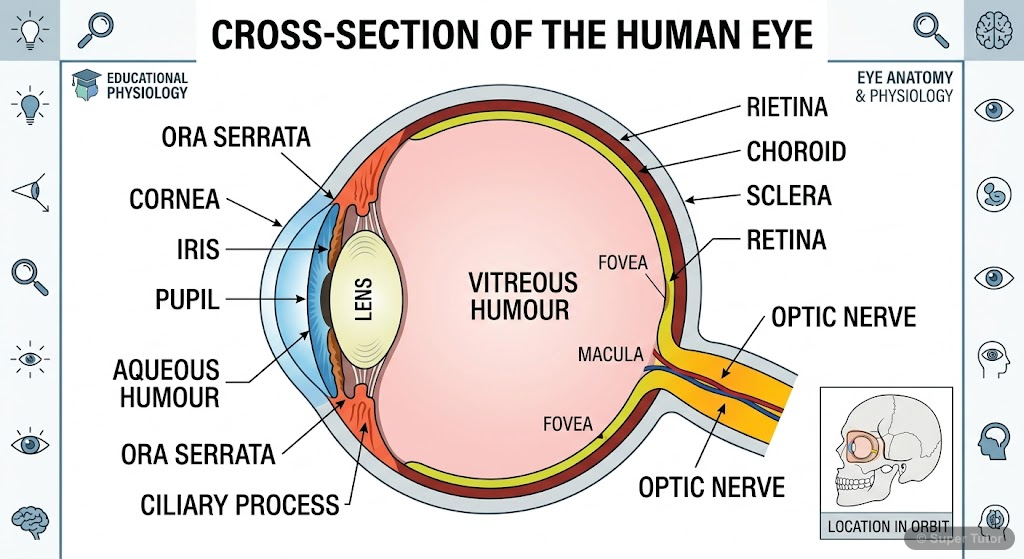
One of 14 illustrations for The Human Eye and the Colourful World in Super Tutor — alongside flashcards, concept maps and practice questions.
Study Plan
Learn the Theory
Read the textbook chapter carefully. Note down definitions, formulas and key ideas. Focus on: 1. Structure and Working of the Human Eye, 2. Power of Accommodation and Vision Limits, 3. Defects of Vision and Their Correction.
Practise
Solve the textbook exercises and extra practice questions. There are 56 questions available for this chapter.
Revise & Test
Revise key points without looking at your notes. Take a practice quiz and mark weak areas for another pass.
Spaced Revision
Come back to The Human Eye and the Colourful World after a week. Use flashcards for quick recall and try past exam questions on this chapter.
What to Focus On
- The eye is approximately spherical with a diameter of about 2.3 cm.
- Cornea is the front transparent bulge through which light enters the eye.
- Most refraction in the eye occurs at the outer surface of the cornea.
- Myopia means near-sightedness.
- In myopia, distant objects appear blurred and the image forms in front of the retina.
- Myopia may be caused by excessive curvature of the eye lens or elongation of the eyeball.
- The angle between the two lateral faces of a prism is the angle of the prism.
- At the first surface, light bends towards the normal.
- At the second surface, light bends away from the normal.
Common Mistakes to Avoid
The cornea only lets light enter the eye; most refraction happens in the eye lens.
The pupil controls the amount of light entering the eye by itself.
The retina is the lens at the back of the eye that bends light to form the image.
Memory Tips
Parts of the human eye
Sequence of VIBGYOR
Accommodation of the eye lens
Cornea and major refraction
Want a personalised study plan?
Super Tutor builds a day-by-day plan for CBSE Class 10 Science that fits your exam date and pace.
Create My Study PlanFrequently Asked Questions
What are the important topics in The Human Eye and the Colourful World for CBSE Class 10 Science?
How should I revise The Human Eye and the Colourful World for the CBSE Class 10 board exam?
Sources & Official References
- NCERT Official — ncert.nic.in
- CBSE Academic — cbseacademic.nic.in
- CBSE Official — cbse.gov.in
- National Education Policy 2020 — education.gov.in
Content is aligned to the official syllabus. Refer to the board website for the latest curriculum.
More resources for The Human Eye and the Colourful World
Practice Quiz
Test yourself with a quick quiz
Important Questions
Exam-style questions with answers
Revision Notes
Key points for last-minute revision
Chapter Summary
Understand the chapter at a glance
Concept Maps
See how topics connect
Flashcards
Quick-fire cards for active recall
Syllabus
What topics to cover
NCERT Solutions
Every textbook question solved step by step
For serious students
Get the full The Human Eye and the Colourful World chapter — start free.
Quizzes, flashcards, an AI doubt solver and a study plan for CBSE Class 10 Science. Free to start, no card needed.