The Human Eye and the Colourful World — NCERT Solutions
CBSE · Class 10 · Science
NCERT Solutions for The Human Eye and the Colourful World, CBSE Class 10 Science: 12 textbook questions solved step by step. Covers Exercises.
Interactive on Super Tutor
Studying The Human Eye and the Colourful World? Get the full interactive chapter.
Quizzes, flashcards, AI doubt-solver and a step-by-step study plan — built for NCERT solutions and more.
Free trial, no card needed.
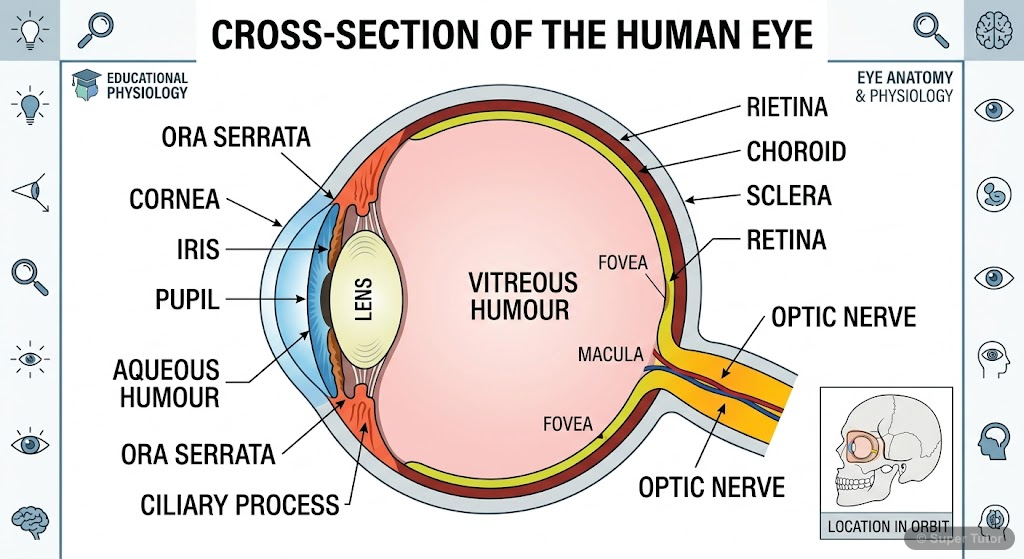
One of 14 illustrations for The Human Eye and the Colourful World in Super Tutor — alongside flashcards, concept maps and practice questions.
The first 6 solutions are open to read. The other 6 are free with a Super Tutor account.
Exercises
1The human eye can focus on objects at different distances by adjusting the focal length of the eye lens. This is due to (a) presbyopia. (b) accommodation. (c) near-sightedness. (d) far-sightedness.Show solution
Correct option: (b) accommodation.
The ability of the eye to adjust its focal length (by changing the curvature of the eye lens through ciliary muscles) to focus on objects at different distances is called accommodation. Presbyopia is the loss of this ability in old age; near-sightedness and far-sightedness are refractive defects, not the focusing mechanism itself.
2The human eye forms the image of an object at its (a) cornea. (b) iris. (c) pupil. (d) retina.Show solution
Correct option: (d) retina.
The eye lens forms a real, inverted image of the object on the retina, which is the light-sensitive screen at the back of the eye. The retina contains photoreceptor cells (rods and cones) that convert the light signal into electrical signals sent to the brain via the optic nerve.
3The least distance of distinct vision for a young adult with normal vision is about (a) 25 m. (b) 2.5 cm. (c) 25 cm. (d) 2.5 m.Show solution
Correct option: (c) 25 cm.
The least distance of distinct vision (also called the near point) is the minimum distance at which the eye can see an object clearly without strain. For a young adult with normal vision, this distance is approximately 25 cm.
4The change in focal length of an eye lens is caused by the action of the (a) pupil. (b) retina. (c) ciliary muscles. (d) iris.Show solution
Correct option: (c) ciliary muscles.
The ciliary muscles hold the eye lens in position and can contract or relax to change the curvature (and hence the focal length) of the eye lens. When ciliary muscles contract, the lens becomes thicker (shorter focal length) for near objects; when they relax, the lens becomes thinner (longer focal length) for distant objects.
5A person needs a lens of power –5.5 dioptres for correcting his distant vision. For correcting his near vision he needs a lens of power +1.5 dioptre. What is the focal length of the lens required for correcting (i) distant vision, and (ii) near vision?Show solution
Given:
- Power of lens for distant vision, D
- Power of lens for near vision, D
Formula used:
(i) Focal length for correcting distant vision:
The negative sign indicates it is a concave (diverging) lens.
(ii) Focal length for correcting near vision:
The positive sign indicates it is a convex (converging) lens.
Answers:
- Focal length for distant vision correction = –18.2 cm (concave lens)
- Focal length for near vision correction = +66.7 cm (convex lens)
6The far point of a myopic person is 80 cm in front of the eye. What is the nature and power of the lens required to correct the problem?Show solution
Given:
- Far point of the myopic person = 80 cm = 0.80 m (in front of the eye)
- A myopic person cannot see objects beyond 80 cm clearly.
Concept:
To correct myopia, we need a lens that forms the image of a distant object (at infinity) at the person's far point (80 cm in front of the eye).
So, object distance and image distance cm m (image is on the same side as the object, hence negative by sign convention).
Using the lens formula:
Power of the lens:
Conclusion: The person requires a concave (diverging) lens of power –1.25 dioptres to correct myopia.
Free with a Super Tutor account
Free with a Super Tutor account
Free with a Super Tutor account
Free with a Super Tutor account
Free with a Super Tutor account
Free with a Super Tutor account
6 more solved questions in The Human Eye and the Colourful World
They are free with a Super Tutor account, along with practice quizzes and flashcards for this chapter. Free to start, no card needed.
Frequently Asked Questions
What are the important topics in The Human Eye and the Colourful World for CBSE Class 10 Science?
Are these NCERT Solutions for The Human Eye and the Colourful World free?
How should I revise The Human Eye and the Colourful World for the CBSE Class 10 board exam?
Sources & Official References
- NCERT Official — ncert.nic.in
- CBSE Academic — cbseacademic.nic.in
- CBSE Official — cbse.gov.in
- National Education Policy 2020 — education.gov.in
Content is aligned to the official syllabus. Refer to the board website for the latest curriculum.
More resources for The Human Eye and the Colourful World
Practice Quiz
Test yourself with a quick quiz
Important Questions
Exam-style questions with answers
Revision Notes
Key points for last-minute revision
Chapter Summary
Understand the chapter at a glance
Concept Maps
See how topics connect
Study Plan
Step-by-step plan for this chapter
Flashcards
Quick-fire cards for active recall
Syllabus
What topics to cover
For serious students
Get the full The Human Eye and the Colourful World chapter — start free.
Quizzes, flashcards, an AI doubt solver and a study plan for CBSE Class 10 Science. Free to start, no card needed.