Organizing
CBSE · Class 12 · Business Studies
Complete topic list for Organizing in CBSE Class 12 Business Studies. Key concepts, sub-topics, and what to focus on for board exams.
Interactive on Super Tutor
Studying Organizing? Get the full interactive chapter.
Quizzes, flashcards, AI doubt-solver and a step-by-step study plan — built for syllabus and more.
1,000+ Class 12 students started this chapter today
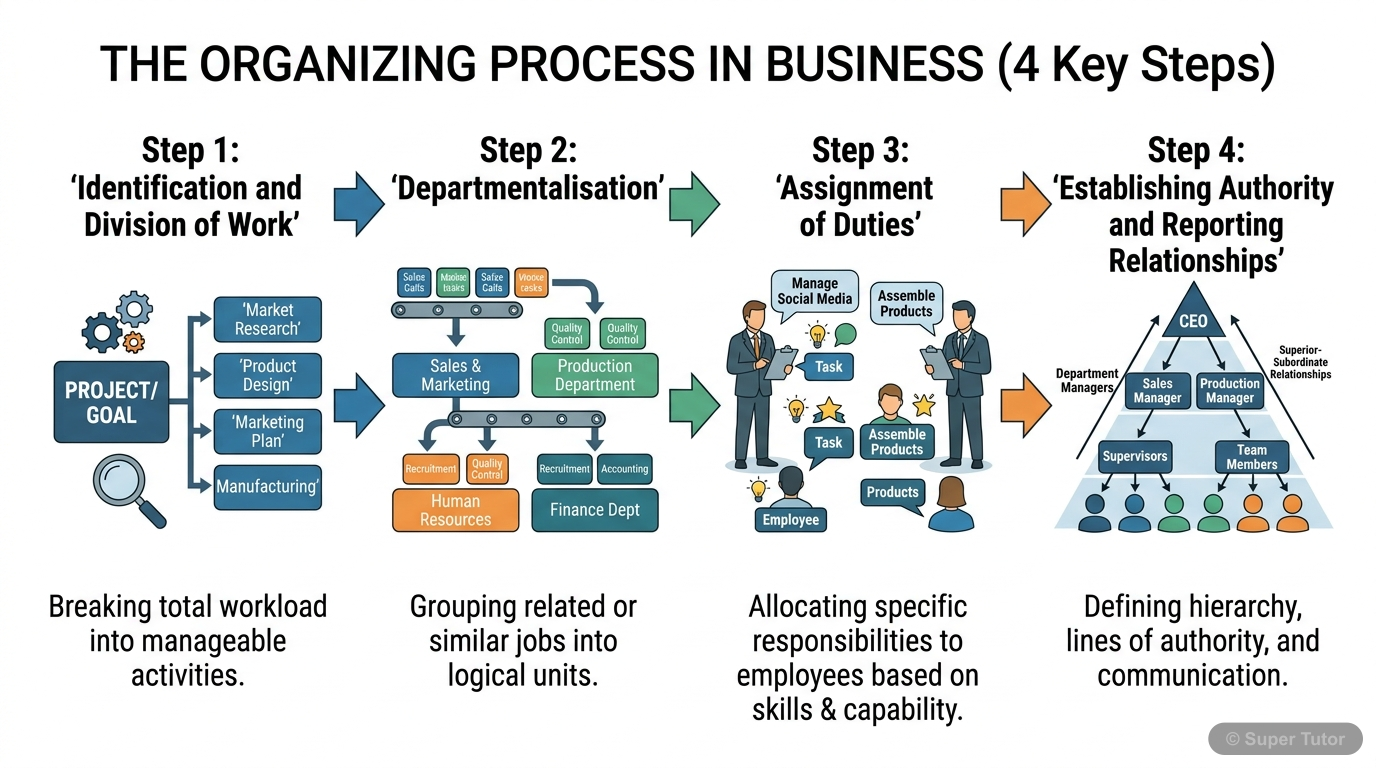
Learn better with visuals Super Tutor has hundreds of illustrations like this across every chapter — all free to try.
Get startedTopics in Organizing
1. Meaning and Process of Organizing
- Organizing is the process that initiates implementation of plans by clarifying jobs and working relationships and effectively deploying resources for attainment of identified and desired results.
- Organizing can also be understood as identifying and grouping work, defining responsibility and authority, and establishing relationships so that people work effectively together.
- The first step in organizing is identification and division of work.
2. Importance of Organizing and Organization Structure
- Organizing is essential for successful implementation of plans.
- It promotes specialisation because workers do similar tasks repeatedly.
- It creates clarity in working relationships by specifying reporting lines.
3. Types of Organization Structure
- The two main types of organization structure are functional structure and divisional structure.
- Functional structure is based on functions.
- Divisional structure is based on product lines and is supported by functions.
4. Formal and Informal Organization
- Formal organisation is deliberately designed by management to accomplish a task.
- It specifies authority, responsibility, and coordination clearly.
- Formal organisation places more emphasis on work than on interpersonal relationships.
Key Concepts
Central concept: Organising as the process of turning plans into action through division of work, departmentalisation, authority relationships, structure, delegation, and decentralisation
Frequently Asked Questions
What are the important topics in Organizing for CBSE Class 12 Business Studies?
How to score full marks in Organizing — CBSE Class 12 Business Studies?
Sources & Official References
- NCERT Official — ncert.nic.in
- CBSE Academic — cbseacademic.nic.in
- CBSE Official — cbse.gov.in
- National Education Policy 2020 — education.gov.in
Content is aligned to the official syllabus. Refer to the board website for the latest curriculum.
More resources for Organizing
Practice Quiz
Test yourself with a quick quiz
Important Questions
Practice with board exam-style questions
Revision Notes
Key points for last-minute revision
Formula Sheet
All formulas in one place
Chapter Summary
Understand the chapter at a glance
Concept Maps
See how topics connect visually
Study Plan
Step-by-step plan to ace this chapter
Flashcards
Quick-fire cards for active recall
NCERT Solutions
Every textbook question solved step by step
For serious students
Get the full Organizing chapter — for free.
Quizzes, flashcards, AI doubt-solver and a step-by-step study plan for CBSE Class 12 Business Studies.