Organizing
CBSE · Class 12 · Business Studies
NCERT Solutions for Organizing — CBSE Class 12 Business Studies.
Interactive on Super Tutor
Studying Organizing? Get the full interactive chapter.
Quizzes, flashcards, AI doubt-solver and a step-by-step study plan — built for ncert solutions and more.
1,000+ Class 12 students started this chapter today
Learn better with visuals Super Tutor has hundreds of illustrations like this across every chapter — all free to try.
Get started10 worked solutions below. Unlock all 20 free in Super Tutor
Exercises
1Identify the network of social relationships which arises spontaneously due to interaction at work.Show solution
Not sure why a step works? check your working in Super Tutor
2What does the term 'Span of management' refer to?Show solution
Not sure why a step works? check your working in Super Tutor
3State any two circumstances under which the functional structure will prove to be an appropriate choice.Show solution
1. The size of the organisation is large.
2. The organisation has diversified activities and operations require a high degree of specialisation.
Any two such circumstances are sufficient.
Not sure why a step works? check your working in Super Tutor
4Draw a diagram depicting a functional structure.Show solution
Not sure why a step works? check your working in Super Tutor
5company has its registered office in Delhi, manufacturing unit at Gurgaon and marketing and sales department at Faridabad. The company manufactures the consumer products. Which type of organisational structure should it adopt to achieve its target?Show solution
Not sure why a step works? check your working in Super Tutor
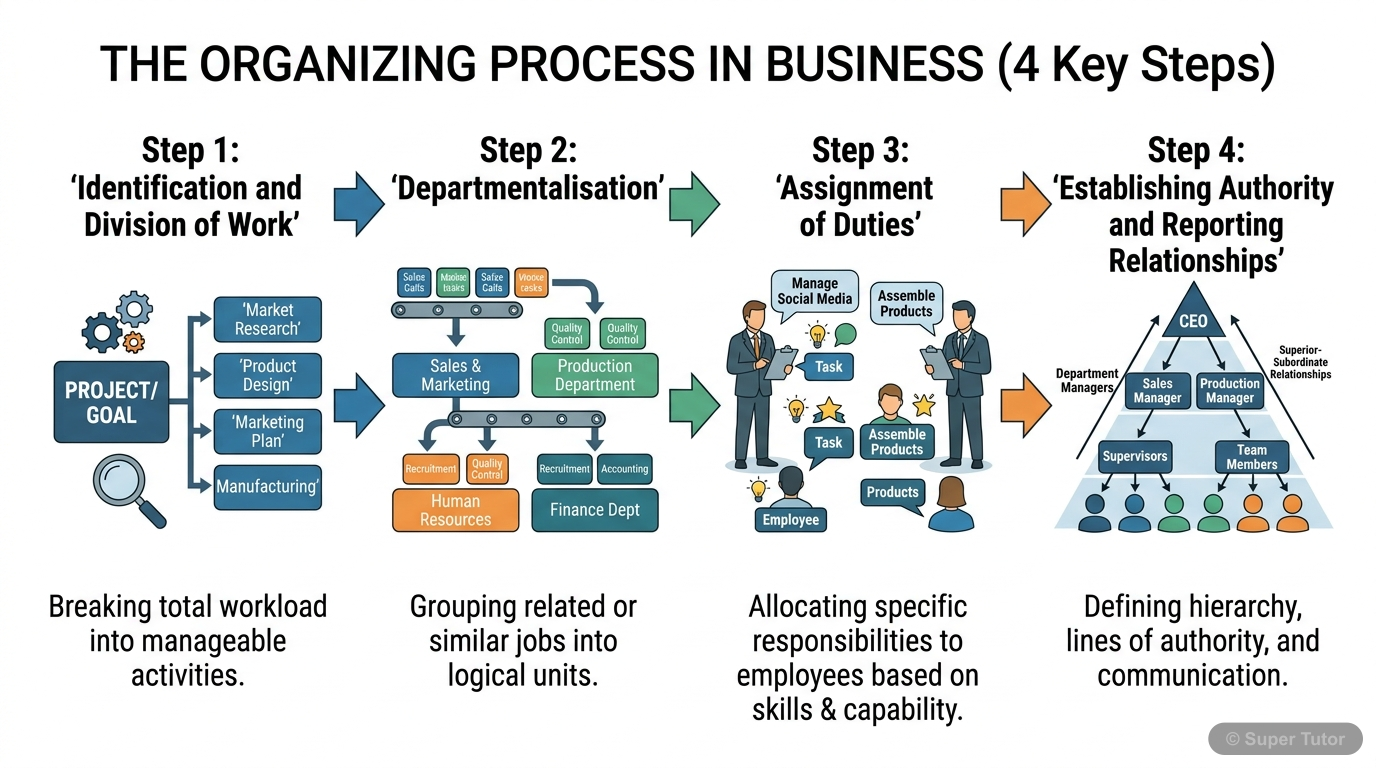
1What are the steps in the process of organising?Show solution
1. Identification and division of work — the total work is identified and broken into manageable activities.
2. Departmentalisation — similar activities are grouped together into departments.
3. Assignment of duties — jobs are allocated to employees according to their skills and competencies.
4. Establishing authority and reporting relationships — it is तय how authority flows and who reports to whom.
These steps help translate plans into action.
Not sure why a step works? check your working in Super Tutor
2Discuss the elements of delegation.Show solution
1. Authority — the right of a superior to command subordinates and take decisions.
2. Responsibility — the obligation of a subordinate to properly perform the assigned duty.
3. Accountability — answerability for the final outcome; it flows upward and cannot be delegated.
Effective delegation requires that authority and responsibility match, while accountability remains with the superior.
Not sure why a step works? check your working in Super Tutor
3How does informal organisation support the formal organisation?Show solution
- It allows faster spread of information and quick feedback.
- It helps fulfill the social needs of employees and increases job satisfaction.
- It can compensate for inadequacies in the formal organisation by testing reactions to plans and policies.
- It can also provide useful communication channels.
Thus, informal groups help work continue smoothly when used wisely by management.
Not sure why a step works? check your working in Super Tutor
4Can a large sized organisation be totally centralised of decentralised? Give your opinion.Show solution
- In a completely centralised organisation, all decision-making is at the top, which would make a hierarchy unnecessary.
- In a completely decentralised organisation, all decisions would go to lower levels, which would make higher management unnecessary.
Both extremes are unrealistic. A large organisation needs a balance of centralisation and decentralisation according to the importance of decisions.
Not sure why a step works? check your working in Super Tutor
5Decentralisation is extending delegation to the lowest level. Comment.Show solution
- Delegation is a transfer of authority from a superior to an immediate subordinate.
- Decentralisation is a policy of systematically dispersing decision-making authority throughout the organisation, up to the lowest levels.
So, decentralisation is the extension of delegation to the lowest level, but it also involves greater autonomy and wider scope than delegation alone.
Not sure why a step works? check your working in Super Tutor
10 more solved questions in Organizing
Every remaining exercise is solved step by step in Super Tutor, plus practice quizzes and flashcards for this chapter. Free to start.
Stuck on a step?
Ask Super Tutor AI to explain any solution on this page in a simpler way — free, 24x7.
Ask a Doubt FreeFrequently Asked Questions
What are the important topics in Organizing for CBSE Class 12 Business Studies?
How to score full marks in Organizing — CBSE Class 12 Business Studies?
Where can I get free NCERT Solutions for Organizing Class 12 Business Studies?
Sources & Official References
- NCERT Official — ncert.nic.in
- CBSE Academic — cbseacademic.nic.in
- CBSE Official — cbse.gov.in
- National Education Policy 2020 — education.gov.in
Content is aligned to the official syllabus. Refer to the board website for the latest curriculum.
More resources for Organizing
Practice Quiz
Test yourself with a quick quiz
Important Questions
Practice with board exam-style questions
Revision Notes
Key points for last-minute revision
Formula Sheet
All formulas in one place
Chapter Summary
Understand the chapter at a glance
Concept Maps
See how topics connect visually
Study Plan
Step-by-step plan to ace this chapter
Flashcards
Quick-fire cards for active recall
Syllabus
What topics to cover
For serious students
Get the full Organizing chapter — for free.
Quizzes, flashcards, AI doubt-solver and a step-by-step study plan for CBSE Class 12 Business Studies.