Haloalkanes and Haloarenes — Practice Quiz
CBSE · Class 12 · Chemistry
Try a 4-question quiz on Haloalkanes and Haloarenes for CBSE Class 12 Chemistry: tap an answer to check it and see why.
Interactive on Super Tutor
Studying Haloalkanes and Haloarenes? Get the full interactive chapter.
Quizzes, flashcards, AI doubt-solver and a step-by-step study plan — built for practice quiz and more.
Free trial, no card needed.
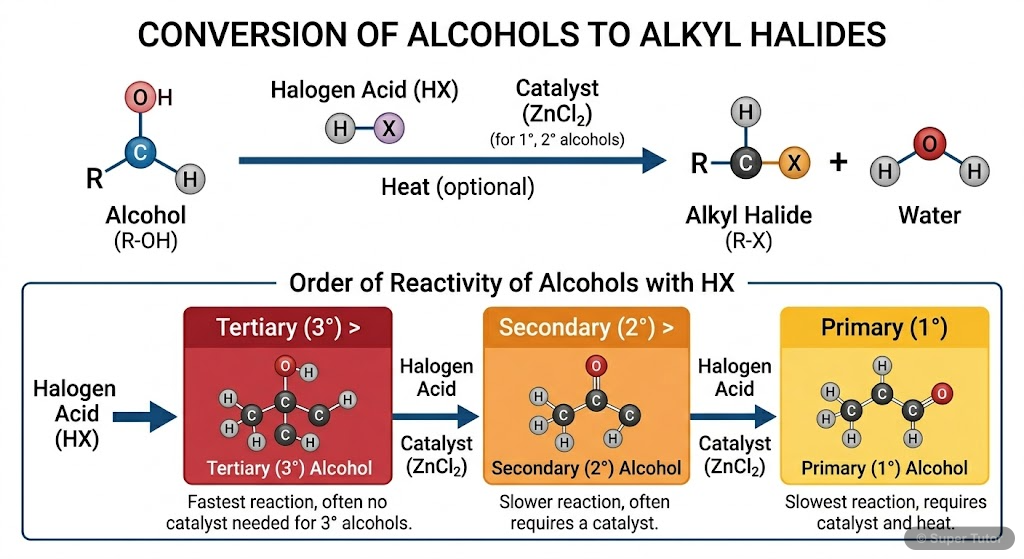
One of 33 illustrations for Haloalkanes and Haloarenes in Super Tutor — alongside flashcards, concept maps and practice questions.
Quick Quiz: Haloalkanes and Haloarenes
0/4Tap an answer to check it instantly. No sign-up needed for these 4.
What is the IUPAC name of (CH₃)₃CBr?
Which reagent is preferred for converting alcohols to alkyl chlorides?
Primary alkyl halides undergo nucleophilic substitution mainly by which mechanism?
What is the major product when 2-bromopentane undergoes elimination reaction with alcoholic KOH?
Sample Questions
Which of the following are characteristics of the C-X bond in haloalkanes?
Show answer
The bond is polar, Carbon bears partial positive charge, Halogen bears partial negative charge, Bond length increases from C-F to C-I
Halogens are more electronegative than carbon, making the C-X bond polar with carbon having δ+ charge and halogen having δ- charge. As we go down the halogen group, atomic size increases, so bond length increases from C-F (139 pm) to C-I (214 pm).
Which of the following factors affect the reactivity of haloalkanes in nucleophilic substitution?
Show answer
Nature of halogen, Nature of alkyl group, Nature of nucleophile, Temperature
Reactivity depends on: nature of halogen (I > Br > Cl > F), alkyl group structure (3° > 2° > 1° for SN1), nucleophile strength, and temperature. Color has no effect on reactivity.
Grignard reagents are prepared by reacting alkyl halides with:
Show answer
Magnesium in dry ether
Grignard reagents (RMgX) are formed by the reaction of alkyl halides with magnesium metal in dry ether. The reaction must be carried out in anhydrous conditions to prevent reaction with water.
Why are aryl halides less reactive than alkyl halides towards nucleophilic substitution?
Show answer
Resonance stabilization, sp² hybridization of carbon, Instability of phenyl cation, Electron repulsion
Aryl halides are less reactive due to: (1) resonance giving C-X partial double bond character, (2) sp² carbon being more electronegative than sp³, (3) phenyl cation instability ruling out SN1, and (4) electron-rich nucleophile repulsion by electron-rich benzene ring. Molecular weight doesn't affect reactivity.
+27 more questions on Haloalkanes and Haloarenes (CBSE Class 12 Chemistry)
Practise AllFrequently Asked Questions
What are the important topics in Haloalkanes and Haloarenes for CBSE Class 12 Chemistry?
How many practice questions are there for Haloalkanes and Haloarenes?
Sources & Official References
- NCERT Official — ncert.nic.in
- CBSE Academic — cbseacademic.nic.in
- CBSE Official — cbse.gov.in
- National Education Policy 2020 — education.gov.in
Content is aligned to the official syllabus. Refer to the board website for the latest curriculum.
More resources for Haloalkanes and Haloarenes
Important Questions
Exam-style questions with answers
Revision Notes
Key points for last-minute revision
Formula Sheet
The chapter's formulas in one place
Chapter Summary
Understand the chapter at a glance
Concept Maps
See how topics connect
Study Plan
Step-by-step plan for this chapter
Flashcards
Quick-fire cards for active recall
Syllabus
What topics to cover
NCERT Solutions
Every textbook question solved step by step
For serious students
Get the full Haloalkanes and Haloarenes chapter — start free.
Quizzes, flashcards, an AI doubt solver and a study plan for CBSE Class 12 Chemistry. Free to start, no card needed.