Biomolecules — Practice Quiz
CBSE · Class 12 · Chemistry
Try a 4-question quiz on Biomolecules for CBSE Class 12 Chemistry: tap an answer to check it and see why. 52 questions in the full chapter test.
Interactive on Super Tutor
Studying Biomolecules? Get the full interactive chapter.
Quizzes, flashcards, AI doubt-solver and a step-by-step study plan — built for practice quiz and more.
Free trial, no card needed.
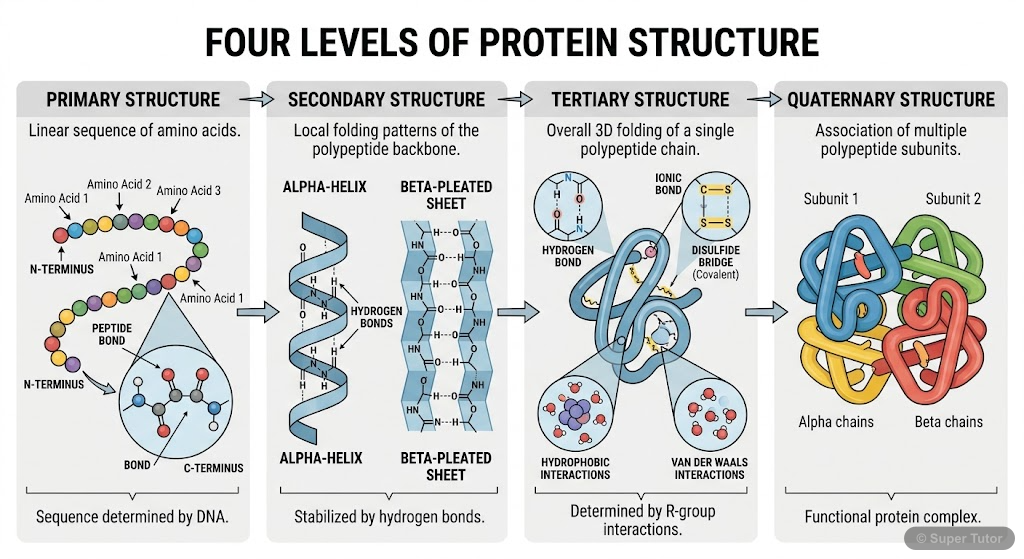
One of 32 illustrations for Biomolecules in Super Tutor — alongside flashcards, concept maps and practice questions.
Quick Quiz: Biomolecules
0/4Tap an answer to check it instantly. No sign-up needed for these 4.
What is the general formula of carbohydrates?
Glucose is also known as:
The linkage between two monosaccharide units in disaccharides is called:
The monomer units of proteins are:
Sample Questions
Which of the following are monosaccharides?
Show answer
Glucose, Fructose, Ribose
Monosaccharides are simple sugars that cannot be hydrolyzed further. Glucose, fructose, and ribose are all monosaccharides. Sucrose and maltose are disaccharides as they can be hydrolyzed to give two monosaccharide units.
Which of the following are examples of polysaccharides?
Show answer
Starch, Cellulose, Glycogen
Starch, cellulose, and glycogen are polysaccharides as they contain many monosaccharide units joined together. Lactose and sucrose are disaccharides containing only two monosaccharide units each.
The bond that links amino acids in proteins is called:
Show answer
Peptide bond
Peptide bond is formed between the carboxyl group of one amino acid and the amino group of another amino acid with the elimination of water molecule. This is also called peptide linkage or amide bond.
Which of the following are fat-soluble vitamins?
Show answer
Vitamin A, Vitamin D, Vitamin E, Vitamin K
Vitamins A, D, E, and K are fat-soluble vitamins. They are stored in liver and adipose tissues. Vitamin C and B-group vitamins are water-soluble vitamins that are readily excreted in urine.
+48 more questions on Biomolecules (CBSE Class 12 Chemistry)
Practise AllFrequently Asked Questions
What are the important topics in Biomolecules for CBSE Class 12 Chemistry?
How many practice questions are there for Biomolecules?
Sources & Official References
- NCERT Official — ncert.nic.in
- CBSE Academic — cbseacademic.nic.in
- CBSE Official — cbse.gov.in
- National Education Policy 2020 — education.gov.in
Content is aligned to the official syllabus. Refer to the board website for the latest curriculum.
More resources for Biomolecules
Important Questions
Exam-style questions with answers
Revision Notes
Key points for last-minute revision
Formula Sheet
The chapter's formulas in one place
Chapter Summary
Understand the chapter at a glance
Concept Maps
See how topics connect
Study Plan
Step-by-step plan for this chapter
Flashcards
Quick-fire cards for active recall
Syllabus
What topics to cover
NCERT Solutions
Every textbook question solved step by step
For serious students
Get the full Biomolecules chapter — start free.
Quizzes, flashcards, an AI doubt solver and a study plan for CBSE Class 12 Chemistry. Free to start, no card needed.