Haloalkanes and Haloarenes
CBSE · Class 12 · Chemistry
NCERT Solutions for Haloalkanes and Haloarenes — CBSE Class 12 Chemistry.
Interactive on Super Tutor
Studying Haloalkanes and Haloarenes? Get the full interactive chapter.
Quizzes, flashcards, AI doubt-solver and a step-by-step study plan — built for ncert solutions and more.
1,000+ Class 12 students started this chapter today
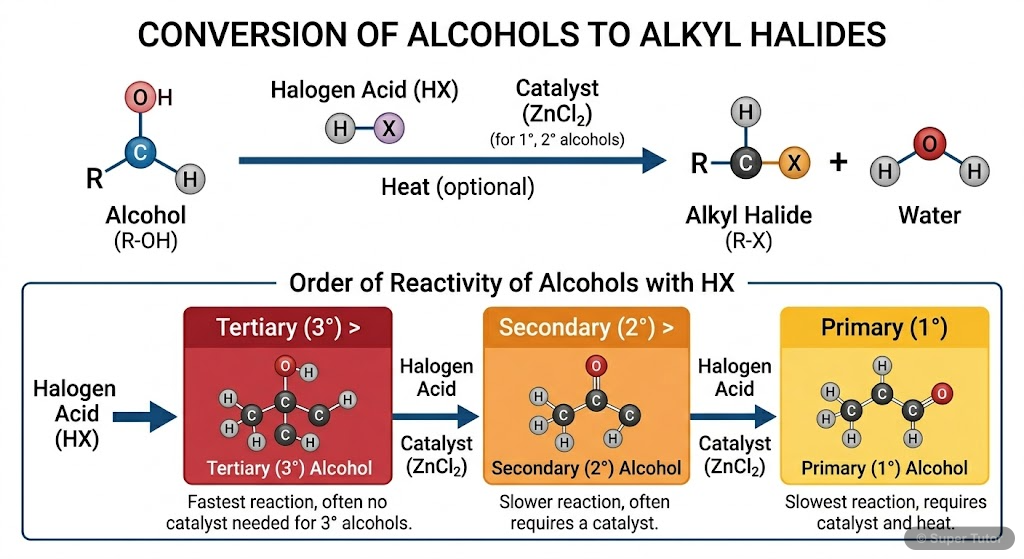
Learn better with visuals Super Tutor has hundreds of illustrations like this across every chapter — all free to try.
Get started11 worked solutions below. Unlock all 22 free in Super Tutor
Exercises
6.1Name the following halides according to IUPAC system and classify them as alkyl, allyl, benzyl (primary, secondary, tertiary), vinyl or aryl halides:Show solution
(CH_3)_2CHCH(Cl)CH_3$ is 2-chloro-3-methylbutane. The carbon bearing Cl is attached to two carbons, so it is a secondary alkyl halide.
2. (ii) $
CH_3CH_2CH(CH_3)CH(C_2H_5)Cl$ is 2-chloro-3-methylpentane. The halogen is on a carbon attached to two other carbons, so it is a secondary alkyl halide.
3. (iii) $
CH_3CH_2C(CH_3)_2CH_2I$ is 1-iodo-3,3-dimethylbutane. The iodine is on a terminal carbon, so it is a primary alkyl halide.
4. (iv) $
(CH_3)_3CCH_2CH(Br)C_6H_5$ is 2-bromo-1,1-dimethyl-3-phenylbutane. The bromine is on a benzylic carbon attached to two carbons, so it is a secondary benzylic halide.
5. (v) $
CH_3CH(CH_3)CH(Br)CH_3$ is 2-bromo-3-methylbutane. The halogen-bearing carbon is attached to two carbons, so it is a secondary alkyl halide.
6. (vi) $
CH_3C(C_2H_5)_2CH_2Br
CH_2$ group, it is a primary alkyl halide.
7. (vii) $
CH_3C(Cl)(C_2H_5)CH_2CH_3$ is 3-chloro-3-methylpentane. The carbon bearing Cl is attached to three carbons, so it is a tertiary alkyl halide.
8. (viii) $
CH_3CH=C(Cl)CH_2CH(CH_3)_2$ is 3-chloro-5-methylhex-2-ene. The halogen is directly attached to a double-bond carbon, so it is a vinyl halide.
9. (ix) $
CH_3CH=CHC(Br)(CH_3)_2$ is 4-bromo-4-methylpent-2-ene. The bromine is on an allylic carbon, so it is an allylic halide.
10. (x) -Cl$
C_6H_4CH_2CH(CH_3)_2$ is 1-chloro-4-isobutylbenzene by common style, but IUPAC is 1-chloro-4-(2-methylpropyl)benzene. Since Cl is directly on the aromatic ring, it is an aryl halide.
11. (xi) -ClCH is 1-(chloromethyl)-3-(2,2-dimethylpropyl)benzene. The Cl is on a benzylic , so it is a benzyl halide.
12. (xii) -Br- is 1-bromo-2-(butan-2-yl)benzene in common terms, but importantly Br is on the ring, so it is an aryl halide.
Not sure why a step works? check your working in Super Tutor
6.2Give the IUPAC names of the following compounds:Show solution
- (i) 2-Chloro-3-methylpentane
- (ii) 1-Chloro-4-ethylcyclohexane
- (iii) 4-tert-Butyl-3-iodoheptane
- (iv) 1,4-Dibromobut-2-ene
- (v) 1-Bromo-4-sec-butyl-2-methylbenzene
These are the required IUPAC structures/names corresponding to the textbook exercise answer set.
Not sure why a step works? check your working in Super Tutor
6.3Write the structures of the following organic halogen compounds.Show solution
- (i) $
ClCH_2CH_2CH_2Cl$
- (ii) $
ClCH_2CHClCH_3$
- (iii) $
Cl_2CHCH_2CH_3$
- (iv) $
CH_3CCl_2CH_3$
These are the required organic halogen compound structures.
Not sure why a step works? check your working in Super Tutor
6.4Which one of the following has the highest dipole moment?Show solution
CH_2Cl_2$ has the highest dipole moment among the given compounds.
Not sure why a step works? check your working in Super Tutor
6.5A hydrocarbon does not react with chlorine in dark but gives a single monochloro compound in bright sunlight. Identify the hydrocarbon.Show solution
C_5H_{10}$ that does not react with chlorine in the dark but gives only one monochloro product in bright sunlight must be a cycloalkane with all hydrogens equivalent. The chapter’s expected identification is cyclopentane.
Not sure why a step works? check your working in Super Tutor
6.6Write the isomers of the compound having formula Show solution
C_4H_9Br$ has four structural isomers:
1. 1-Bromobutane
2. 2-Bromobutane
3. 1-Bromo-2-methylpropane
4. 2-Bromo-2-methylpropane
These are the isomers required by the exercise.
Not sure why a step works? check your working in Super Tutor
6.7Write the equations for the preparation of 1-iodobutane fromShow solution
### (i) From 1-butanol
Use hydrogen iodide or KI in 95% orthophosphoric acid:
### (ii) From 1-chlorobutane
Use NaI in dry acetone by Finkelstein reaction:
### (iii) From but-1-ene
First add HI to but-1-ene:
To obtain 1-iodobutane, a better school-level route is to first make 1-butanol by anti-Markovnikov hydration is not in this chapter, so using the chapter content, the direct textbook-preferred preparation of alkyl iodides is from alcohols or halides. Thus for but-1-ene, the standard expected pathway is via conversion to 1-butanol by an accepted intermediate, then reaction with HI. If only chapter methods are used, the direct hydrohalogenation of but-1-ene gives the Markovnikov iodide, not 1-iodobutane.
Not sure why a step works? check your working in Super Tutor
6.8What are ambident nucleophiles? Explain with an example.Show solution
The chapter gives cyanide ion and nitrite ion as examples:
- CN⁻ can attack through carbon to form alkyl cyanides:
- AgCN gives attack through nitrogen to form isocyanides:
Similarly, NO₂⁻ can link through oxygen to give alkyl nitrites or through nitrogen to give nitroalkanes.
So, an ambident nucleophile is one that can react from two alternative atoms.
Not sure why a step works? check your working in Super Tutor
6.9Which compound in each of the following pairs will react faster in reaction with ?Show solution
- (i) Between $
CH_3Br
CH_3I
CH_3I$ reacts faster because iodide is a better leaving group than bromide.
- (ii) Between and $
CH_3Cl
CH_3Cl$ reacts faster because it is least hindered; tert-butyl chloride is highly hindered.
So the answers are $
CH_3I
CH_3Cl$**.
Not sure why a step works? check your working in Super Tutor
6.10Predict all the alkenes that would be formed by dehydrohalogenation of the following halides with sodium ethoxide in ethanol and identify the major alkene:Show solution
### (i) 1-Bromo-1-methylcyclohexane
Elimination gives mainly 1-methylcyclohexene as the major alkene.
### (ii) 2-Chloro-2-methylbutane
Possible alkenes:
- 2-Methylbut-1-ene
- 2-Methylbut-2-ene
The major alkene is 2-methylbut-2-ene because it is the more substituted alkene.
### (iii) 2,2,3-Trimethyl-3-bromopentane
Elimination can occur from a β-carbon giving the alkene with the double bond between C3 and the adjacent carbon. The major product is the more substituted alkene. In such cases, write all possible alkenes formed by removing a β-hydrogen adjacent to the carbon bearing Br, and choose the most substituted one as major.
The general rule from the chapter is Zaitsev’s rule: the preferred product is the alkene with the greater number of alkyl groups attached to the doubly bonded carbon atoms.
Not sure why a step works? check your working in Super Tutor
6.11How will you bring about the following conversions?Show solution
- Use appropriate haloalkanes, halogen exchange, elimination, addition, or Grignard/ Wurtz reactions depending on the target.
- For example:
- Alcohol to haloalkane: with HX, PCl5, PBr3, or SOCl2.
- Haloalkane to alcohol: with aqueous KOH.
- Haloalkane to alkene: with alcoholic KOH.
- Haloalkane to higher alkane: Wurtz reaction with Na/dry ether.
- Halide exchange: Finkelstein for iodides, Swarts for fluorides.
- Aryl amine to aryl halide: diazotisation followed by Sandmeyer reaction.
If a specific conversion is requested, the exact reagents are chosen from these chapter methods.
Not sure why a step works? check your working in Super Tutor
11 more solved questions in Haloalkanes and Haloarenes
Every remaining exercise is solved step by step in Super Tutor, plus practice quizzes and flashcards for this chapter. Free to start.
Stuck on a step?
Ask Super Tutor AI to explain any solution on this page in a simpler way — free, 24x7.
Ask a Doubt FreeFrequently Asked Questions
What are the important topics in Haloalkanes and Haloarenes for CBSE Class 12 Chemistry?
How to score full marks in Haloalkanes and Haloarenes — CBSE Class 12 Chemistry?
Where can I get free NCERT Solutions for Haloalkanes and Haloarenes Class 12 Chemistry?
Sources & Official References
- NCERT Official — ncert.nic.in
- CBSE Academic — cbseacademic.nic.in
- CBSE Official — cbse.gov.in
- National Education Policy 2020 — education.gov.in
Content is aligned to the official syllabus. Refer to the board website for the latest curriculum.
More resources for Haloalkanes and Haloarenes
Practice Quiz
Test yourself with a quick quiz
Important Questions
Practice with board exam-style questions
Revision Notes
Key points for last-minute revision
Formula Sheet
All formulas in one place
Chapter Summary
Understand the chapter at a glance
Concept Maps
See how topics connect visually
Study Plan
Step-by-step plan to ace this chapter
Flashcards
Quick-fire cards for active recall
Syllabus
What topics to cover
For serious students
Get the full Haloalkanes and Haloarenes chapter — for free.
Quizzes, flashcards, AI doubt-solver and a step-by-step study plan for CBSE Class 12 Chemistry.