Introduction
CBSE · Class 12 · Economics
Practice quiz for Introduction — CBSE Class 12 Economics. MCQs and questions with answers to test your preparation.
Interactive on Super Tutor
Studying Introduction? Get the full interactive chapter.
Quizzes, flashcards, AI doubt-solver and a step-by-step study plan — built for practice quiz and more.
1,000+ Class 12 students started this chapter today
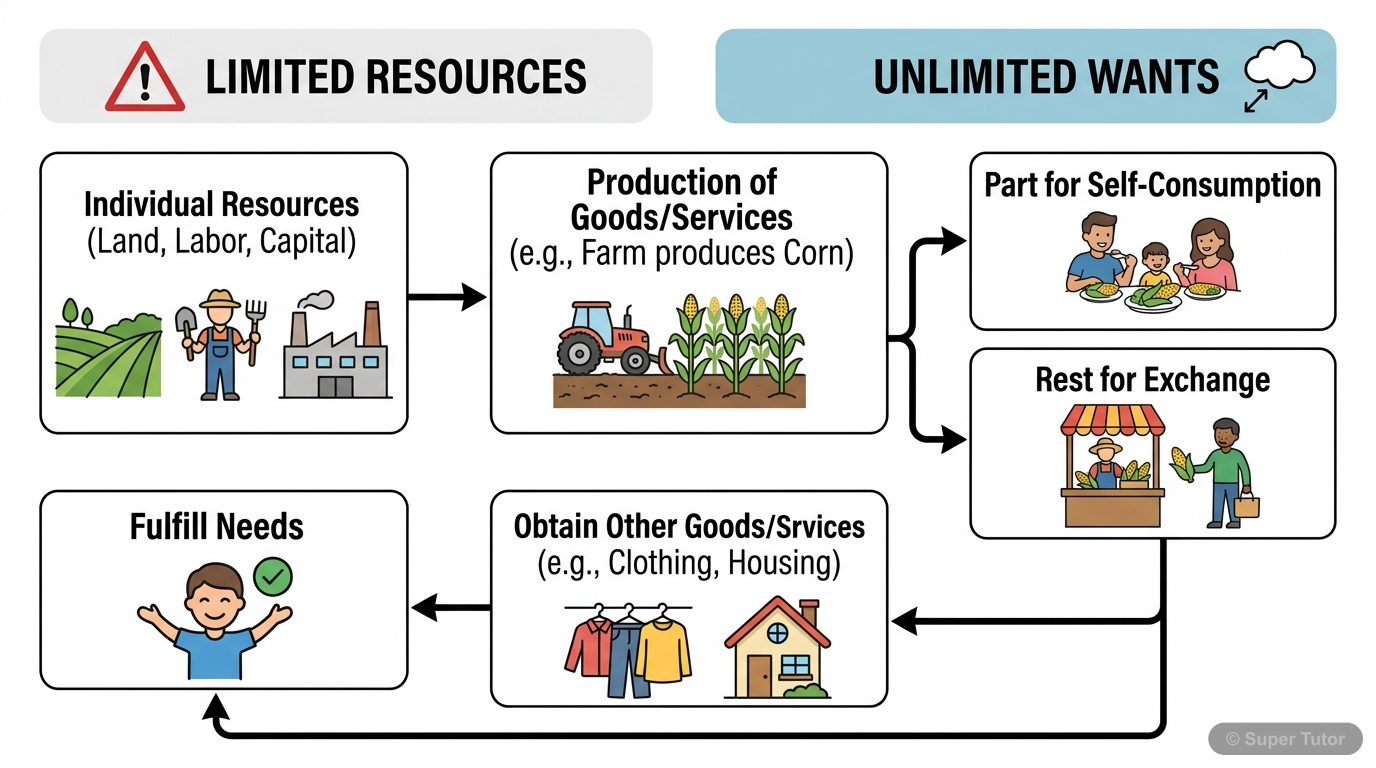
Learn better with visuals Super Tutor has hundreds of illustrations like this across every chapter — all free to try.
Get startedQuick Quiz: Introduction
0/4Tap an answer to check it instantly. No sign-up needed for these 4.
What is the basic economic problem that all societies face?
The Production Possibility Frontier (PPF) shows:
Opportunity cost refers to:
In a centrally planned economy, economic decisions are made by:
Sample Questions
Which of the following are examples of goods? (Select all correct answers)
Show answer
Books and notebooks, Food items like rice and wheat, Clothes and furniture
Goods are physical, tangible objects that satisfy human wants and needs. Books, food items, and clothes are all physical objects. Teaching services and medical treatment are services (intangible), not goods.
Which of the following are characteristics of a market economy? (Select all correct answers)
Show answer
All economic activities are organised through the market, Economic agents can freely exchange their endowments or products with each other, Prices of goods and services help coordinate economic activities
In a market economy, economic activities are organised through the market, which is a set of arrangements where agents can freely exchange their endowments or products. The chapter also explains that prices send information across the market and help coordinate the actions of buyers and sellers. Government making all important decisions describes a centrally planned economy, not a market economy.
Which of the following are basic economic activities? (Select all correct answers)
Show answer
Production, Exchange, Consumption
The three basic economic activities are production (creating goods and services), exchange (trading goods and services), and consumption (using goods and services to satisfy wants). Sleeping and playing games are not economic activities.
Microeconomics studies:
Show answer
Individual consumers and producers in specific markets
Microeconomics focuses on the behavior of individual economic agents (consumers, producers, firms) and how they interact in specific markets. It studies how prices and quantities are determined in individual markets.
+81 more questions available
Practice AllFrequently Asked Questions
What are the important topics in Introduction for CBSE Class 12 Economics?
How to score full marks in Introduction — CBSE Class 12 Economics?
Sources & Official References
- NCERT Official — ncert.nic.in
- CBSE Academic — cbseacademic.nic.in
- CBSE Official — cbse.gov.in
- National Education Policy 2020 — education.gov.in
Content is aligned to the official syllabus. Refer to the board website for the latest curriculum.
More resources for Introduction
Important Questions
Practice with board exam-style questions
Revision Notes
Key points for last-minute revision
Formula Sheet
All formulas in one place
Chapter Summary
Understand the chapter at a glance
Concept Maps
See how topics connect visually
Study Plan
Step-by-step plan to ace this chapter
Flashcards
Quick-fire cards for active recall
Syllabus
What topics to cover
NCERT Solutions
Every textbook question solved step by step
For serious students
Get the full Introduction chapter — for free.
Quizzes, flashcards, AI doubt-solver and a step-by-step study plan for CBSE Class 12 Economics.