Introduction
CBSE · Class 12 · Economics
NCERT Solutions for Introduction — CBSE Class 12 Economics.
Interactive on Super Tutor
Studying Introduction? Get the full interactive chapter.
Quizzes, flashcards, AI doubt-solver and a step-by-step study plan — built for ncert solutions and more.
1,000+ Class 12 students started this chapter today
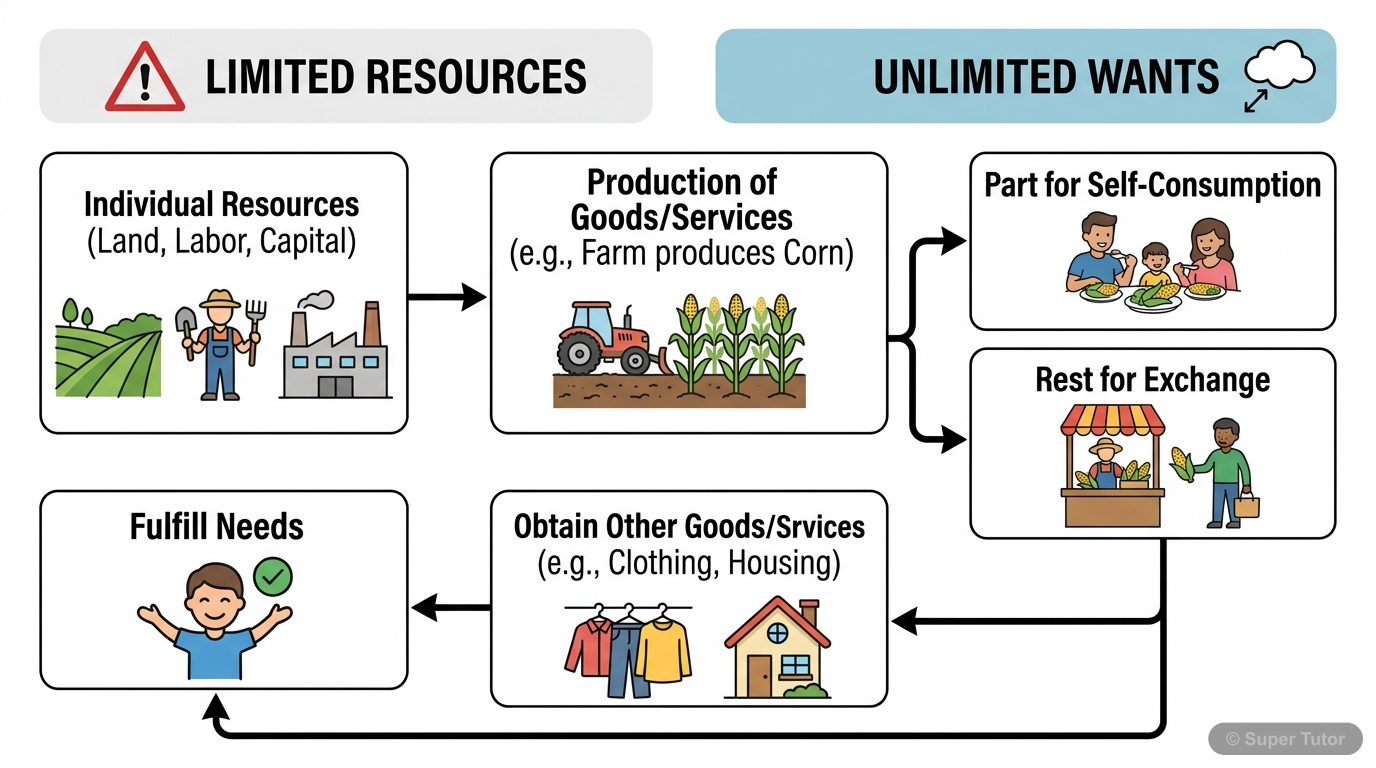
Learn better with visuals Super Tutor has hundreds of illustrations like this across every chapter — all free to try.
Get started4 worked solutions below. Unlock all 8 free in Super Tutor
Exercises
1Discuss the central problems of an economy.Show solution
1. What is produced and in what quantities?
Every society must decide how much of different goods and services—such as food, clothing, housing, education, health services, and luxury goods—should be produced.
2. How are these goods produced?
Society must decide which resources and techniques to use in producing goods and services. For example, whether to use more labour or more machines, and which technology to adopt.
3. For whom are these goods produced?
Society must decide how the produced goods and services should be distributed among people. It has to decide who gets how much, and whether everyone should get a minimum amount of basic goods and services.
Thus, the central problems of an economy are the allocation of scarce resources among different uses and the distribution of the final output among individuals.
Not sure why a step works? check your working in Super Tutor
2What do you mean by the production possibilities of an economy?Show solution
For example, if an economy can produce corn and cotton, it may be able to produce:
- more corn and less cotton,
- less corn and more cotton,
- or some intermediate combination of the two.
The set of all such possible combinations is called the economy’s production possibilities. These possibilities show the choices available to society when its resources are fully or differently used.
Not sure why a step works? check your working in Super Tutor
3What is a production possibility frontier?Show solution
In the chapter’s example of corn and cotton, the PPF shows all combinations of corn and cotton that can be produced with the available resources and technology. Points on the frontier represent efficient use of resources, while points below it represent underutilisation or waste of resources.
So, the PPF is the boundary of feasible output combinations for an economy.
Not sure why a step works? check your working in Super Tutor
4Discuss the subject matter of economics.Show solution
Its subject matter includes:
- Production of goods and services,
- Exchange of goods and services,
- Consumption of goods and services,
- The allocation of scarce resources, and
- The distribution of the goods and services produced.
The chapter also explains that economics is traditionally divided into two branches:
- Microeconomics, which studies individual economic units and markets,
- Macroeconomics, which studies the economy as a whole using aggregate measures like total output, employment, and price level.
Thus, economics is the study of how scarce resources are used to satisfy human wants and how economic activities are organised and analysed.
Not sure why a step works? check your working in Super Tutor
4 more solved questions in Introduction
Every remaining exercise is solved step by step in Super Tutor, plus practice quizzes and flashcards for this chapter. Free to start.
Stuck on a step?
Ask Super Tutor AI to explain any solution on this page in a simpler way — free, 24x7.
Ask a Doubt FreeFrequently Asked Questions
What are the important topics in Introduction for CBSE Class 12 Economics?
How to score full marks in Introduction — CBSE Class 12 Economics?
Where can I get free NCERT Solutions for Introduction Class 12 Economics?
Sources & Official References
- NCERT Official — ncert.nic.in
- CBSE Academic — cbseacademic.nic.in
- CBSE Official — cbse.gov.in
- National Education Policy 2020 — education.gov.in
Content is aligned to the official syllabus. Refer to the board website for the latest curriculum.
More resources for Introduction
Practice Quiz
Test yourself with a quick quiz
Important Questions
Practice with board exam-style questions
Revision Notes
Key points for last-minute revision
Formula Sheet
All formulas in one place
Chapter Summary
Understand the chapter at a glance
Concept Maps
See how topics connect visually
Study Plan
Step-by-step plan to ace this chapter
Flashcards
Quick-fire cards for active recall
Syllabus
What topics to cover
For serious students
Get the full Introduction chapter — for free.
Quizzes, flashcards, AI doubt-solver and a step-by-step study plan for CBSE Class 12 Economics.