Machine Drawing — Study Plan
CBSE · Class 12 · Engineering Graphics
A step-by-step study plan for Machine Drawing, CBSE Class 12 Engineering Graphics: what to learn first, what to practise and when to revise.
Interactive on Super Tutor
Studying Machine Drawing? Get the full interactive chapter.
Quizzes, flashcards, AI doubt-solver and a step-by-step study plan — built for study plan and more.
Free trial, no card needed.
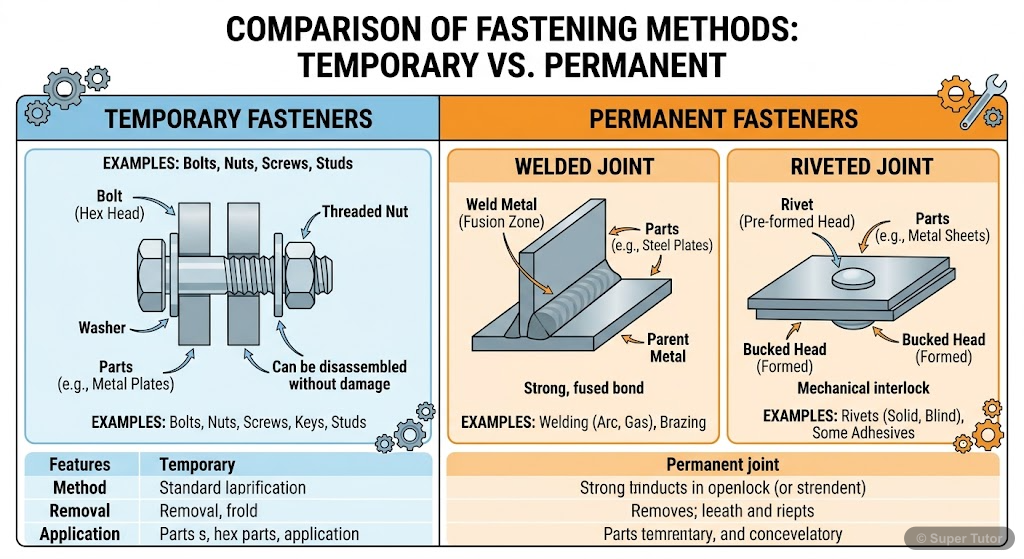
Learn better with visuals Super Tutor pairs illustrations like this with notes and quizzes for Machine Drawing.
Get startedStudy Plan
Learn the Theory
Read the textbook chapter carefully. Note down definitions, formulas and key ideas. Focus on: Screw Threads and Thread Forms, Bolts and Nuts, Washers and Assembly Drawings.
Practise
Solve the textbook exercises and extra practice questions.
Revise & Test
Revise key points without looking at your notes. Take a practice quiz and mark weak areas for another pass.
Spaced Revision
Come back to Machine Drawing after a week. Use flashcards for quick recall and try past exam questions on this chapter.
What to Focus On
- Machine parts are individual components that form complete mechanical systems
- Fasteners are classified as temporary or permanent based on their removability
- Temporary fasteners allow for easy disassembly and maintenance
- Screw threads are continuous helical grooves that enable fastening
- Pitch determines the mechanical advantage and holding power
- Lead equals pitch for single-start threads
- V-threads are used for fastening due to their wedge action
- Square threads are used for power transmission with less friction
- B.S.W. threads have 55° angle with rounded crests and roots
Common Mistakes to Avoid
External threads are represented by continuous thick lines for both major and minor diameters
Internal threads are represented exactly the same as external threads
Bolt length includes the height of the bolt head
Memory Tips
Major parts of a screw thread (Crest, Root, Flank, Thread Angle)
BSW thread profile has 55-degree angle and rounded crests/roots
Metric thread has 60-degree angle with flat crest and rounded root
Square thread has equal width spaces and thread portions (P/2 each)
Want a personalised study plan?
Super Tutor builds a day-by-day plan for CBSE Class 12 Engineering Graphics that fits your exam date and pace.
Create My Study PlanFrequently Asked Questions
What are the important topics in Machine Drawing for CBSE Class 12 Engineering Graphics?
Sources & Official References
- NCERT Official — ncert.nic.in
- CBSE Academic — cbseacademic.nic.in
- CBSE Official — cbse.gov.in
- National Education Policy 2020 — education.gov.in
Content is aligned to the official syllabus. Refer to the board website for the latest curriculum.
More resources for Machine Drawing
For serious students
Get the full Machine Drawing chapter — start free.
Quizzes, flashcards, an AI doubt solver and a study plan for CBSE Class 12 Engineering Graphics. Free to start, no card needed.