Chapter 2 of 6
Revision Notes
Enterprise Planning — Revision Notes
CBSE · Class 12 · Entrepreneurship
Enterprise Planning revision notes for CBSE Class 12 Entrepreneurship: 4 topics in quick points. Part of the CBSE Class 12 Entrepreneurship syllabus.
3 formulas & key relations5 concepts
Interactive on Super Tutor
Studying Enterprise Planning? Get the full interactive chapter.
Quizzes, flashcards, AI doubt-solver and a step-by-step study plan — built for revision notes and more.
Free trial, no card needed.
Super Tutor
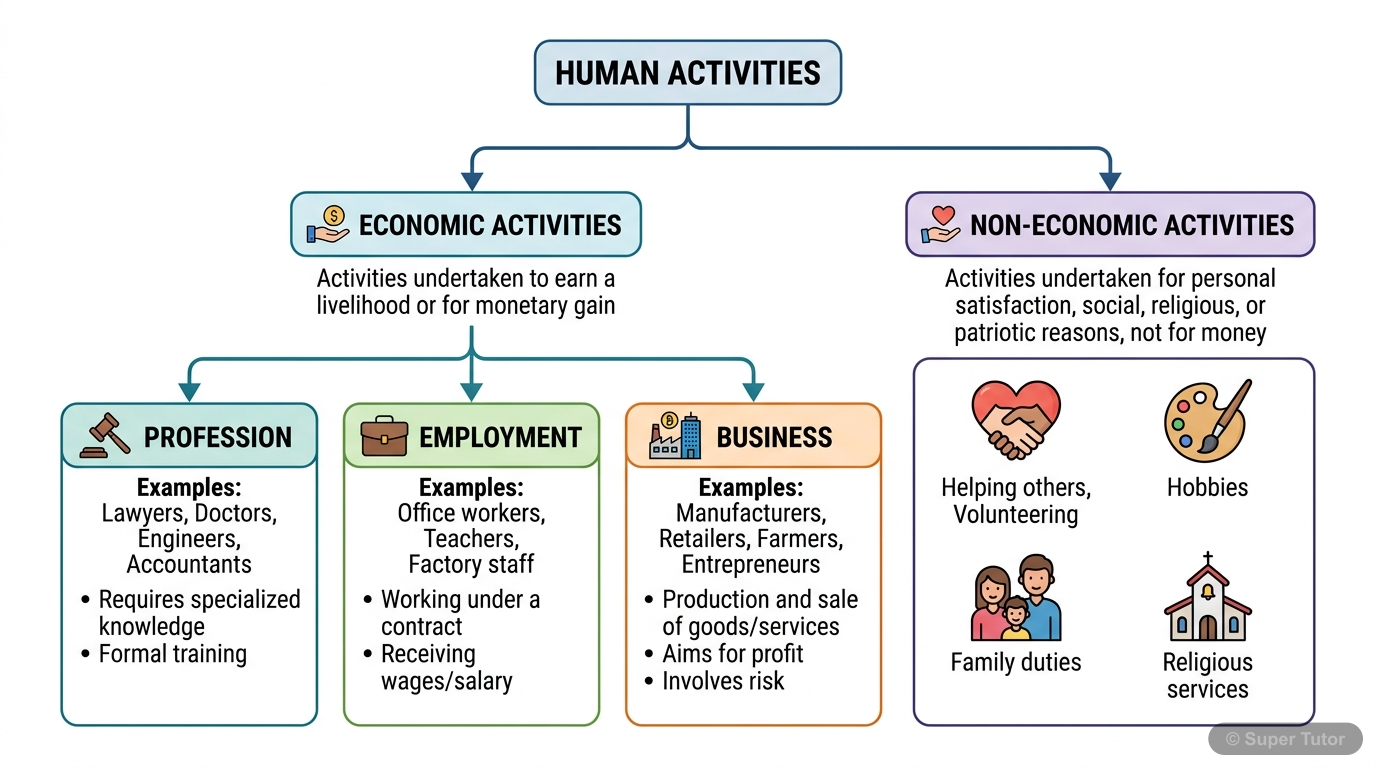
Learn better with visuals Super Tutor pairs illustrations like this with notes and quizzes for Enterprise Planning.
Key Topics to Revise
1
Economic Activities and Types of Business
- Economic activities are undertaken primarily for monetary gains involving production, distribution, or consumption of goods and services
- Three main types of economic activities: Profession, Employment, and Business
- Business activities are classified into Manufacturing, Service, and Trading
2
Forms of Business Organization
- Three main sectors: Private sector, Public sector, and Joint sector enterprises
- Private sector forms: Sole Proprietorship, Partnership, Joint Hindu Family, Cooperative, Company
- Sole Proprietorship: Single ownership, unlimited liability, easy formation, limited resources
3
Business Plan Components
- Business plan is a comprehensive written document describing all elements of starting a new venture
- Nine main components: Introduction, Business Venture, Organizational Plan, Production Plan, Operational Plan, Human Resource Plan, Marketing Plan, Financial Plan, Miscellaneous/Appendix
- Helps determine viability, provides guidance, satisfies stakeholder concerns, enables self-assessment
4
Production and Operational Planning
- Production Plan covers what work shall be done, how it shall be done, when and by whom
- Three situations: No manufacturing, Partial manufacturing, Complete manufacturing
- Includes production schedule, machinery requirements, plant layout, raw materials, inventory
Get complete notes with diagrams and examples
Full NotesKey Concepts
Activities undertaken primarily for monetary gainsLegal structures under which businesses operateA comprehensive written document that formallyDetails the manufacturing processFocuses on the day
Frequently Asked Questions
What are the important topics in Enterprise Planning for CBSE Class 12 Entrepreneurship?
Key topics in Enterprise Planning include Economic Activities and Types of Business, Forms of Business Organization, Business Plan Components, Production and Operational Planning. Study these first, then practise questions on each for the CBSE Class 12 board exam.
Sources & Official References
- NCERT Official — ncert.nic.in
- CBSE Academic — cbseacademic.nic.in
- CBSE Official — cbse.gov.in
- National Education Policy 2020 — education.gov.in
Content is aligned to the official syllabus. Refer to the board website for the latest curriculum.
More resources for Enterprise Planning
For serious students
Get the full Enterprise Planning chapter — start free.
Quizzes, flashcards, an AI doubt solver and a study plan for CBSE Class 12 Entrepreneurship. Free to start, no card needed.