Chapter 4 of 6
Revision Notes
Enterprise Growth Strategies — Revision Notes
CBSE · Class 12 · Entrepreneurship
Enterprise Growth Strategies revision notes for CBSE Class 12 Entrepreneurship: 4 topics in quick points. Includes Growth and Development.
5 concepts
Interactive on Super Tutor
Studying Enterprise Growth Strategies? Get the full interactive chapter.
Quizzes, flashcards, AI doubt-solver and a step-by-step study plan — built for revision notes and more.
Free trial, no card needed.
Super Tutor
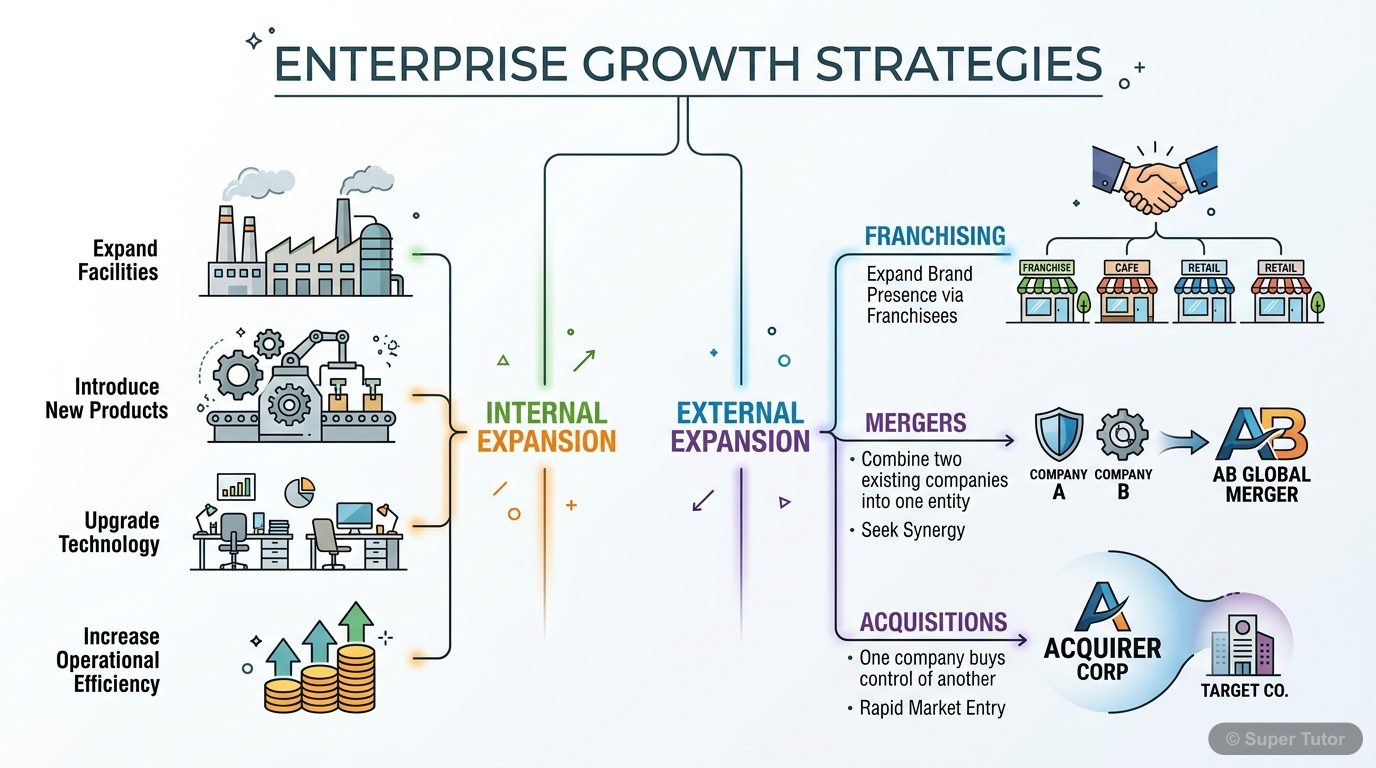
One of 12 illustrations for Enterprise Growth Strategies in Super Tutor — alongside flashcards, concept maps and practice questions.
Key Topics to Revise
1
Growth and Development of an Enterprise
- Growth is essential for the survival of any business concern — a stagnant firm risks decline.
- Entrepreneurs must evaluate financial, logistical, and emotional readiness before expanding.
- The rule of thumb: expand only when untapped opportunities exist that can benefit the business.
2
Franchising
- Origin: Franchising began in the 1850s when Isaac Singer sold licenses to distribute sewing machines. Ray Kroc scaled McDonald's into the world's most successful franchise system in 1955.
- Definition: An arrangement whereby the manufacturer or sole distributor of a trademarked product/service gives exclusive rights of local distribution to independent retailers in return for royalties a
- Franchisor: The company/person offering the franchise (e.g., McDonald's, Subway, Goli Vada Pav).
3
Advantages and Disadvantages of Franchising
- ADVANTAGES TO FRANCHISEE:
- 1. Product Acceptance: Franchisee enters business with an already accepted name, product, or service (e.g., Subway brand recognition; no need to build credibility from scratch).
- 2. Management Expertise: Franchisor provides training programs covering accounting, personnel management, marketing, and production (e.g., McDonald's Hamburger University).
4
Mergers
- Definition: A merger is a combination of two companies into one larger company involving stock swap or cash payment to the target.
- In a merger, the acquiring company takes over the assets and liabilities of the merged company.
- When firms are of similar size, the term 'Consolidation' is used; when sizes differ significantly, 'Merger' is used.
Get complete notes with diagrams and examples
Full NotesKey Concepts
A business can grow either internallyFranchising is 'an arrangement wherebyThere are four types of franchisingAdvantages to the franchisee includeA merger is the combination
Frequently Asked Questions
What are the important topics in Enterprise Growth Strategies for CBSE Class 12 Entrepreneurship?
Key topics in Enterprise Growth Strategies include Growth and Development of an Enterprise, Franchising, Advantages and Disadvantages of Franchising, Mergers. Study these first, then practise questions on each for the CBSE Class 12 board exam.
Sources & Official References
- NCERT Official — ncert.nic.in
- CBSE Academic — cbseacademic.nic.in
- CBSE Official — cbse.gov.in
- National Education Policy 2020 — education.gov.in
Content is aligned to the official syllabus. Refer to the board website for the latest curriculum.
More resources for Enterprise Growth Strategies
For serious students
Get the full Enterprise Growth Strategies chapter — start free.
Quizzes, flashcards, an AI doubt solver and a study plan for CBSE Class 12 Entrepreneurship. Free to start, no card needed.