Primary Activities — NCERT Solutions
CBSE · Class 12 · Geography
NCERT Solutions for Primary Activities, CBSE Class 12 Geography: 13 textbook questions solved step by step. Covers Exercises.
Interactive on Super Tutor
Studying Primary Activities? Get the full interactive chapter.
Quizzes, flashcards, AI doubt-solver and a step-by-step study plan — built for NCERT solutions and more.
Free trial, no card needed.
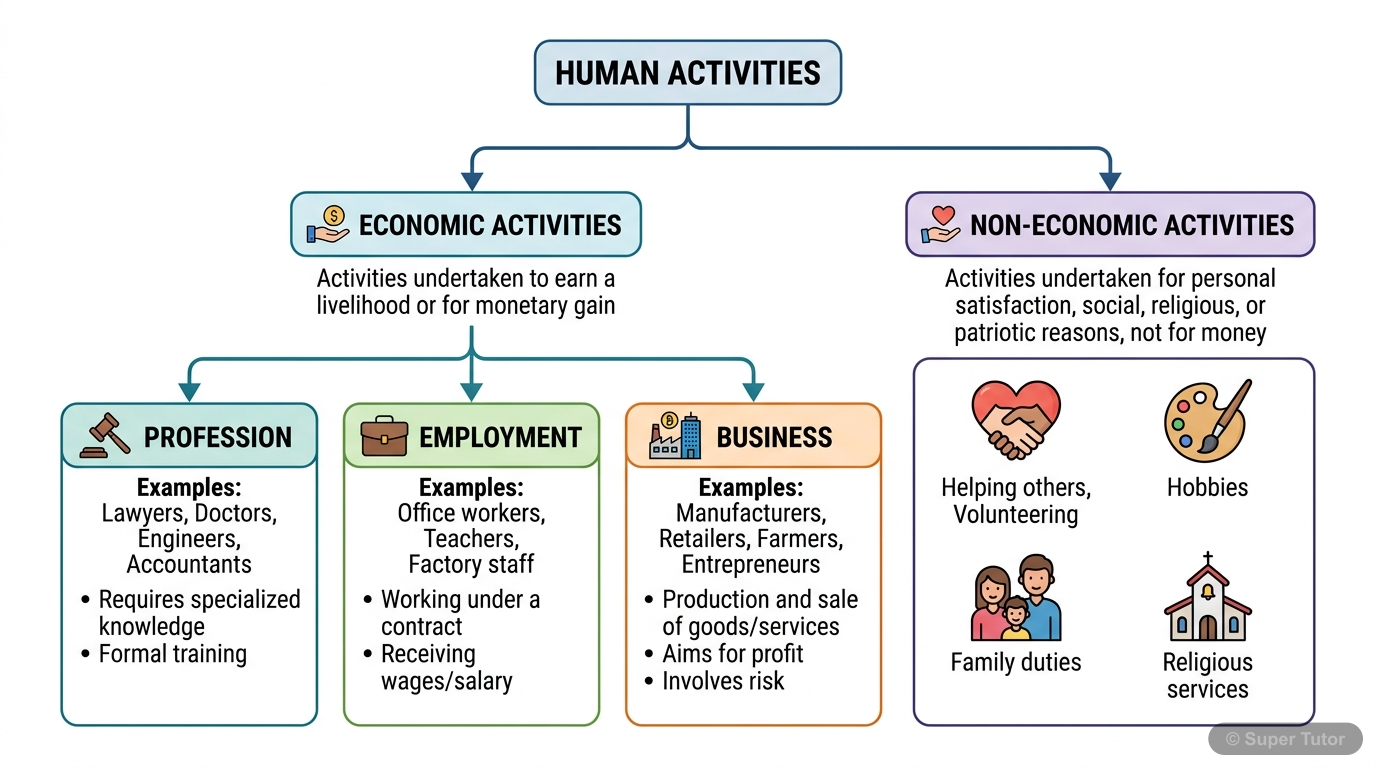
Learn better with visuals Super Tutor pairs illustrations like this with notes and quizzes for Primary Activities.
Get startedThe first 7 solutions are open to read. The other 6 are free with a Super Tutor account. Unlock all 13 free in Super Tutor
Exercises
1(i)Which one of the following is not a plantation crop?- (a) Coffee
- (b) Sugarcane
- (c) Wheat
- (d) Rubber
Show solution
- (a) Coffee
- (b) Sugarcane
- (c) Wheat
- (d) Rubber
Wheat is not a plantation crop. Plantation crops mentioned in the chapter include coffee, sugarcane, rubber, tea, cocoa, cotton, oil palm, bananas and pineapples.
Not sure why a step works? check your working in Super Tutor
1(ii)In which one of the following countries co-operative farming was the most successful experiment?- (a) Russia
- (b) Denmark
- (c) India
- (d) The Netherlands
Show solution
- (a) Russia
- (b) Denmark
- (c) India
- (d) The Netherlands
The chapter states that the co-operative movement has been successful in many western European countries, and that in Denmark it has been so successful that practically every farmer is a member of a co-operative.
Not sure why a step works? check your working in Super Tutor
1(iii)Growing of flowers is called:Choose the right answer from the four alternatives given below.
- (a) Truck farming
- (b) Factory farming
- (c) Mixed farming
- (d) Floriculture
Show solution
Choose the right answer from the four alternatives given below.
- (a) Truck farming
- (b) Factory farming
- (c) Mixed farming
- (d) Floriculture
Floriculture means the growing of flowers. So the correct option is (d) Floriculture.
Not sure why a step works? check your working in Super Tutor
1(iv)Which one of the following types of cultivation was developed by European colonists?- (a) Kolkoz
- (b) Viticulture
- (c) Mixed farming
- (d) Plantation
Show solution
- (a) Kolkoz
- (b) Viticulture
- (c) Mixed farming
- (d) Plantation
The chapter says that plantation agriculture was introduced by the European colonists in the tropics.
Not sure why a step works? check your working in Super Tutor
1(v)In which one of the following regions is extensive commercial grain cultivation not practised?- (a) American Canadian prairies
- (b) European Steppes
- (c) Pampas of Argentina
- (d) Amazon Basin
Show solution
- (a) American Canadian prairies
- (b) European Steppes
- (c) Pampas of Argentina
- (d) Amazon Basin
Extensive commercial grain cultivation is found in the Eurasian steppes, the Canadian and American prairies, and the Pampas of Argentina. It is not practised in the Amazon Basin.
Not sure why a step works? check your working in Super Tutor
1(vi)In which of the following types of agriculture is the farming of citrus fruit very important?- (a) Market gardening
- (b) Plantation agriculture
- (c) Mediterranean agriculture
- (d) Co-operative farming
Show solution
- (a) Market gardening
- (b) Plantation agriculture
- (c) Mediterranean agriculture
- (d) Co-operative farming
The chapter says that Mediterranean agriculture is an important supplier of citrus fruits.
Not sure why a step works? check your working in Super Tutor
1(vii)Which one type of agriculture amongst the following is also called 'slash and burn agriculture'?- (a) Extensive subsistence agriculture
- (b) Primitive subsistence agriculture
- (c) Extensive commercial grain cultivation
- (d) Mixed farming
Show solution
- (a) Extensive subsistence agriculture
- (b) Primitive subsistence agriculture
- (c) Extensive commercial grain cultivation
- (d) Mixed farming
Primitive subsistence agriculture or shifting cultivation is also called slash and burn agriculture.
Not sure why a step works? check your working in Super Tutor
- (a) Dairy farming
- (b) Mixed farming
- (c) Plantation agriculture
- (d) Commercial grain farming
Free with a Super Tutor account
Free with a Super Tutor account
Free with a Super Tutor account
Free with a Super Tutor account
Free with a Super Tutor account
Free with a Super Tutor account
6 more solved questions in Primary Activities
They are free with a Super Tutor account, along with practice quizzes and flashcards for this chapter. Free to start, no card needed.
Frequently Asked Questions
What are the important topics in Primary Activities for CBSE Class 12 Geography?
Are these NCERT Solutions for Primary Activities free?
How should I revise Primary Activities for the CBSE Class 12 board exam?
Sources & Official References
- NCERT Official — ncert.nic.in
- CBSE Academic — cbseacademic.nic.in
- CBSE Official — cbse.gov.in
- National Education Policy 2020 — education.gov.in
Content is aligned to the official syllabus. Refer to the board website for the latest curriculum.
More resources for Primary Activities
Practice Quiz
Test yourself with a quick quiz
Important Questions
Exam-style questions with answers
Revision Notes
Key points for last-minute revision
Chapter Summary
Understand the chapter at a glance
Concept Maps
See how topics connect
Study Plan
Step-by-step plan for this chapter
Flashcards
Quick-fire cards for active recall
Syllabus
What topics to cover
For serious students
Get the full Primary Activities chapter — start free.
Quizzes, flashcards, an AI doubt solver and a study plan for CBSE Class 12 Geography. Free to start, no card needed.