Dual Nature of Radiation and Matter — Chapter Summary
CBSE · Class 12 · Physics
Summary of Dual Nature of Radiation and Matter for CBSE Class 12 Physics. Part of the CBSE Class 12 Physics syllabus.
Interactive on Super Tutor
Studying Dual Nature of Radiation and Matter? Get the full interactive chapter.
Quizzes, flashcards, AI doubt-solver and a step-by-step study plan — built for chapter summary and more.
Free trial, no card needed.
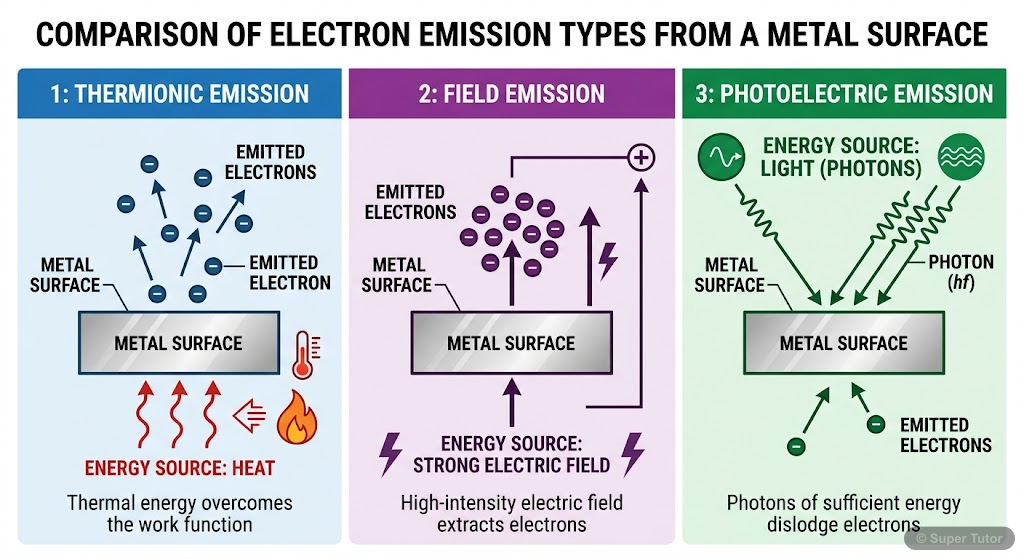
One of 10 illustrations for Dual Nature of Radiation and Matter in Super Tutor — alongside flashcards, concept maps and practice questions.
Overview
Light and matter both show a dual character. Light behaves as a wave in interference, diffraction, and polarisation, but behaves as a particle in photoelectric effect and Compton scattering. Matter such as electrons also shows wave-like behaviour, described by the de Broglie relation. The chapter co
Key Concepts
Cathode rays were discovered by William
Cathode rays were discovered by William Crookes in 1870 and later confirmed by J. J. Thomson to be streams of negatively charged particles. Thomson al
Free electrons inside metals need extra
Free electrons inside metals need extra energy to escape from the attractive forces of the metal surface. The minimum energy needed is called the work
Photoelectric emission is the release
Photoelectric emission is the release of electrons from a metal surface when light of suitable frequency falls on it. Heinrich Hertz discovered the ph
No electrons are emitted below
No electrons are emitted below the threshold frequency, no matter how high the intensity is. The stopping potential V0 is the minimum negative potenti
At fixed frequency and potential
At fixed frequency and potential, photocurrent increases linearly with intensity because the number of photoelectrons emitted per second increases. Sa
Learning Objectives
- Understand the discovery and nature of cathode rays and electrons
- Explain electron emission from metals by thermionic, field, and photoelectric processes
- Describe the main observations of photoelectric effect
- Compare wave theory of light with the photon picture
- Use Einstein’s photoelectric equation and related formulas
Frequently Asked Questions
What are the important topics in Dual Nature of Radiation and Matter for CBSE Class 12 Physics?
How should I revise Dual Nature of Radiation and Matter for the CBSE Class 12 board exam?
Sources & Official References
- NCERT Official — ncert.nic.in
- CBSE Academic — cbseacademic.nic.in
- CBSE Official — cbse.gov.in
- National Education Policy 2020 — education.gov.in
Content is aligned to the official syllabus. Refer to the board website for the latest curriculum.
More resources for Dual Nature of Radiation and Matter
Practice Quiz
Test yourself with a quick quiz
Important Questions
Exam-style questions with answers
Revision Notes
Key points for last-minute revision
Formula Sheet
The chapter's formulas in one place
Concept Maps
See how topics connect
Study Plan
Step-by-step plan for this chapter
Flashcards
Quick-fire cards for active recall
Syllabus
What topics to cover
NCERT Solutions
Every textbook question solved step by step
For serious students
Get the full Dual Nature of Radiation and Matter chapter — start free.
Quizzes, flashcards, an AI doubt solver and a study plan for CBSE Class 12 Physics. Free to start, no card needed.