Dual Nature of Radiation and Matter — Study Plan
CBSE · Class 12 · Physics
A step-by-step study plan for Dual Nature of Radiation and Matter, CBSE Class 12 Physics: what to learn first, what to practise and when to revise.
Interactive on Super Tutor
Studying Dual Nature of Radiation and Matter? Get the full interactive chapter.
Quizzes, flashcards, AI doubt-solver and a step-by-step study plan — built for study plan and more.
Free trial, no card needed.
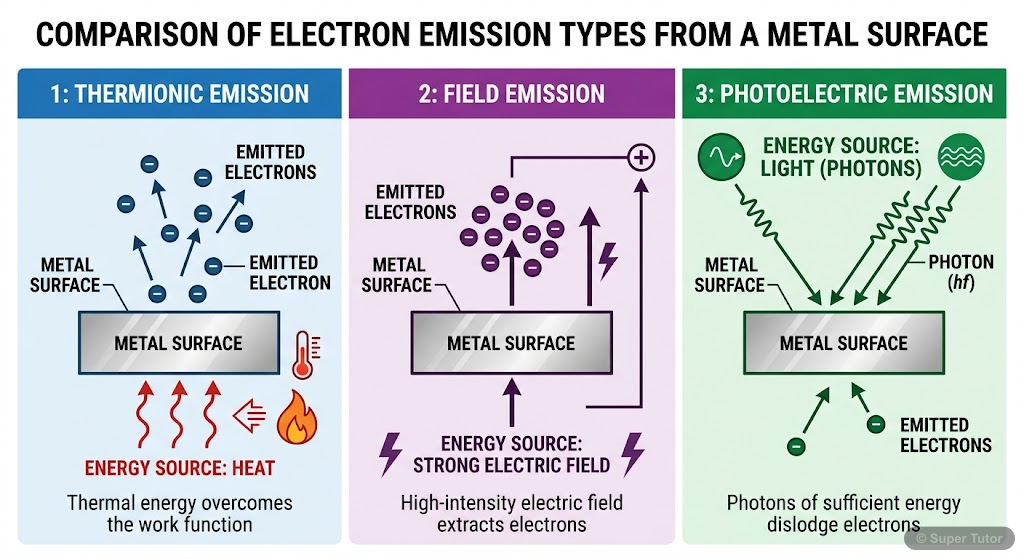
One of 10 illustrations for Dual Nature of Radiation and Matter in Super Tutor — alongside flashcards, concept maps and practice questions.
Study Plan
Learn the Theory
Read the textbook chapter carefully. Note down definitions, formulas and key ideas. Focus on: 1. Electron emission and work function, 2. Photoelectric effect and experimental observations, 3. Failure of wave theory and Einstein’s explanation.
Practise
Solve the textbook exercises and extra practice questions. There are 109 questions available for this chapter.
Revise & Test
Revise key points without looking at your notes. Take a practice quiz and mark weak areas for another pass.
Spaced Revision
Come back to Dual Nature of Radiation and Matter after a week. Use flashcards for quick recall and try past exam questions on this chapter.
What to Focus On
- Cathode rays were discovered by William Crookes in 1870.
- J. J. Thomson confirmed that cathode rays are negatively charged particles.
- The specific charge e/m of cathode rays is independent of cathode material and gas.
- Work function is the least energy required by an electron to come out of a metal.
- 1 eV = 1.602×10^-19 J.
- Thermionic emission is due to heating.
- Photoelectric effect is emission of electrons by light of suitable frequency.
- Heinrich Hertz discovered photoelectric emission in 1887.
- Hallwachs and Lenard studied the effect during 1886-1902.
Common Mistakes to Avoid
A brighter light always gives photoelectrons more maximum kinetic energy.
If light is very intense, photoelectric emission must occur even below the threshold frequency.
Stopping potential depends on intensity because a stronger light should require a stronger retarding voltage.
Memory Tips
Kinds of electron emission
Cathode rays identity
Electron charge quantisation
Work function
Want a personalised study plan?
Super Tutor builds a day-by-day plan for CBSE Class 12 Physics that fits your exam date and pace.
Create My Study PlanFrequently Asked Questions
What are the important topics in Dual Nature of Radiation and Matter for CBSE Class 12 Physics?
How should I revise Dual Nature of Radiation and Matter for the CBSE Class 12 board exam?
Sources & Official References
- NCERT Official — ncert.nic.in
- CBSE Academic — cbseacademic.nic.in
- CBSE Official — cbse.gov.in
- National Education Policy 2020 — education.gov.in
Content is aligned to the official syllabus. Refer to the board website for the latest curriculum.
More resources for Dual Nature of Radiation and Matter
Practice Quiz
Test yourself with a quick quiz
Important Questions
Exam-style questions with answers
Revision Notes
Key points for last-minute revision
Formula Sheet
The chapter's formulas in one place
Chapter Summary
Understand the chapter at a glance
Concept Maps
See how topics connect
Flashcards
Quick-fire cards for active recall
Syllabus
What topics to cover
NCERT Solutions
Every textbook question solved step by step
For serious students
Get the full Dual Nature of Radiation and Matter chapter — start free.
Quizzes, flashcards, an AI doubt solver and a study plan for CBSE Class 12 Physics. Free to start, no card needed.