Change and Development in Rural Society — Practice Quiz
CBSE · Class 12 · Sociology
Try a 4-question quiz on Change and Development in Rural Society for CBSE Class 12 Sociology: tap an answer to check it and see why.
Interactive on Super Tutor
Studying Change and Development in Rural Society? Get the full interactive chapter.
Quizzes, flashcards, AI doubt-solver and a step-by-step study plan — built for practice quiz and more.
Free trial, no card needed.
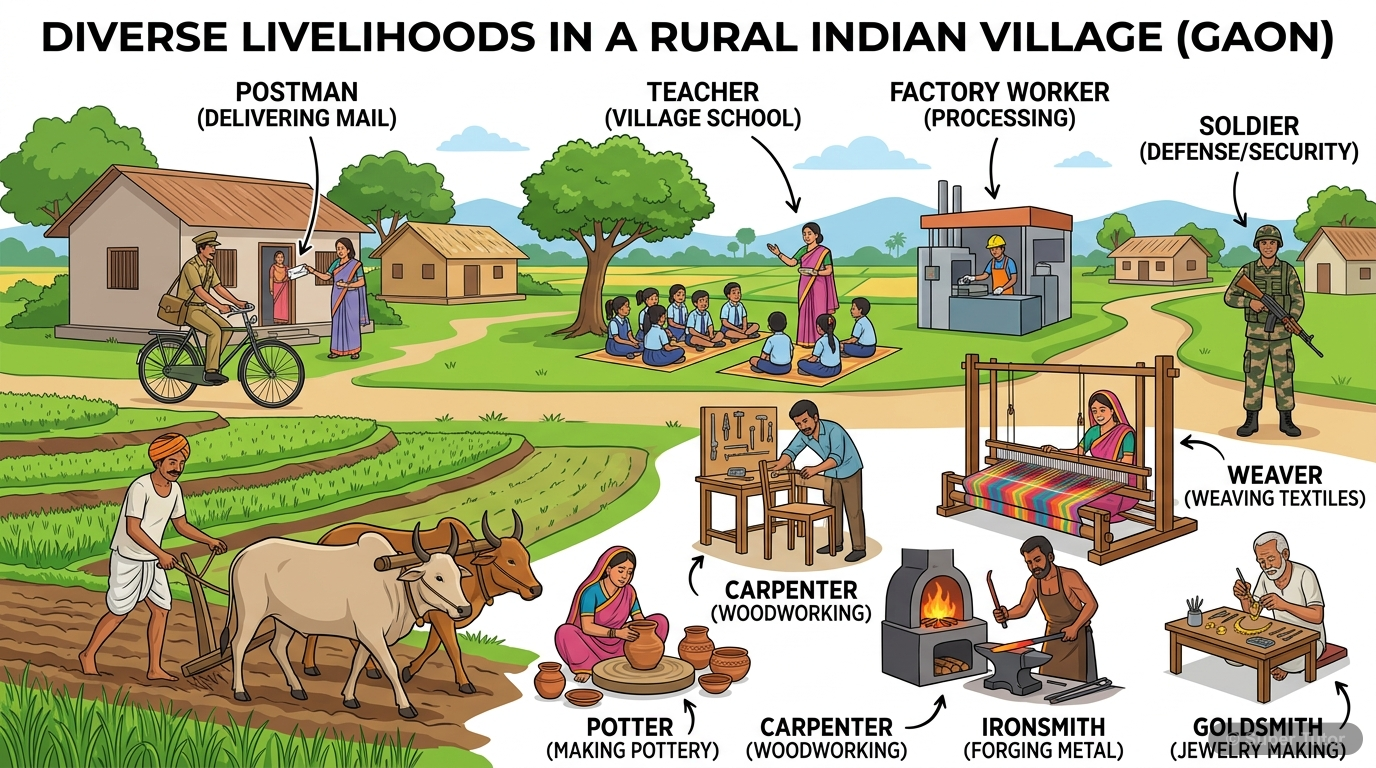
Learn better with visuals Super Tutor pairs illustrations like this with notes and quizzes for Change and Development in Rural Society.
Quick Quiz: Change and Development in Rural Society
0/4Tap an answer to check it instantly. No sign-up needed for these 4.
According to the 2011 Census, what percentage of India's population lives in rural areas?
What term is used to refer to the structure or distribution of landholding in rural areas?
The Green Revolution primarily benefited which category of farmers?
When agriculturists produce primarily for themselves and cannot produce for the market, they are called:
Sample Questions
Which of the following are examples of harvest festivals celebrated in different regions of India?
Show answer
Pongal in Tamil Nadu, Bihu in Assam, Baisakhi in Punjab, Ugadi in Karnataka
Pongal, Bihu, Baisakhi, and Ugadi are all harvest festivals that celebrate the main harvest season and herald the beginning of new agricultural seasons in their respective regions. Diwali is not primarily a harvest festival.
Dominant castes in rural areas are characterized by which of the following features?
Show answer
Major landowners, Economically powerful, Politically influential, Numerically significant
Dominant castes are characterized by being major landowners, economically powerful, politically influential, and numerically significant in their regions. They are not necessarily the highest caste (like Brahmins).
The zamindari system was abolished after Indian independence.
Show answer
True
True. The abolition of the zamindari system was the first important land reform legislation after independence, which removed the layer of intermediaries between cultivators and the state.
Which of the following were the main components of the Green Revolution package?
Show answer
High-yielding variety seeds, Pesticides, Fertilizers, Assured irrigation
The Green Revolution package included high-yielding variety seeds, pesticides, fertilizers, and required assured irrigation. Land redistribution was part of land reforms, not the Green Revolution.
+42 more questions on Change and Development in Rural Society (CBSE Class 12 Sociology)
Practise AllFrequently Asked Questions
What are the important topics in Change and Development in Rural Society for CBSE Class 12 Sociology?
How many practice questions are there for Change and Development in Rural Society?
Sources & Official References
- NCERT Official — ncert.nic.in
- CBSE Academic — cbseacademic.nic.in
- CBSE Official — cbse.gov.in
- National Education Policy 2020 — education.gov.in
Content is aligned to the official syllabus. Refer to the board website for the latest curriculum.
More resources for Change and Development in Rural Society
Important Questions
Exam-style questions with answers
Revision Notes
Key points for last-minute revision
Chapter Summary
Understand the chapter at a glance
Concept Maps
See how topics connect
Study Plan
Step-by-step plan for this chapter
Flashcards
Quick-fire cards for active recall
Syllabus
What topics to cover
NCERT Solutions
Every textbook question solved step by step
For serious students
Get the full Change and Development in Rural Society chapter — start free.
Quizzes, flashcards, an AI doubt solver and a study plan for CBSE Class 12 Sociology. Free to start, no card needed.