Structural Change — Practice Quiz
CBSE · Class 12 · Sociology
Try a 4-question quiz on Structural Change for CBSE Class 12 Sociology: tap an answer to check it and see why. 45 questions in the full chapter test.
Interactive on Super Tutor
Studying Structural Change? Get the full interactive chapter.
Quizzes, flashcards, AI doubt-solver and a step-by-step study plan — built for practice quiz and more.
Free trial, no card needed.
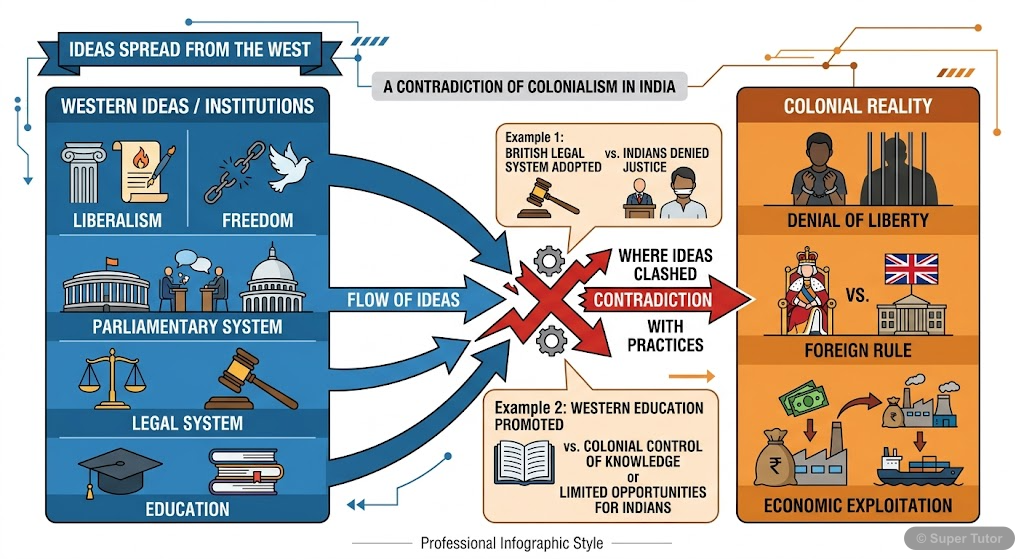
One of 9 illustrations for Structural Change in Super Tutor — alongside flashcards, concept maps and practice questions.
Quick Quiz: Structural Change
0/4Tap an answer to check it instantly. No sign-up needed for these 4.
What is the primary characteristic that distinguishes British colonialism from pre-capitalist conquests?
What does industrialization primarily refer to?
The tea industry in India began in which year?
What was the initial impact of British industrialization on India's traditional industries?
Sample Questions
Which of the following are examples of how British colonialism continues to influence contemporary India?
Show answer
Parliamentary and legal system based on British model, Driving on the left side of the road, School uniforms including neck-ties
These are direct legacies of British colonial rule that continue in modern India. Hindi as official language and traditional festivals are not colonial influences but part of Indian heritage.
Which cities were favored as coastal cities during the colonial period?
Show answer
Mumbai (Bombay), Kolkata (Calcutta), Chennai (Madras)
These three coastal cities were favored because they served as prime links between Britain and colonial India, facilitating easy export of raw materials and import of manufactured goods.
Nation-state refers to a government having sovereign power within a defined territorial area.
Show answer
True
This is the correct definition of a nation-state as given in the chapter - a government with sovereign power within defined territorial boundaries where people are citizens of a single nation.
Who established the trading post that later became Kolkata?
Show answer
Job Charnock
According to the chapter, Job Charnock, an English merchant, arranged to lease three villages (Kolikata, Gobindapur, and Sutanuti) in 1690 to set up a trading post that became Kolkata.
+41 more questions on Structural Change (CBSE Class 12 Sociology)
Practise AllFrequently Asked Questions
What are the important topics in Structural Change for CBSE Class 12 Sociology?
How many practice questions are there for Structural Change?
Sources & Official References
- NCERT Official — ncert.nic.in
- CBSE Academic — cbseacademic.nic.in
- CBSE Official — cbse.gov.in
- National Education Policy 2020 — education.gov.in
Content is aligned to the official syllabus. Refer to the board website for the latest curriculum.
More resources for Structural Change
Important Questions
Exam-style questions with answers
Revision Notes
Key points for last-minute revision
Chapter Summary
Understand the chapter at a glance
Concept Maps
See how topics connect
Study Plan
Step-by-step plan for this chapter
Flashcards
Quick-fire cards for active recall
Syllabus
What topics to cover
NCERT Solutions
Every textbook question solved step by step
For serious students
Get the full Structural Change chapter — start free.
Quizzes, flashcards, an AI doubt solver and a study plan for CBSE Class 12 Sociology. Free to start, no card needed.