Introducing Indian Society — Practice Quiz
CBSE · Class 12 · Sociology
Try a 4-question quiz on Introducing Indian Society for CBSE Class 12 Sociology: tap an answer to check it and see why.
Interactive on Super Tutor
Studying Introducing Indian Society? Get the full interactive chapter.
Quizzes, flashcards, AI doubt-solver and a step-by-step study plan — built for practice quiz and more.
Free trial, no card needed.
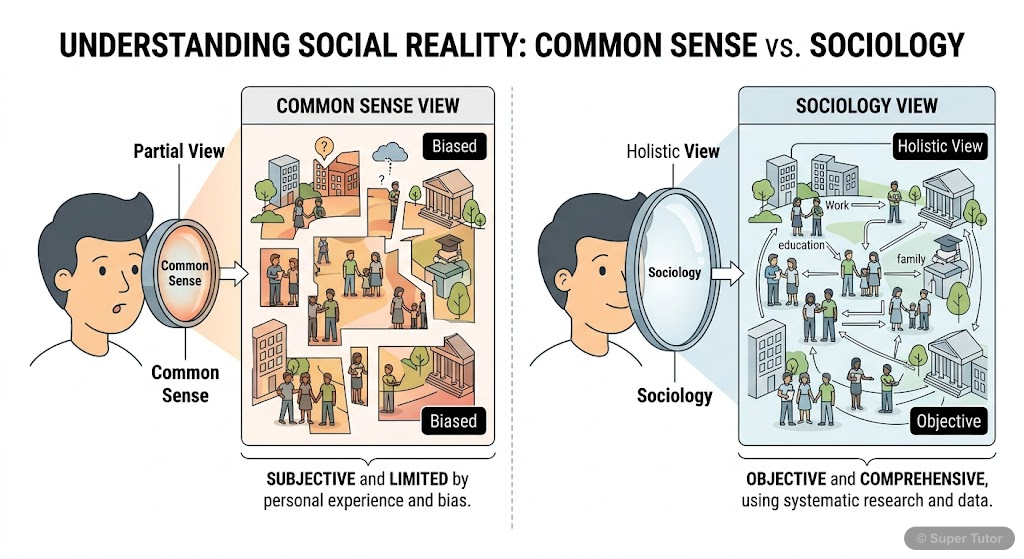
One of 5 illustrations for Introducing Indian Society in Super Tutor — alongside flashcards, concept maps and practice questions.
Quick Quiz: Introducing Indian Society
0/4Tap an answer to check it instantly. No sign-up needed for these 4.
What is the main advantage of studying Sociology compared to other subjects?
What is 'self-reflexivity' in sociology?
Approximately what percentage of India's population consists of young people (your age or younger)?
Who wrote about the connection between 'personal troubles' and 'social issues'?
Sample Questions
According to the chapter, what does 'partial' mean in the context of common sense knowledge? (Select all correct answers)
Show answer
Incomplete, Biased, One-sided
The word 'partial' is used in two senses: incomplete (opposite of whole) and biased (opposite of impartial). It also means one-sided as it comes from our particular social group's viewpoint.
Which of the following are examples of social identities mentioned in the chapter? (Select all correct answers)
Show answer
Regional or linguistic community, Economic class, Religious community, Caste or tribe
The chapter mentions regional/linguistic communities, economic class, religious communities, and caste/tribe as examples of social identities that locate you on a social map.
What is the difference between 'personal troubles' and 'social issues'?
Show answer
Personal troubles affect individuals, social issues affect large groups
Personal troubles are individual worries and concerns that derive meaning from a personalized perspective, while social issues are about large groups and not about the individuals who make them up.
According to the chapter, what is India projected to become in terms of population?
Show answer
The most populous country in the world
The chapter states that India is currently the second most populous country and is projected to overtake China and become the most populous country in the world in a few decades.
+41 more questions on Introducing Indian Society (CBSE Class 12 Sociology)
Practise AllFrequently Asked Questions
What are the important topics in Introducing Indian Society for CBSE Class 12 Sociology?
How many practice questions are there for Introducing Indian Society?
Sources & Official References
- NCERT Official — ncert.nic.in
- CBSE Academic — cbseacademic.nic.in
- CBSE Official — cbse.gov.in
- National Education Policy 2020 — education.gov.in
Content is aligned to the official syllabus. Refer to the board website for the latest curriculum.
More resources for Introducing Indian Society
Important Questions
Exam-style questions with answers
Revision Notes
Key points for last-minute revision
Chapter Summary
Understand the chapter at a glance
Concept Maps
See how topics connect
Study Plan
Step-by-step plan for this chapter
Flashcards
Quick-fire cards for active recall
Syllabus
What topics to cover
For serious students
Get the full Introducing Indian Society chapter — start free.
Quizzes, flashcards, an AI doubt solver and a study plan for CBSE Class 12 Sociology. Free to start, no card needed.