Crop Production and Management — Important Questions
Gujarat Board · Class 8 · Science
45 important questions from Crop Production and Management for Gujarat Board Class 8 Science, with answers. Includes multiple choice questions.
Interactive on Super Tutor
Studying Crop Production and Management? Get the full interactive chapter.
Quizzes, flashcards, AI doubt-solver and a step-by-step study plan — built for important questions and more.
Free trial, no card needed.
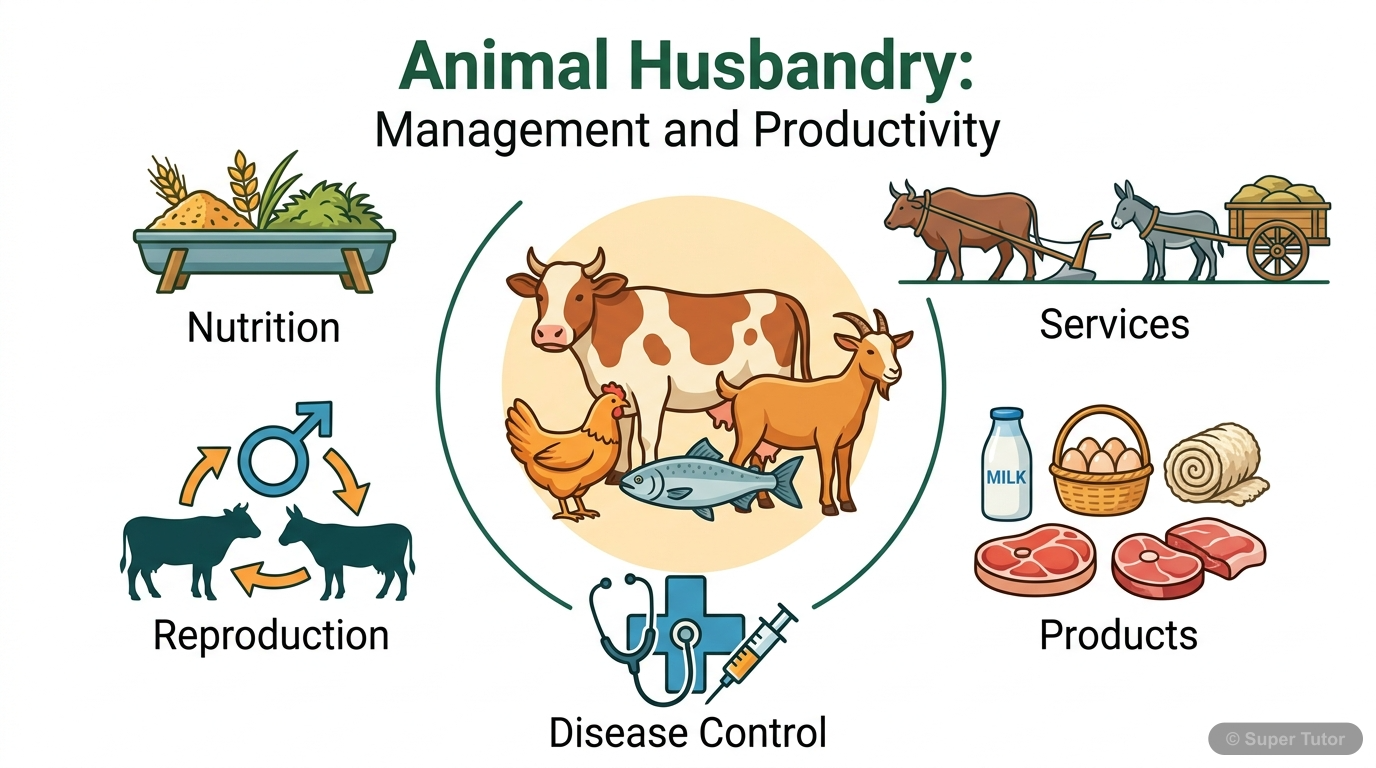
Learn better with visuals Super Tutor pairs illustrations like this with notes and quizzes for Crop Production and Management.
Important Questions from Crop Production and Management
Why do damaged seeds float on water while healthy seeds sink?
Show answer
Damaged seeds are hollow and lighter
Step 1: For a seed to float, it must be lighter than water. Step 2: Damaged or unhealthy seeds become hollow from the inside. Step 3: Because they are hollow, they weigh less (lighter) than healthy seeds and float on water. Step 4: Healthy seeds are full of food material inside, making them heavier, so they sink. Step 5: This is a simple and effective method farmers use to separate good seeds from damaged ones before sowing.
A seed drill is used in modern farming mainly for:
Show answer
Sowing seeds uniformly at equal distance and depth
Step 1: In modern farming, sowing needs to be done efficiently and uniformly for a good yield. Step 2: A seed drill is a machine attached to a tractor that sows seeds. Step 3: It places seeds at equal distance and equal depth into the soil. Step 4: It also covers the seeds with soil after sowing, protecting them from birds. Step 5: This saves time and labour compared to traditional sowing methods. Watering is done by irrigation systems, weeds are removed by khurpi or weedicides, and cutting is done by a sickle or harvester.
Manure is obtained from:
Show answer
Decomposition of plant and animal wastes
Step 1: Manure is a natural substance — it is not made in factories. Step 2: Farmers collect plant waste and animal dung in pits and allow them to decompose. Step 3: Microorganisms break down this waste over time to form organic manure. Step 4: This decomposed material is rich in nutrients and improves soil health. Step 5: Fertilisers like urea are made in factories from chemicals — this is the key difference between manure and fertilisers.
Which of the following is an example of a chemical fertiliser?
Show answer
Urea
Step 1: Fertilisers are man-made chemicals that are rich in specific nutrients like nitrogen, phosphorus, or potassium. Step 2: Urea is a chemical fertiliser that provides nitrogen to plants. Step 3: It is manufactured in factories, unlike manure which is made naturally. Step 4: Cow dung manure, compost, and vermicompost are all examples of organic manure — they are natural. Step 5: Other examples of fertilisers include ammonium sulphate, super phosphate, potash, and NPK.
+41 more questions on Crop Production and Management (Gujarat Board Class 8 Science)
Practise AllFrequently Asked Questions
What are the important topics in Crop Production and Management for Gujarat Board Class 8 Science?
How many important questions are there in Crop Production and Management?
Sources & Official References
Content is aligned to the official syllabus. Refer to the board website for the latest curriculum.
More resources for Crop Production and Management
For serious students
Get the full Crop Production and Management chapter — start free.
Quizzes, flashcards, an AI doubt solver and a study plan for Gujarat Board Class 8 Science. Free to start, no card needed.