Structure of the Atom — Chapter Summary
Gujarat Board · Class 9 · Science
Summary of Structure of the Atom for Gujarat Board Class 9 Science. Key concepts: Atoms consist of three, J and Ernest Rutherford conducted.
Interactive on Super Tutor
Studying Structure of the Atom? Get the full interactive chapter.
Quizzes, flashcards, AI doubt-solver and a step-by-step study plan — built for chapter summary and more.
Free trial, no card needed.
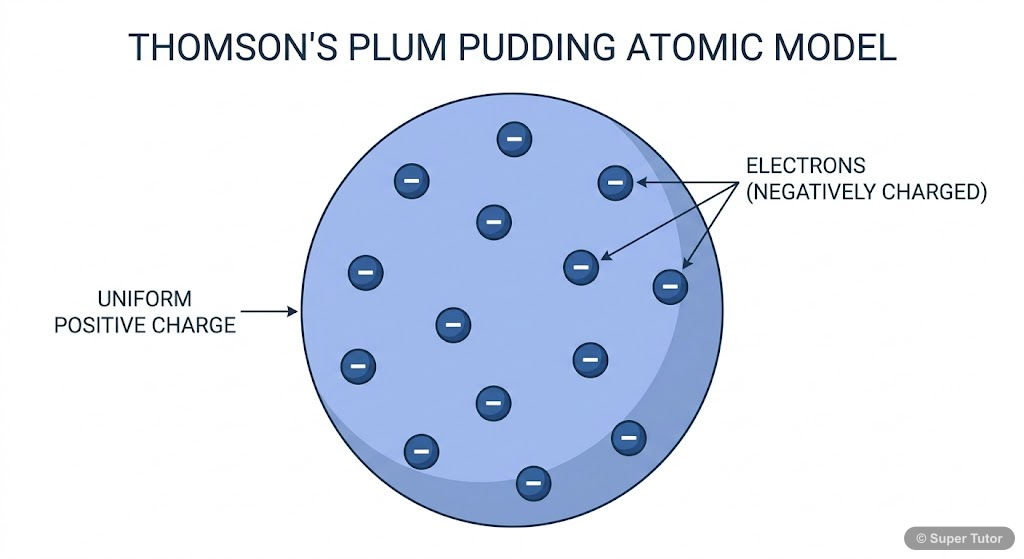
Learn better with visuals Super Tutor pairs illustrations like this with notes and quizzes for Structure of the Atom.
Overview
The atom is the fundamental building block of all matter. For a long time, scientists believed atoms were indivisible, but through a series of groundbreaking experiments, we now know that atoms contain smaller particles called subatomic particles. This chapter explores the discovery of these particl
Key Concepts
Atoms consist of three fundamental particles
Atoms consist of three fundamental particles: electrons (negatively charged), protons (positively charged), and neutrons (neutral/uncharged). Electron
J
J.J. Thomson proposed that an atom consists of a sphere of positive charge with electrons embedded throughout it, like currants in a Christmas pudding
Ernest Rutherford conducted the famous alpha
Ernest Rutherford conducted the famous alpha-particle scattering experiment using a thin gold foil. He fired fast-moving alpha particles at the foil a
Niels Bohr improved Rutherford's model by
Niels Bohr improved Rutherford's model by proposing that electrons exist in specific, discrete energy levels (shells) around the nucleus, not in rando
J
J. Chadwick discovered the neutron in 1932, a particle with no electrical charge and mass approximately equal to a proton. Neutrons are found in the n
Learning Objectives
- Understand that atoms are divisible and contain subatomic particles
- Learn about the three main subatomic particles: electrons, protons, and neutrons
- Understand the historical atomic models proposed by Thomson, Rutherford, and Bohr
- Learn how electrons are distributed in different shells/orbits around the nucleus
- Understand the concept of atomic number, mass number, and valency
Frequently Asked Questions
What are the important topics in Structure of the Atom for Gujarat Board Class 9 Science?
How should I revise Structure of the Atom for Class 9 exams?
Sources & Official References
Content is aligned to the official syllabus. Refer to the board website for the latest curriculum.
More resources for Structure of the Atom
For serious students
Get the full Structure of the Atom chapter — start free.
Quizzes, flashcards, an AI doubt solver and a study plan for Gujarat Board Class 9 Science. Free to start, no card needed.