Is Matter Around us Pure? — Chapter Summary
Gujarat Board · Class 9 · Science
Summary of Is Matter Around us Pure? for Gujarat Board Class 9 Science. Part of the Gujarat Board Class 9 Science syllabus.
Interactive on Super Tutor
Studying Is Matter Around us Pure?? Get the full interactive chapter.
Quizzes, flashcards, AI doubt-solver and a step-by-step study plan — built for chapter summary and more.
Free trial, no card needed.
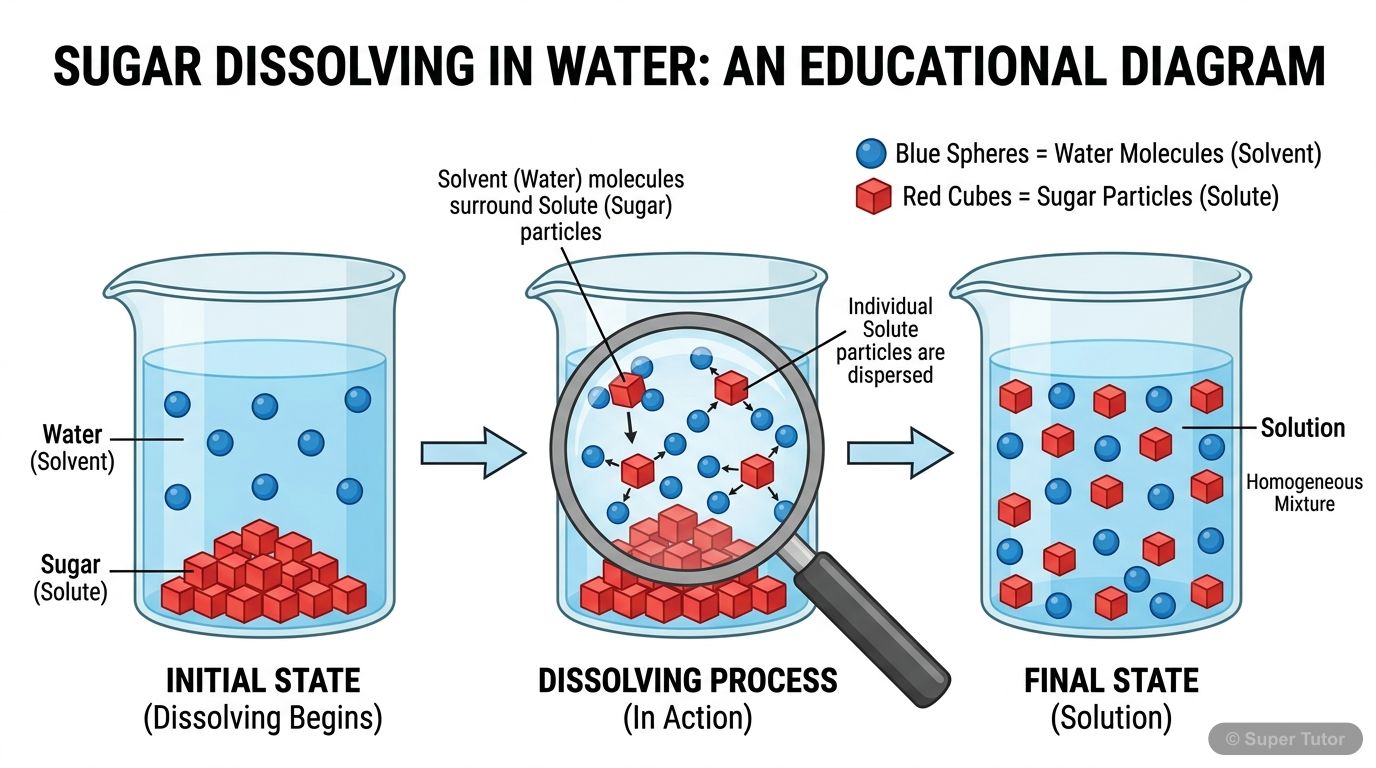
One of 2 illustrations for Is Matter Around us Pure? in Super Tutor — alongside flashcards, concept maps and practice questions.
Overview
In our daily lives, we encounter many materials like milk, water, salt, and air. Have you ever wondered if these substances are truly pure? While common people might think 'pure' means without adulteration, scientists have a different definition. For scientists, a substance is pure only when all its
Key Concepts
A pure substance consists of particles
A pure substance consists of particles that are all of the same chemical nature. It has a fixed composition and specific characteristic properties lik
A mixture is formed when two
A mixture is formed when two or more pure substances combine without undergoing a chemical reaction. Mixtures have variable composition and can be sep
A homogeneous mixture has uniform composition
A homogeneous mixture has uniform composition and properties throughout. It appears as a single phase. Examples include sugar solution, salt water, br
A heterogeneous mixture has non
A heterogeneous mixture has non-uniform composition with visibly distinct parts. Examples include sand and salt mixture, oil and water, and soil. The
A suspension is a heterogeneous mixture
A suspension is a heterogeneous mixture where solid particles are dispersed in a liquid but do not dissolve. The particles are visible to the naked ey
Learning Objectives
- Define and differentiate between pure substances and mixtures
- Classify mixtures into homogeneous and heterogeneous types
- Understand solutions, suspensions, and colloids with their properties
- Learn methods to determine the concentration of solutions
- Distinguish between physical and chemical changes
Frequently Asked Questions
What are the important topics in Is Matter Around us Pure? for Gujarat Board Class 9 Science?
How should I revise Is Matter Around us Pure? for Class 9 exams?
Sources & Official References
Content is aligned to the official syllabus. Refer to the board website for the latest curriculum.
More resources for Is Matter Around us Pure?
For serious students
Get the full Is Matter Around us Pure? chapter — start free.
Quizzes, flashcards, an AI doubt solver and a study plan for Gujarat Board Class 9 Science. Free to start, no card needed.