Chapter 4 of 12
Revision Notes
Structure of the Atom — Revision Notes
Gujarat Board · Class 9 · Science
Structure of the Atom revision notes for Gujarat Board Class 9 Science: 4 topics in quick points. Part of the Gujarat Board Class 9 Science syllabus.
45 questions25 flashcards3 formulas & key relations5 concepts
Interactive on Super Tutor
Studying Structure of the Atom? Get the full interactive chapter.
Quizzes, flashcards, AI doubt-solver and a step-by-step study plan — built for revision notes and more.
Free trial, no card needed.
Super Tutor
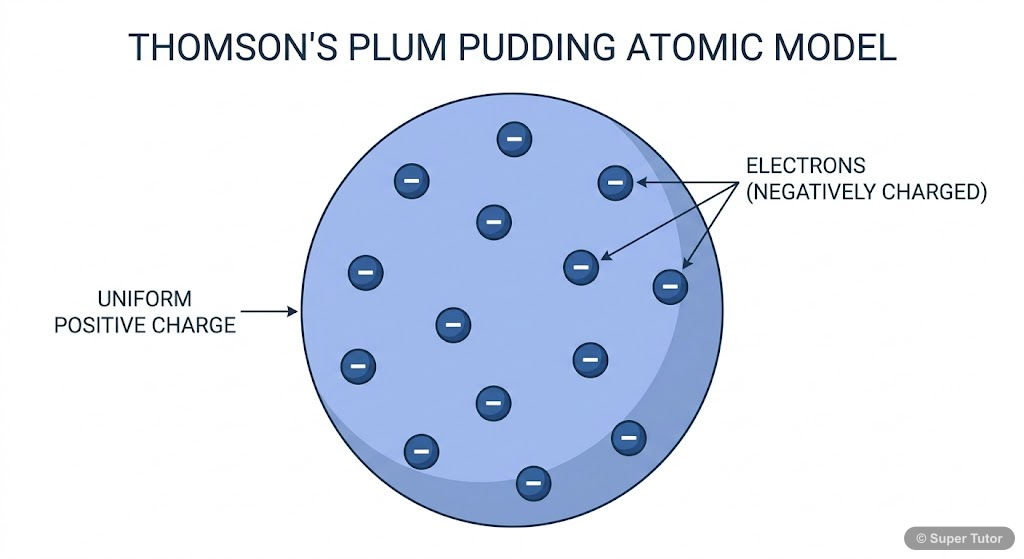
Learn better with visuals Super Tutor pairs illustrations like this with notes and quizzes for Structure of the Atom.
Key Topics to Revise
1
1. Charged Particles in Matter – Sub-Atomic Particles
- Atoms are divisible and contain smaller particles called sub-atomic particles.
- The three main sub-atomic particles are: Electron (e⁻), Proton (p⁺), and Neutron (n⁰).
- J.J. Thomson discovered the electron.
2
2. Atomic Models – Thomson, Rutherford, and Bohr
- Thomson's Model (Plum Pudding / Watermelon Model): Atom is a positively charged sphere with electrons embedded in it like seeds in a watermelon or dry fruits in a Christmas pudding.
- Thomson's model explained electrical neutrality but could NOT explain Rutherford's scattering results.
- Rutherford's Alpha-Particle Scattering Experiment: Fast-moving alpha (α) particles were fired at a thin gold foil (1000 atoms thick).
3
3. Distribution of Electrons in Shells (Bohr-Bury Rules)
- The distribution of electrons in shells follows the Bohr-Bury scheme.
- Rule 1: Maximum electrons in a shell = 2n², where n = shell number (1, 2, 3, 4...).
- K shell (n=1): max 2 electrons. L shell (n=2): max 8 electrons. M shell (n=3): max 18 electrons. N shell (n=4): max 32 electrons.
4
4. Valency
- Valency is the combining capacity of an atom — how many bonds it can form.
- Valency is determined by the number of electrons in the outermost shell (valence electrons).
- If valence electrons ≤ 4: Valency = number of valence electrons (electrons lost or shared).
Get complete notes with diagrams and examples
Full NotesKey Concepts
Atoms consist of three fundamental particlesJErnest Rutherford conducted the famous alphaNiels Bohr improved Rutherford's model byJ
Frequently Asked Questions
What are the important topics in Structure of the Atom for Gujarat Board Class 9 Science?
Key topics in Structure of the Atom include Charged Particles in Matter – Sub-Atomic Particles, Atomic Models – Thomson, Rutherford, and Bohr, Distribution of Electrons in Shells (Bohr-Bury Rules), Valency. Study these first, then practise questions on each for Class 9 exams.
How should I revise Structure of the Atom for Class 9 exams?
Learn the core ideas first, then work through the 45 practice questions on Structure of the Atom. Revise definitions regularly and use flashcards for quick recall before the exam.
Sources & Official References
Content is aligned to the official syllabus. Refer to the board website for the latest curriculum.
More resources for Structure of the Atom
For serious students
Get the full Structure of the Atom chapter — start free.
Quizzes, flashcards, an AI doubt solver and a study plan for Gujarat Board Class 9 Science. Free to start, no card needed.