Lifelines of National Economy — NCERT Solutions
Himachal Pradesh Board · Class 10 · Social Science
NCERT Solutions for Lifelines of National Economy, Himachal Pradesh Board Class 10 Social Science: 17 textbook questions solved step by step.
Interactive on Super Tutor
Studying Lifelines of National Economy? Get the full interactive chapter.
Quizzes, flashcards, AI doubt-solver and a step-by-step study plan — built for NCERT solutions and more.
Free trial, no card needed.
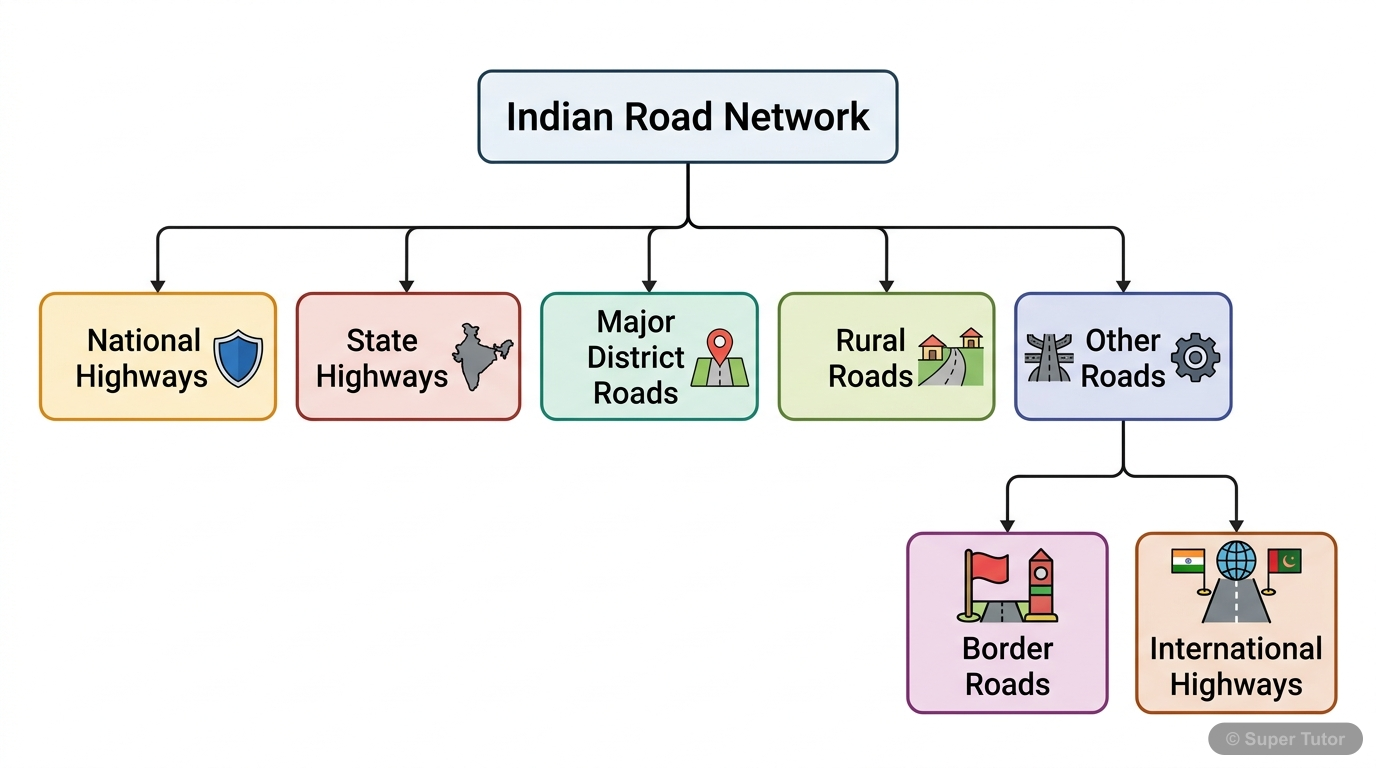
Learn better with visuals Super Tutor pairs illustrations like this with notes and quizzes for Lifelines of National Economy.
The first 9 solutions are open to read. The other 8 are free with a Super Tutor account.
Exercise 1: Multiple Choice Questions
1(i)Which two of the following extreme locations are connected by the east-west corridor?
(a) Mumbai and Nagpur
(b) Silchar and Porbandar
(c) Mumbai and Kolkata
(d) Nagpur and SiligudiShow solution
Correct answer: (b) Silchar and Porbandar
Justification: The East-West Corridor is part of the Golden Quadrilateral Super Highway project. It connects Silchar (in Assam, extreme east) to Porbandar (in Gujarat, extreme west), covering a distance of about 3,640 km.
1(ii)Which mode of transportation reduces trans-shipment losses and delays?
(a) Railways
(b) Roadways
(c) Pipeline
(d) WaterwaysShow solution
Correct answer: (c) Pipeline
Justification: Pipelines are used to transport liquids, gases, and even slurry (solids mixed with water) directly from source to destination without any intermediate loading/unloading (trans-shipment). This eliminates losses and delays caused by handling at multiple points.
1(iii)Which one of the following states is not connected with the H.V.J. pipeline?
(a) Madhya Pradesh
(b) Maharashtra
(c) Gujarat
(d) Uttar PradeshShow solution
Correct answer: (b) Maharashtra
Justification: The Hazira–Vijaipur–Jagdishpur (HVJ) pipeline passes through Gujarat, Madhya Pradesh, and Uttar Pradesh. Maharashtra is not connected with this pipeline network.
1(iv)Which one of the following ports is the deepest land-locked and well-protected port along the east coast?
(a) Chennai
(b) Paradwip
(c) V.O. Chidambaranar (Tuticorin)
(d) VishakhapatnamShow solution
Correct answer: (d) Vishakhapatnam
Justification: Vishakhapatnam (Visakhapatnam) is the deepest land-locked and well-protected port on the east coast of India. It is located in Andhra Pradesh and handles a large volume of cargo including iron ore exports.
1(v)Which one of the following is the most important mode of transportation in India?
(a) Pipeline
(b) Railways
(c) Roadways
(d) AirwaysShow solution
Correct answer: (c) Roadways
Justification: Roadways constitute the most important mode of transportation in India. India has one of the largest road networks in the world (~63 lakh km). Roads carry about 85% of passenger traffic and 70% of freight traffic, making them the dominant mode of transport.
1(vi)Which one of the following terms is used to describe trade between two or more countries?
(a) Internal trade
(b) International trade
(c) External trade
(d) Local tradeShow solution
Correct answer: (b) International trade
Justification: Trade that takes place between two or more countries is called International trade. It involves the exchange of goods and services across national boundaries and is also referred to as foreign trade.
Exercise 2: Short Answer Questions (about 30 words)
2(i)State any three merits of roadways.Show solution
Three merits of roadways are:
- Door-to-door service: Roads provide the advantage of door-to-door delivery of goods and passengers, which is not possible with railways or airways.
- Construction in difficult terrain: Roads can be constructed in hilly, mountainous, and remote areas where laying railway lines is difficult and expensive.
- Economical for short distances: Transporting goods and passengers over short distances is cheaper and more convenient by road than by any other mode of transport.
2(ii)Where and why is rail transport the most convenient means of transportation?Show solution
Rail transport is most convenient in the northern plains of India because:
- The vast level land makes construction of railway lines easy and economical.
- The high density of population and large volume of agricultural produce and goods require bulk transport over long distances.
- The extensive plain area allows a dense network of railway lines to be laid easily.
2(iii)What is the significance of the border roads?Show solution
Border roads are significant because:
- They have improved accessibility in remote and strategically important areas near international borders (e.g., in the Himalayas and North-East India).
- They are vital for the movement of defence personnel and military equipment to border areas.
- They have promoted economic development and integration of border regions with the rest of the country by connecting previously isolated areas.
Free with a Super Tutor account
Exercise 3: Long Answer Questions (about 120 words)
Free with a Super Tutor account
Free with a Super Tutor account
Quiz Drive
Free with a Super Tutor account
Free with a Super Tutor account
Free with a Super Tutor account
Free with a Super Tutor account
Free with a Super Tutor account
8 more solved questions in Lifelines of National Economy
They are free with a Super Tutor account, along with practice quizzes and flashcards for this chapter. Free to start, no card needed.
Frequently Asked Questions
What are the important topics in Lifelines of National Economy for Himachal Pradesh Board Class 10 Social Science?
Are these NCERT Solutions for Lifelines of National Economy free?
How should I revise Lifelines of National Economy for the Himachal Pradesh Board Class 10 board exam?
Sources & Official References
Content is aligned to the official syllabus. Refer to the board website for the latest curriculum.
More resources for Lifelines of National Economy
Practice Quiz
Test yourself with a quick quiz
Important Questions
Exam-style questions with answers
Revision Notes
Key points for last-minute revision
Chapter Summary
Understand the chapter at a glance
Concept Maps
See how topics connect
Study Plan
Step-by-step plan for this chapter
Flashcards
Quick-fire cards for active recall
Syllabus
What topics to cover
For serious students
Get the full Lifelines of National Economy chapter — start free.
Quizzes, flashcards, an AI doubt solver and a study plan for Himachal Pradesh Board Class 10 Social Science. Free to start, no card needed.