The Village School Master
ICSE · Class 10 · English Literature-Treasure Chest ( Poems and Short Stories)
Quick revision notes for The Village School Master — ICSE Class 10 English Literature-Treasure Chest ( Poems and Short Stories). Key concepts, formulas, and definitions for last-minute revision.
Interactive on Super Tutor
Studying The Village School Master? Get the full interactive chapter.
Quizzes, flashcards, AI doubt-solver and a step-by-step study plan — built for revision notes and more.
1,000+ Class 10 students started this chapter today
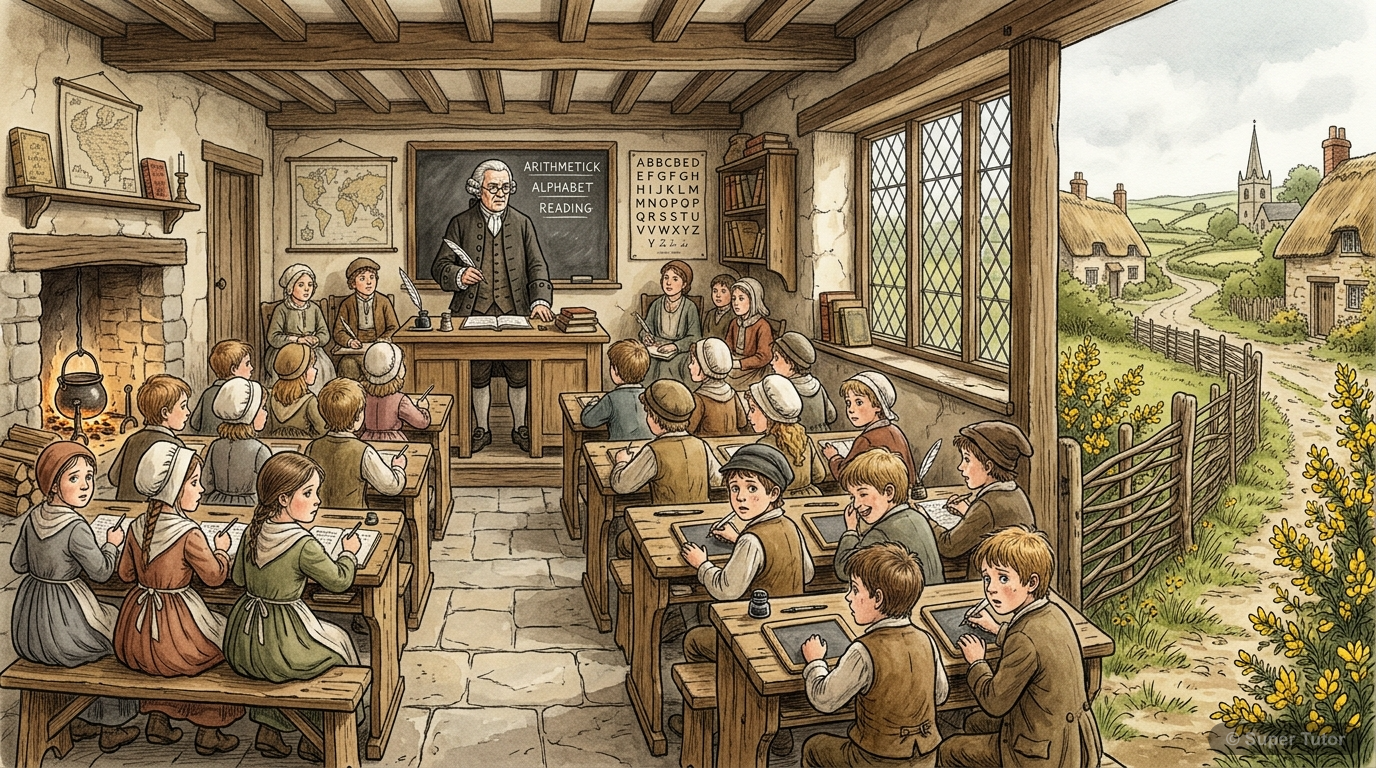
Learn better with visuals Super Tutor has hundreds of illustrations like this across every chapter — all free to try.
Get startedKey Topics to Revise
Chapter Overview
- The poem is an extract from The Deserted Village, not a separate complete poem.
- It is written by Oliver Goldsmith, a major writer of the Augustan Age.
- The title suggests a rural setting through the words village and schoolmaster.
About the Poet
- Oliver Goldsmith was born in Ireland.
- He graduated from Trinity College, Dublin.
- He studied medicine in Edinburgh but never received a medical degree.
Character Sketch of the Schoolmaster
- The schoolmaster is the central character of the extract.
- He is severe and stern in appearance.
- The narrator personally knew him, and every truant knew him too.
Themes
- Respect for knowledge is the main idea of the extract.
- The poem shows that learning gives a person dignity and authority.
- There is a contrast between fear and respect.
Get complete notes with diagrams and examples
Full NotesKey Concepts
Frequently Asked Questions
What are the important topics in The Village School Master for ICSE Class 10 English Literature-Treasure Chest ( Poems and Short Stories)?
How to score full marks in The Village School Master — ICSE Class 10 English Literature-Treasure Chest ( Poems and Short Stories)?
Sources & Official References
Content is aligned to the official syllabus. Refer to the board website for the latest curriculum.
More resources for The Village School Master
Practice Quiz
Test yourself with a quick quiz
Important Questions
Practice with board exam-style questions
Formula Sheet
All formulas in one place
Chapter Summary
Understand the chapter at a glance
Concept Maps
See how topics connect visually
Study Plan
Step-by-step plan to ace this chapter
Flashcards
Quick-fire cards for active recall
Syllabus
What topics to cover
NCERT Solutions
Every textbook question solved step by step
For serious students
Get the full The Village School Master chapter — for free.
Quizzes, flashcards, AI doubt-solver and a step-by-step study plan for ICSE Class 10 English Literature-Treasure Chest ( Poems and Short Stories).