Shares and Dividends — Flashcards
ICSE · Class 10 · Mathematics
28 flashcards for Shares and Dividends (ICSE Class 10 Mathematics) to test yourself on key terms and facts. Part of the ICSE Class 10 Mathematics syllabus.
Interactive on Super Tutor
Studying Shares and Dividends? Get the full interactive chapter.
Quizzes, flashcards, AI doubt-solver and a step-by-step study plan — built for flashcards and more.
Free trial, no card needed.
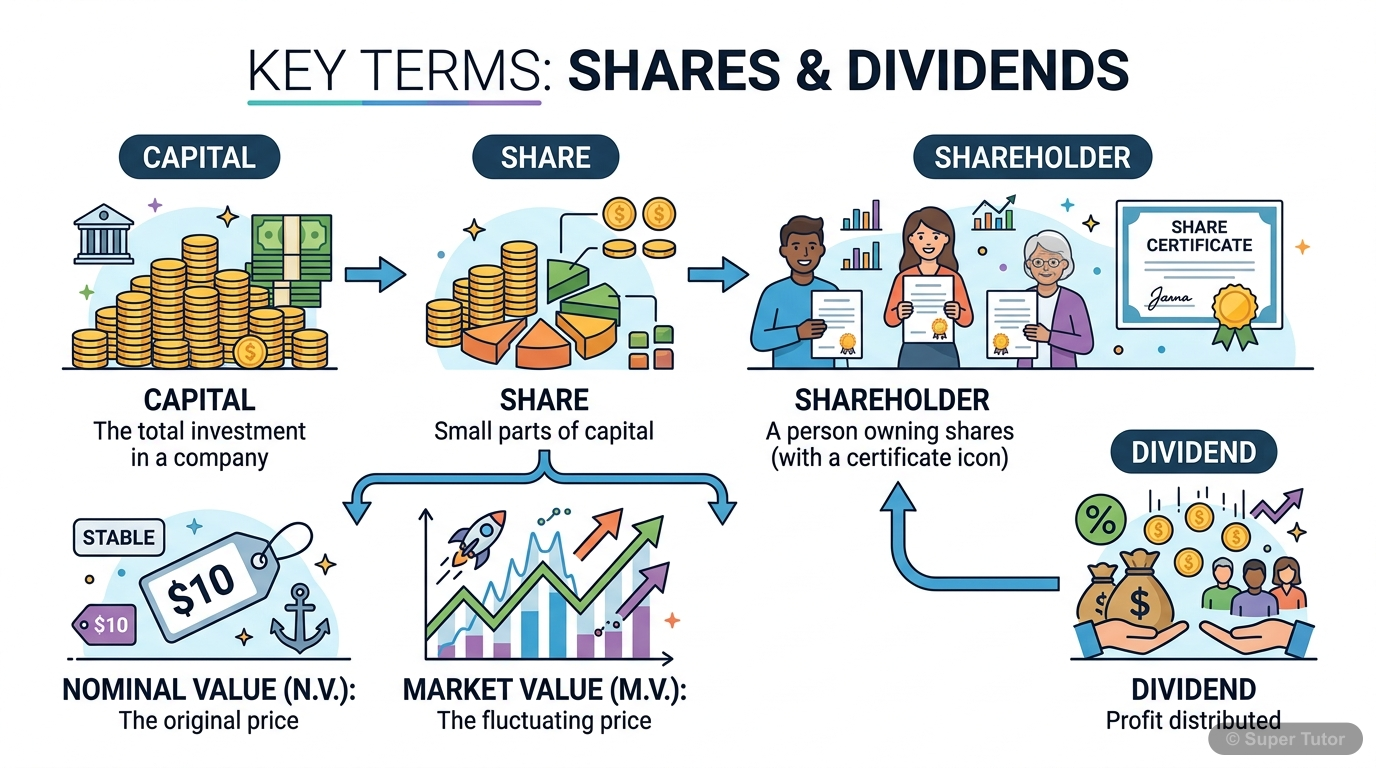
Learn better with visuals Super Tutor pairs illustrations like this with notes and quizzes for Shares and Dividends.
A ₹100 share is quoted at a premium of ₹20. Find its market value.
Answer
Step 1: Market value = nominal value + premium. Step 2: Market value = ₹100 + ₹20 = ₹120. Answer: The market value is ₹120.
A ₹100 share is quoted at a discount of ₹20. Find its market value.
Answer
Step 1: Market value = nominal value - discount. Step 2: Market value = ₹100 - ₹20 = ₹80. Answer: The market value is ₹80.
Solve: Find the amount required to buy 500 shares of face value ₹50 each at a premium of ₹5.
Answer
Step 1: Find market value of one share. Market value = ₹50 + ₹5 = ₹55. Step 2: Use money invested = number of shares × market value of one share. Money invested = 500 × 55 = ₹27,500. Answer: ₹27,500.
Solve: Find the amount required to buy 400 shares of face value ₹90 each at a discount of ₹15.
Answer
Step 1: Find market value of one share. Market value = ₹90 - ₹15 = ₹75. Step 2: Use money invested = number of shares × market value of one share. Money invested = 400 × 75 = ₹30,000. Answer: ₹30,000.
Dr. Bansal buys 250 shares at a face value of ₹75 each and sells them at ₹82 each. Find the profit percent.
Answer
Step 1: Profit on one share = ₹82 - ₹75 = ₹7. Step 2: Total profit = 250 × 7 = ₹1,750. Step 3: Cost price = 250 × 75 = ₹18,750. Step 4: Profit percent = (Profit / Cost price) × 100. Profit percent = (…
Mr. Chauhan buys 120 shares at a face value of ₹40 each and sells them at ₹42.50 each. Find the profit percent.
Answer
Step 1: Profit on one share = ₹42.50 - ₹40 = ₹2.50. Step 2: Total profit = 120 × 2.50 = ₹300. Step 3: Cost price = 120 × 40 = ₹4,800. Step 4: Profit percent = (300 / 4800) × 100 = 6.25%. Answer: 6.25%…
A company issued 20,000 shares of par value ₹25 each. If the total dividend declared is ₹85,000, find the rate of dividend.
Answer
Step 1: Total par value = 20,000 × 25 = ₹5,00,000. Step 2: Rate of dividend = (Total dividend / Total par value) × 100. Step 3: Rate = (85,000 / 5,00,000) × 100 = 17%. Answer: 17%.
A company issued 20,000 shares of par value ₹25 each and the rate of dividend is 17%. Find the dividend received by Ram who has 400 shares.
Answer
Step 1: Dividend is calculated on nominal value. Step 2: Total nominal value of Ram's shares = 400 × 25 = ₹10,000. Step 3: Dividend received = 17% of 10,000. Step 4: Dividend = (17 / 100) × 10,000 = ₹…
+20 more flashcards
Practise AllFrequently Asked Questions
What are the important topics in Shares and Dividends for ICSE Class 10 Mathematics?
How many flashcards are available for Shares and Dividends?
How should I revise Shares and Dividends for the ICSE Class 10 board exam?
Sources & Official References
Content is aligned to the official syllabus. Refer to the board website for the latest curriculum.
More resources for Shares and Dividends
Practice Quiz
Test yourself with a quick quiz
Important Questions
Exam-style questions with answers
Revision Notes
Key points for last-minute revision
Formula Sheet
The chapter's formulas in one place
Chapter Summary
Understand the chapter at a glance
Concept Maps
See how topics connect
Study Plan
Step-by-step plan for this chapter
Syllabus
What topics to cover
For serious students
Get the full Shares and Dividends chapter — start free.
Quizzes, flashcards, an AI doubt solver and a study plan for ICSE Class 10 Mathematics. Free to start, no card needed.