Business Environment
ICSE · Class 11 · Business Studies
Most important questions from Business Environment for ICSE Class 11 Business Studies board exam 2026. MCQs, short answer, and long answer questions with marks.
Interactive on Super Tutor
Studying Business Environment? Get the full interactive chapter.
Quizzes, flashcards, AI doubt-solver and a step-by-step study plan — built for important questions and more.
1,000+ Class 11 students started this chapter today
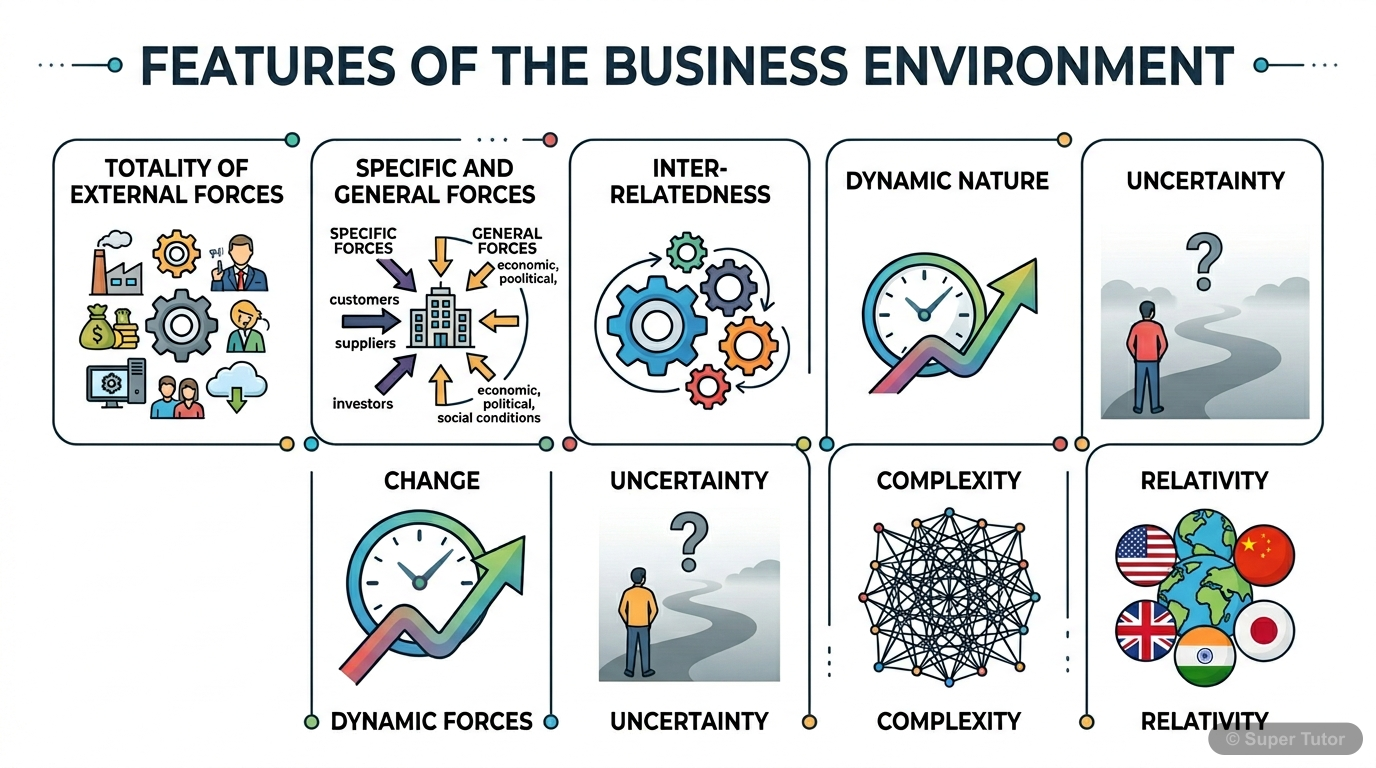
This is just one of 5+ visuals inside Super Tutor's Business Environment chapter
Explore the full setSample Questions
Which of the following economic systems gives NO freedom to individuals to run their own business, as the government directs and controls all business activities?
Show answer
Socialistic System
Step 1: The economic system shapes how much freedom businesses have. Step 2: Capitalistic System gives maximum freedom to private businesses — individuals own and run businesses freely. Step 3: Mixed Economy System allows both government and private individuals to own businesses — India follows this system. Step 4: Liberal Economy System is not a standard category mentioned in this chapter. Step 5: Socialistic System is where the government directs and controls all business. Individuals have NO freedom to run their own businesses. This perfectly matches the question description.
In Porter's Five Forces, a situation where buyers can easily switch to alternative products without incurring extra costs primarily refers to high:
Show answer
Threat of Substitutes
Step 1: The key phrases in the question are 'alternative products' and 'switch without extra costs.' Step 2: Threat of Substitutes specifically deals with alternative products that can replace the company's product. Step 3: If switching costs are low and substitute products are available at good prices, the Threat of Substitutes is HIGH. Step 4: Bargaining Power of Buyers relates to buyers demanding lower prices/better quality — not specifically about switching to alternative products. Step 5: New Entrants relates to new competitors entering the market, not alternatives. Step 6: Rivalry relate
Which of the following is a part of the MICRO environment (operating environment) of a business?
Show answer
Marketing Intermediaries
Step 1: Business environment has two components — Micro (Operating) and Macro (General) environment. Step 2: Micro environment includes factors closely related to the specific business — Customers, Competitors, Suppliers, Public, and Marketing Intermediaries. Step 3: Marketing Intermediaries (agents, wholesalers, retailers) directly interact with a specific company's distribution process — this is micro environment. Step 4: General Price Level, Technological developments, and Legal regulations affect ALL businesses simultaneously, not just one specific company — these are Macro environment fac
According to Keith Davis, business environment is defined as 'the aggregate of all conditions, events and influences that surround and affect business.' Which feature of business environment is highlighted by the phrase 'aggregate of all conditions'?
Show answer
Totality of Internal and External Forces
Step 1: The phrase 'aggregate of all conditions' means the SUM TOTAL of everything that surrounds and affects business. Step 2: Totality of Internal and External Forces means business environment is the combined result of ALL internal forces (management, culture, resources) AND external forces (economic, social, political, legal, technological). Step 3: Universality means the environment applies to all enterprises everywhere — not specifically about 'aggregate.' Step 4: Dynamic means it keeps changing — not about being a sum total. Step 5: Complex means it is difficult to understand — not the
+41 more questions available
Practice AllFrequently Asked Questions
What are the important topics in Business Environment for ICSE Class 11 Business Studies?
How to score full marks in Business Environment — ICSE Class 11 Business Studies?
How many important questions are there in Business Environment?
Sources & Official References
Content is aligned to the official syllabus. Refer to the board website for the latest curriculum.
More resources for Business Environment
Practice Quiz
Test yourself with a quick quiz
Revision Notes
Key points for last-minute revision
Formula Sheet
All formulas in one place
Chapter Summary
Understand the chapter at a glance
Concept Maps
See how topics connect visually
Study Plan
Step-by-step plan to ace this chapter
Flashcards
Quick-fire cards for active recall
Syllabus
What topics to cover
NCERT Solutions
Every textbook question solved step by step
For serious students
Get the full Business Environment chapter — for free.
Quizzes, flashcards, AI doubt-solver and a step-by-step study plan for ICSE Class 11 Business Studies.