Entrepreneurship — Important Questions
ICSE · Class 11 · Business Studies
44 important questions from Entrepreneurship for ICSE Class 11 Business Studies, with answers. Includes multiple choice questions.
Interactive on Super Tutor
Studying Entrepreneurship? Get the full interactive chapter.
Quizzes, flashcards, AI doubt-solver and a step-by-step study plan — built for important questions and more.
Free trial, no card needed.
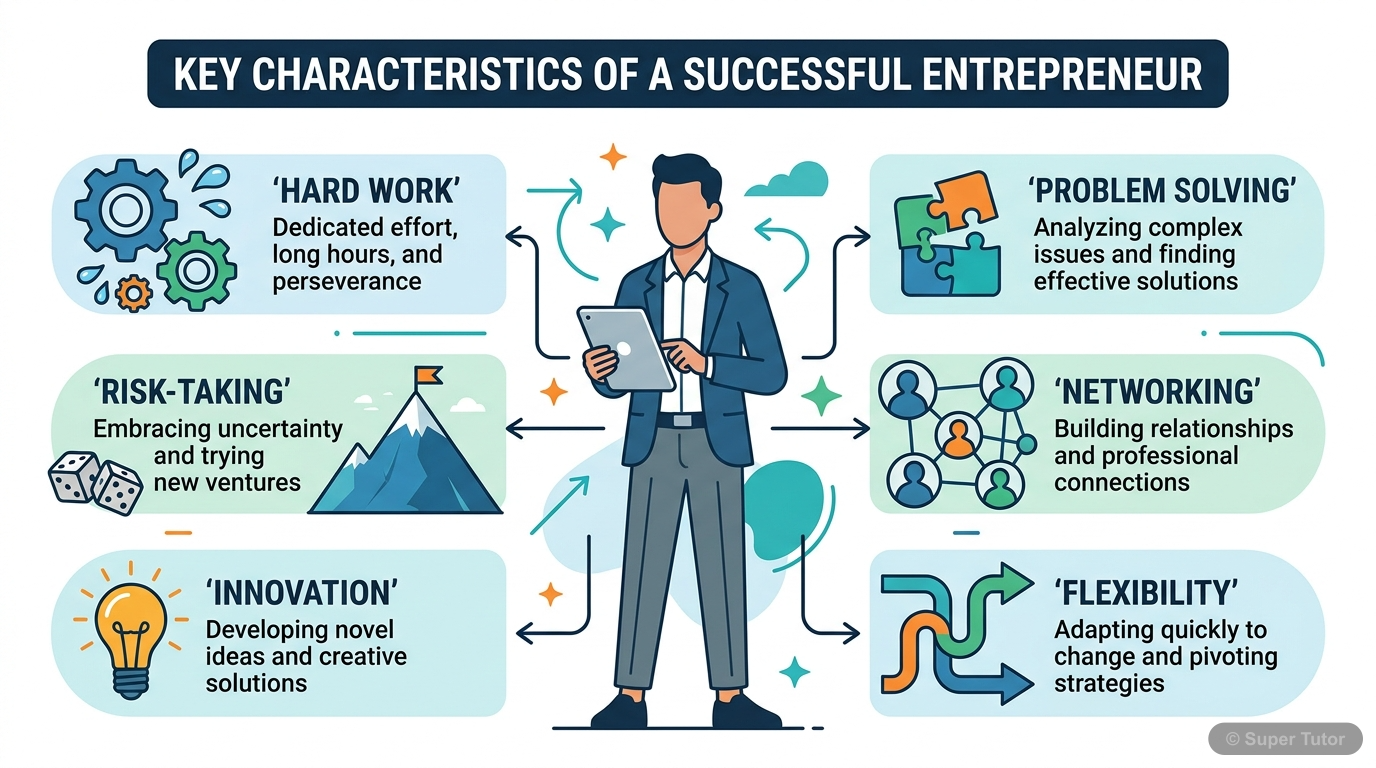
An illustration from Super Tutor's Entrepreneurship chapter — alongside flashcards, concept maps and practice questions.
Important Questions from Entrepreneurship
What is the PRIMARY reward for an entrepreneur as compared to an intrapreneur?
Show answer
Profit (which can also be a loss)
Step 1: This question tests understanding of the key difference between an entrepreneur and an intrapreneur in terms of financial reward. Step 2: An entrepreneur is the owner of the business and therefore earns PROFIT as the reward. However, since profit is uncertain, it can also result in a loss — making this reward risky. Step 3: An intrapreneur, being a paid senior executive, receives a FIXED SALARY and fringe benefits such as bonuses, stock options, insurance, etc. Step 4: 'Stock options only' is incorrect because intrapreneurs get salary plus stock options, not just stock options. 'Fixed
Which of the following best describes a 'Fabian Entrepreneur' as classified by Clarence Danhof?
Show answer
One who is cautious, follows predecessors, and avoids risk and change
Step 1: Clarence Danhof's classification includes Fabian entrepreneurs as a distinct type. Step 2: Fabian entrepreneurs are described as very cautious and skeptical about change. They are shy and lazy, unwilling to take risks, and follow the footsteps of their predecessors. Step 3: They are dominated by customs, traditions, religion, and past practices. Mom and Pop stores are a classic example. Step 4: The option 'refuses to adopt changes and suffers losses due to stubbornness' describes DRONE entrepreneurs — they are even more resistant than Fabian entrepreneurs and are pushed out of the mark
Joseph Schumpeter defined an entrepreneur as someone who brings economic development through new combinations of factors of production. What is the key term used to describe this role of an entrepreneur?
Show answer
Innovator
Step 1: The question directly refers to Schumpeter's definition of an entrepreneur. Step 2: According to Joseph Schumpeter, 'An entrepreneur is an innovator who brings economic development through new combination of factors of production.' Step 3: The key term here is 'Innovator' — the entrepreneur brings something NEW by combining land, labour, and capital in a new way. Step 4: 'Risk-bearer' is associated with Richard Cantillon's view. 'Organiser' is one of the three elements of entrepreneurship but not Schumpeter's defining term. 'Manager' is a different role — a manager runs an existing ent
In which phase of the business cycle do producers continue to produce even after demand starts declining, leading to excess supply in the market?
Show answer
Recession
Step 1: The question describes a specific scenario — demand is falling but production continues, creating excess supply. Step 2: This is the hallmark of the RECESSION phase. Producers do not notice the decrease in demand instantly, so they keep producing, leading to oversupply and falling prices. Step 3: The PEAK phase is when prices and profits are at their highest — not a period of falling demand. Step 4: The TROUGH phase is when the economy hits its lowest point — prices, demand, and supply are all at the minimum. Step 5: RECOVERY is when demand starts picking up again from the lowest point
+40 more questions on Entrepreneurship (ICSE Class 11 Business Studies)
Practise AllFrequently Asked Questions
What are the important topics in Entrepreneurship for ICSE Class 11 Business Studies?
How many important questions are there in Entrepreneurship?
Sources & Official References
Content is aligned to the official syllabus. Refer to the board website for the latest curriculum.
More resources for Entrepreneurship
For serious students
Get the full Entrepreneurship chapter — start free.
Quizzes, flashcards, an AI doubt solver and a study plan for ICSE Class 11 Business Studies. Free to start, no card needed.