Probability — Important Questions
ICSE · Class 11 · Mathematics
64 important questions from Probability for ICSE Class 11 Mathematics, with answers. Includes multiple choice and true false questions.
Interactive on Super Tutor
Studying Probability? Get the full interactive chapter.
Quizzes, flashcards, AI doubt-solver and a step-by-step study plan — built for important questions and more.
Free trial, no card needed.
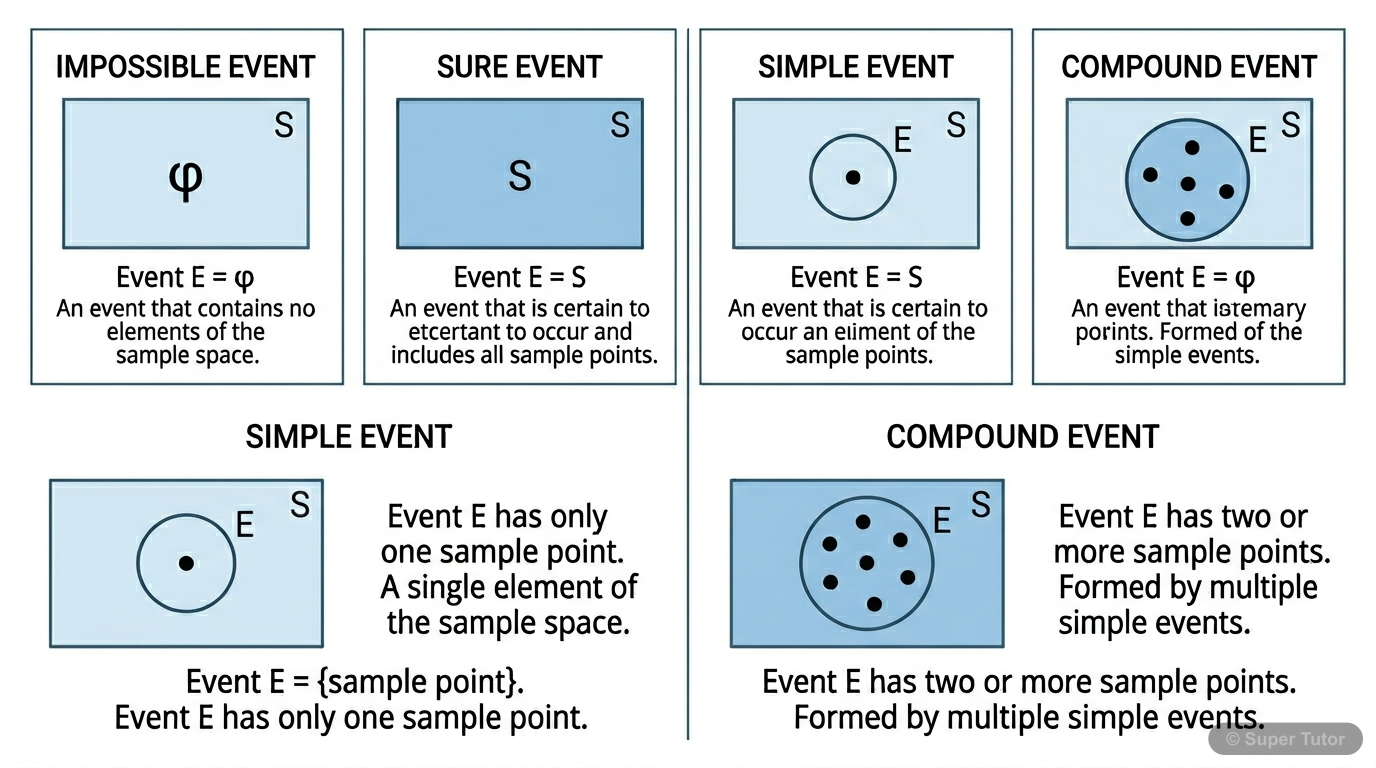
Learn better with visuals Super Tutor pairs illustrations like this with notes and quizzes for Probability.
Important Questions from Probability
A bag contains 2 red balls, 5 black balls and 8 green balls. One ball is drawn at random. Find the probability that the ball is neither red nor black.
Show answer
8/15
Neither red nor black means the ball must be green. There are 8 green balls out of 15 total balls. So the probability is 8/15.
A die is thrown once. Let E be getting a number less than 7 and F be getting a number greater than 7. Find P(E union F).
Show answer
1
On a die, every outcome is less than 7. So E is the whole sample space and P(E) = 1. Event F is impossible. Therefore E union F is still the whole sample space, so P(E union F) = 1.
A die is thrown once. Let E be the event of getting an even number and F be the event of getting 6. Find P(E intersection F).
Show answer
1/6
E = {2,4,6} and F = {6}. So E intersection F = {6}. There is 1 favourable outcome out of 6 total outcomes. Hence P(E intersection F) = 1/6.
A die is thrown once. Let E be the event of getting an even number and F be the event of getting an odd number. Which statement is correct?
Show answer
E and F are mutually exclusive and exhaustive
E = {2,4,6} and F = {1,3,5}. They have no common outcome, so they are mutually exclusive. Their union is {1,2,3,4,5,6}, which is the sample space, so they are exhaustive too.
+60 more questions on Probability (ICSE Class 11 Mathematics)
Practise AllFrequently Asked Questions
What are the important topics in Probability for ICSE Class 11 Mathematics?
How many important questions are there in Probability?
Sources & Official References
Content is aligned to the official syllabus. Refer to the board website for the latest curriculum.
More resources for Probability
Practice Quiz
Test yourself with a quick quiz
Revision Notes
Key points for last-minute revision
Formula Sheet
The chapter's formulas in one place
Chapter Summary
Understand the chapter at a glance
Concept Maps
See how topics connect
Study Plan
Step-by-step plan for this chapter
Flashcards
Quick-fire cards for active recall
Syllabus
What topics to cover
For serious students
Get the full Probability chapter — start free.
Quizzes, flashcards, an AI doubt solver and a study plan for ICSE Class 11 Mathematics. Free to start, no card needed.