Probability — Flashcards
ICSE · Class 11 · Mathematics
36 flashcards for Probability (ICSE Class 11 Mathematics) to test yourself on key terms and facts. Sample: "A die is thrown once. Find the sample space"
Interactive on Super Tutor
Studying Probability? Get the full interactive chapter.
Quizzes, flashcards, AI doubt-solver and a step-by-step study plan — built for flashcards and more.
Free trial, no card needed.
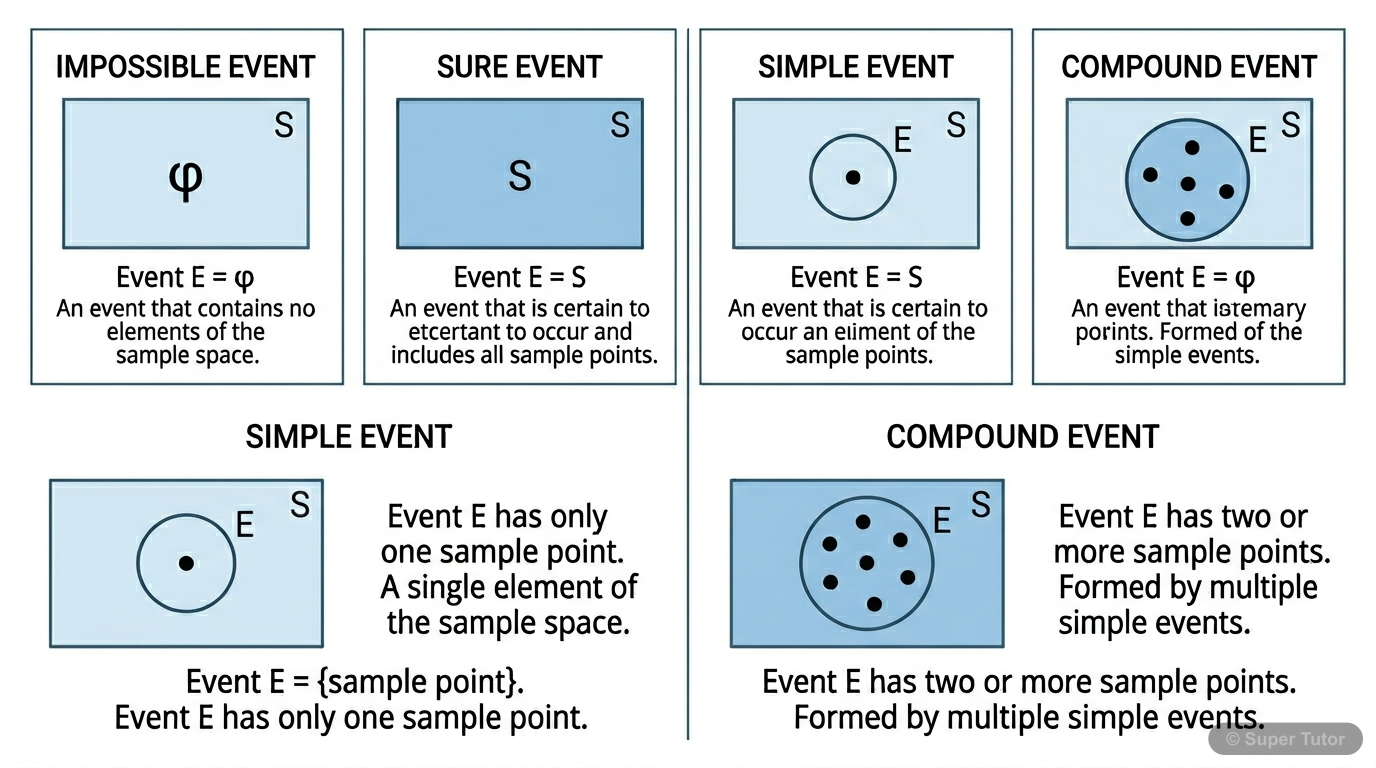
Learn better with visuals Super Tutor pairs illustrations like this with notes and quizzes for Probability.
A die is thrown once. Find the sample space and the probability of getting an even number.
Answer
Step 1: The sample space is S = {1, 2, 3, 4, 5, 6}. Step 2: The event of getting an even number is E = {2, 4, 6}. Step 3: Favourable outcomes = 3 and total outcomes = 6. Step 4: P(E) = 3/6 = 1/2. Answ…
A coin is tossed twice. Write the sample space and find the probability of getting exactly one head.
Answer
Step 1: Sample space is S = {HH, HT, TH, TT}. Step 2: Exactly one head occurs in HT and TH. Step 3: Favourable outcomes = 2 and total outcomes = 4. Step 4: P(exactly one head) = 2/4 = 1/2. Answer: Sam…
A coin is tossed three times. Find the probability of getting exactly two heads.
Answer
Step 1: Sample space has 8 outcomes. Step 2: Exactly two heads occur in HHT, HTH, and THH. Step 3: Favourable outcomes = 3. Step 4: P(exactly two heads) = 3/8. Answer: 3/8.
A die is thrown once. Find the probability of getting a prime number.
Answer
Step 1: Sample space is S = {1, 2, 3, 4, 5, 6}. Step 2: Prime numbers here are 2, 3, and 5. Step 3: Favourable outcomes = 3 and total outcomes = 6. Step 4: P(prime number) = 3/6 = 1/2. Answer: 1/2.
A die is thrown once. Find the probability of getting a number more than 6.
Answer
Step 1: Sample space is S = {1, 2, 3, 4, 5, 6}. Step 2: No outcome is more than 6. Step 3: Favourable outcomes = 0. Step 4: P = 0/6 = 0. Answer: 0.
A die is thrown once. Find the probability of getting a number less than 7.
Answer
Step 1: Sample space is S = {1, 2, 3, 4, 5, 6}. Step 2: Every outcome is less than 7. Step 3: Favourable outcomes = 6 and total outcomes = 6. Step 4: P = 6/6 = 1. Answer: 1. This is a sure event.
If P(E) = 2/11, find P(not E).
Answer
Step 1: Use the complement rule P(Ē) = 1 - P(E). Step 2: Substitute P(E) = 2/11. Step 3: P(Ē) = 1 - 2/11 = 9/11. Answer: 9/11.
A die is thrown once. Let E be getting an even number. Find the complementary event and its probability.
Answer
Step 1: E = {2, 4, 6}. Step 2: The complementary event is not E = {1, 3, 5}. Step 3: Favourable outcomes for not E = 3. Step 4: P(not E) = 3/6 = 1/2. Answer: not E = {1,3,5} and probability = 1/2.
+28 more flashcards
Practise AllFrequently Asked Questions
What are the important topics in Probability for ICSE Class 11 Mathematics?
How many flashcards are available for Probability?
How should I revise Probability for Class 11 exams?
Sources & Official References
Content is aligned to the official syllabus. Refer to the board website for the latest curriculum.
More resources for Probability
Practice Quiz
Test yourself with a quick quiz
Important Questions
Exam-style questions with answers
Revision Notes
Key points for last-minute revision
Formula Sheet
The chapter's formulas in one place
Chapter Summary
Understand the chapter at a glance
Concept Maps
See how topics connect
Study Plan
Step-by-step plan for this chapter
Syllabus
What topics to cover
For serious students
Get the full Probability chapter — start free.
Quizzes, flashcards, an AI doubt solver and a study plan for ICSE Class 11 Mathematics. Free to start, no card needed.