Introduction to Three Dimensional Geometry — Practice Quiz
ICSE · Class 11 · Mathematics
Try a 4-question quiz on Introduction to Three Dimensional Geometry for ICSE Class 11 Mathematics: tap an answer to check it and see why.
Interactive on Super Tutor
Studying Introduction to Three Dimensional Geometry? Get the full interactive chapter.
Quizzes, flashcards, AI doubt-solver and a step-by-step study plan — built for practice quiz and more.
Free trial, no card needed.
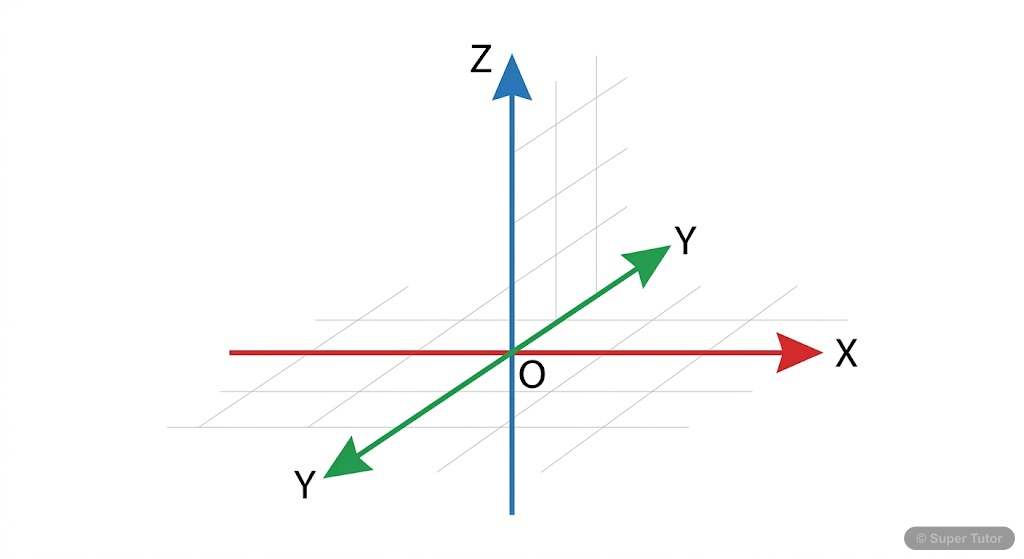
Learn better with visuals Super Tutor pairs illustrations like this with notes and quizzes for Introduction to Three Dimensional Geometry.
Quick Quiz: Introduction to Three Dimensional Geometry
0/4Tap an answer to check it instantly. No sign-up needed for these 4.
A point P has coordinates (2, 4, 6). Find the foot of the perpendicular from P on the xz-plane.
A point P has coordinates (-3, 5, 7). Find the reflection of P in the yz-plane and then state the new coordinates.
Two points are A(2, 3, 5) and B(8, 9, 11). Find the lengths of the edges of the rectangular parallelopiped formed by planes through A and B parallel to the coordinate planes.
Three points are A(3, 6, 9), B(6, 12, 18) and C(9, 18, 27). Use the distance formula to decide whether they are collinear.
Sample Questions
Find the point on the x-axis that is equidistant from A(1, 2, 2) and B(7, 5, 8).
Show answer
(11/2, 0, 0)
Let the point be P(x, 0, 0). Then PA = PB. So √((x-1)^2 + (0-2)^2 + (0-2)^2) = √((x-7)^2 + (0-5)^2 + (0-8)^2). Squaring gives (x-1)^2 + 8 = (x-7)^2 + 89. Simplifying: x^2 - 2x + 9 = x^2 - 14x + 138, so 12x = 129 and x = 11/2. Therefore P = (11/2, 0, 0).
A point lies in the yz-plane and is equidistant from A(2, 0, 3), B(0, 3, 2) and C(0, 0, 1). Find the point.
Show answer
(0, 1, 3)
Let P = (0, y, z). Equating PA and PB gives 3y - z = 0. Equating PB and PC gives 3y + z = 6. Solving these two equations gives y = 1 and z = 3. So the point is (0, 1, 3).
Find the coordinates of the centroid of triangle with vertices A(1, 2, 3), B(4, 5, 6) and C(7, 8, 9).
Show answer
(4, 5, 6)
The centroid is the average of the three vertices. So G = ((1+4+7)/3, (2+5+8)/3, (3+6+9)/3) = (4, 5, 6).
Find the coordinates of the point that divides the line segment joining P(2, -3, 4) and Q(8, 0, 10) in the ratio 1:2 internally.
Show answer
(4, -2, 6)
Use the internal section formula with m:n = 1:2. Coordinates are ((1·8 + 2·2)/3, (1·0 + 2·(-3))/3, (1·10 + 2·4)/3) = (4, -2, 6).
+55 more questions on Introduction to Three Dimensional Geometry (ICSE Class 11 Mathematics)
Practise AllFrequently Asked Questions
What are the important topics in Introduction to Three Dimensional Geometry for ICSE Class 11 Mathematics?
How many practice questions are there for Introduction to Three Dimensional Geometry?
Sources & Official References
Content is aligned to the official syllabus. Refer to the board website for the latest curriculum.
More resources for Introduction to Three Dimensional Geometry
Important Questions
Exam-style questions with answers
Revision Notes
Key points for last-minute revision
Chapter Summary
Understand the chapter at a glance
Concept Maps
See how topics connect
Study Plan
Step-by-step plan for this chapter
Flashcards
Quick-fire cards for active recall
Syllabus
What topics to cover
For serious students
Get the full Introduction to Three Dimensional Geometry chapter — start free.
Quizzes, flashcards, an AI doubt solver and a study plan for ICSE Class 11 Mathematics. Free to start, no card needed.