Introduction to Three Dimensional Geometry — Chapter Summary
ICSE · Class 11 · Mathematics
Summary of Introduction to Three Dimensional Geometry for ICSE Class 11 Mathematics. Part of the ICSE Class 11 Mathematics syllabus.
Interactive on Super Tutor
Studying Introduction to Three Dimensional Geometry? Get the full interactive chapter.
Quizzes, flashcards, AI doubt-solver and a step-by-step study plan — built for chapter summary and more.
Free trial, no card needed.
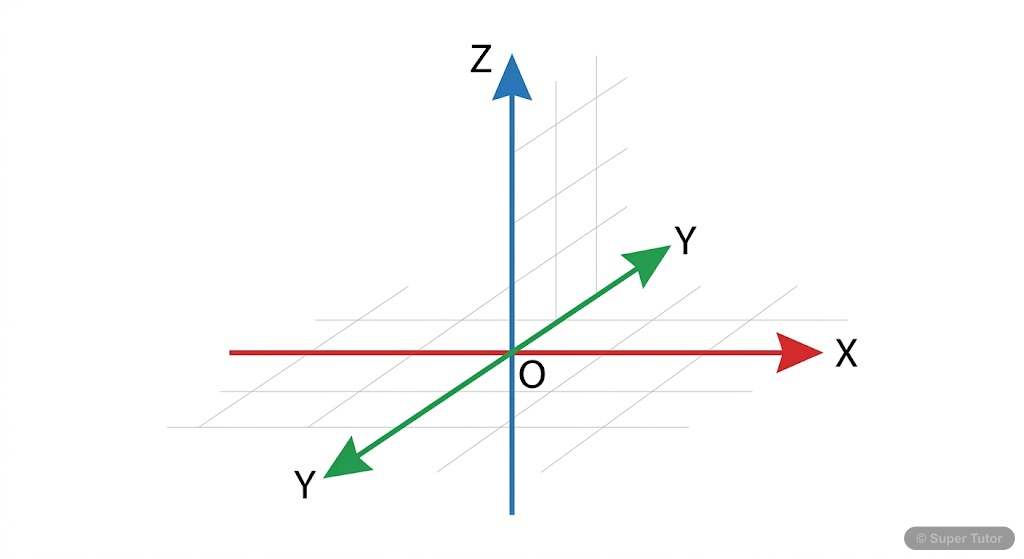
Learn better with visuals Super Tutor pairs illustrations like this with notes and quizzes for Introduction to Three Dimensional Geometry.
Overview
Three-dimensional geometry extends coordinate geometry from a plane to space. A point in a plane has two coordinates, while a point in space has three coordinates. These three coordinates describe the point’s perpendicular distances from the three coordinate planes. The chapter begins with the three
Key Concepts
Three mutually perpendicular lines in space
Three mutually perpendicular lines in space passing through a fixed point O are called the x-axis, y-axis, and z-axis. They are also called rectangula
A point in space has three
A point in space has three coordinates. These coordinates are the perpendicular distances of the point from the three coordinate planes. Their signs d
Points on the xy
Points on the xy-plane have coordinates of the form (x,y,0), on the yz-plane of the form (0,y,z), and on the xz-plane of the form (x,0,z). Points on t
The equations of the coordinate planes
The equations of the coordinate planes are z=0 for the xy-plane, x=0 for the yz-plane, and y=0 for the xz-plane. The equations of the axes are y=0, z=
The three coordinate axes divide space
The three coordinate axes divide space into eight octants. The sign pattern of x, y, and z determines the octant. First use the first two coordinates
Learning Objectives
- Understand the three-dimensional rectangular coordinate system
- Identify coordinate planes, coordinate axes, and the origin
- Locate points in different octants using signs of coordinates
- Find coordinates of feet of perpendiculars on planes and axes
- Use reflection rules across coordinate planes
Frequently Asked Questions
What are the important topics in Introduction to Three Dimensional Geometry for ICSE Class 11 Mathematics?
How should I revise Introduction to Three Dimensional Geometry for Class 11 exams?
Sources & Official References
Content is aligned to the official syllabus. Refer to the board website for the latest curriculum.
More resources for Introduction to Three Dimensional Geometry
For serious students
Get the full Introduction to Three Dimensional Geometry chapter — start free.
Quizzes, flashcards, an AI doubt solver and a study plan for ICSE Class 11 Mathematics. Free to start, no card needed.