Staff Leadership
ICSE · Class 12 · Business Studies
Most important questions from Staff Leadership for ICSE Class 12 Business Studies board exam 2026. MCQs, short answer, and long answer questions with marks.
Interactive on Super Tutor
Studying Staff Leadership? Get the full interactive chapter.
Quizzes, flashcards, AI doubt-solver and a step-by-step study plan — built for important questions and more.
1,000+ Class 12 students started this chapter today
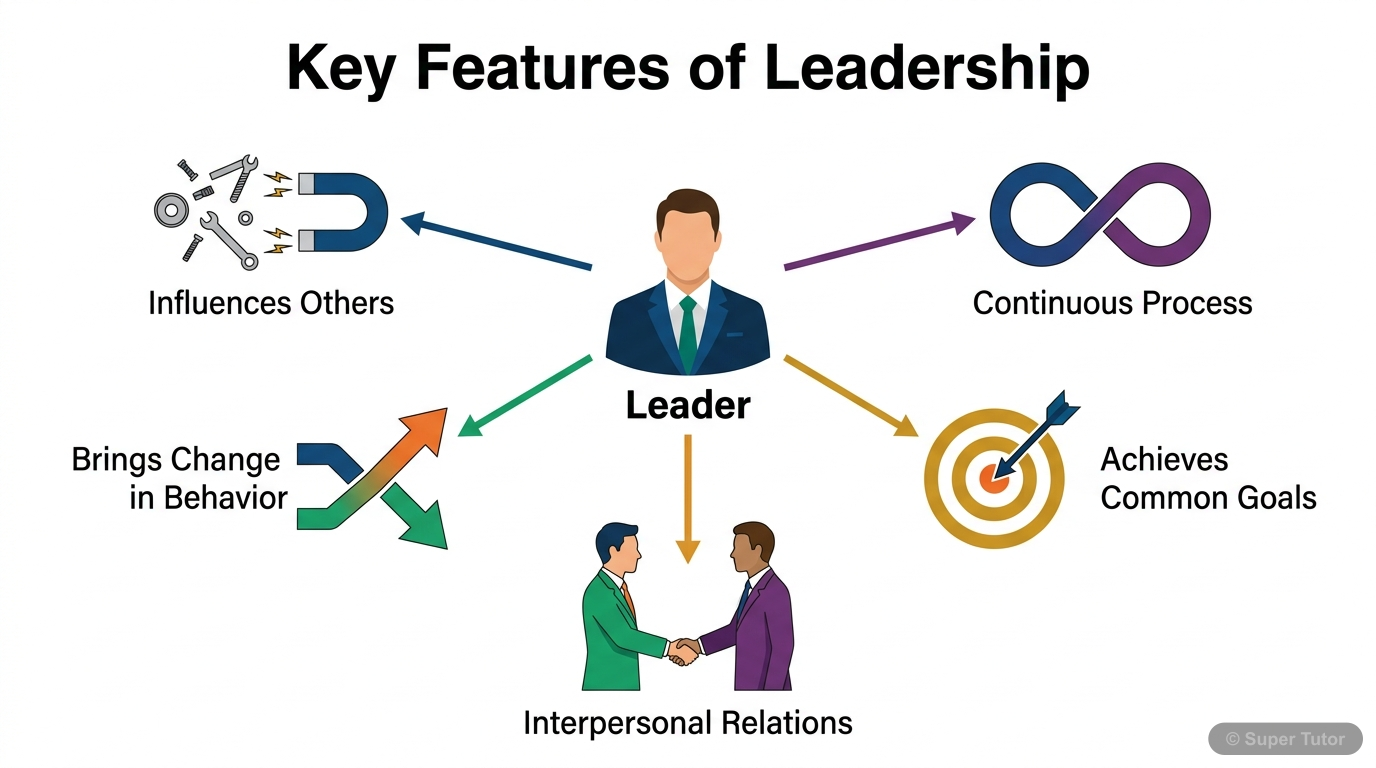
Super Tutor has 5+ illustrations like this for Staff Leadership alone — flashcards, concept maps, and step-by-step visuals.
See them allSample Questions
Which of the following is a key DISADVANTAGE of Autocratic leadership style that directly impacts the long-term development of an organisation?
Show answer
Future leadership potential does not develop as followers remain uninformed and afraid.
Step 1: Autocratic leadership centralises all decision-making power with the leader, leaving no room for subordinates to exercise judgement or initiative. Step 2: Option A (delay in decisions) is a disadvantage of Democratic/Participative leadership, not autocratic. Step 3: Option C (too much freedom) is associated with Laissez-Faire, not autocratic style. Step 4: Option D partially describes Laissez-Faire advantages and is incorrect for autocratic style. Step 5: The correct answer is Option B — because followers are kept uninformed, insecure, and dependent on the leader, they never develop le
Koontz and O'Donnell define leadership as the ability to exert interpersonal influence by means of communication towards the achievement of a goal. Which feature of leadership does this definition MOST highlight?
Show answer
Leadership is a process of inter-personal influence
Step 1: The definition by Koontz and O'Donnell specifically uses the words 'interpersonal influence' and 'communication' to describe leadership. Step 2: 'Situational' leadership refers to adapting style based on the situation — this definition does not mention situations. Step 3: 'Presupposes followers' refers to the existence of people who accept the leader — not directly stated here. Step 4: 'Community of interests' refers to shared goals between leader and followers — while a goal is mentioned, the emphasis is on influence. Step 5: The core of this definition is that a leader works by influ
In the Managerial Grid, the (9,9) Team Management style is considered the best. What is the PRIMARY reason for this?
Show answer
It achieves maximum concern for both production and people through trust, commitment, and mutual respect.
Step 1: In Blake and Mouton's grid, (9,9) means the leader scores 9 on concern for production AND 9 on concern for people — the maximum on both dimensions. Step 2: Option A describes (9,1) Task Management — high production, low people concern. Step 3: Option B describes (1,9) Country Club — high people concern but low production. Step 4: Option D resembles Laissez-Faire or Free-Rein leadership, not Team Management. Step 5: Team Management (9,9) achieves work accomplishment through committed people, interdependence, and a common stake in organisational goals — built on trust and mutual respect.
Which writer defined leadership as 'the ability to awaken in others the desire to follow a common objective'?
Show answer
Livingston
Step 1: Multiple writers have defined leadership, each emphasising different aspects. Step 2: George R. Terry defined it as 'the ability of influencing people to strive willingly for mutual objectives.' Step 3: Koontz and O'Donnell defined it as 'the ability to exert interpersonal influence by means of communication towards the achievement of a goal.' Step 4: Hodge and Johnson defined it as 'the ability to shape the attitude and behaviour of others whether in formal or informal situations.' Step 5: Livingston specifically used the phrase 'awaken in others the desire to follow a common objectiv
+38 more questions available
Practice AllFrequently Asked Questions
What are the important topics in Staff Leadership for ICSE Class 12 Business Studies?
How to score full marks in Staff Leadership — ICSE Class 12 Business Studies?
How many important questions are there in Staff Leadership?
Sources & Official References
Content is aligned to the official syllabus. Refer to the board website for the latest curriculum.
More resources for Staff Leadership
Practice Quiz
Test yourself with a quick quiz
Revision Notes
Key points for last-minute revision
Formula Sheet
All formulas in one place
Chapter Summary
Understand the chapter at a glance
Concept Maps
See how topics connect visually
Study Plan
Step-by-step plan to ace this chapter
Flashcards
Quick-fire cards for active recall
Syllabus
What topics to cover
NCERT Solutions
Every textbook question solved step by step
For serious students
Get the full Staff Leadership chapter — for free.
Quizzes, flashcards, AI doubt-solver and a step-by-step study plan for ICSE Class 12 Business Studies.