Equilibrium Price — Practice Quiz
ICSE · Class 12 · Economics
Try a 4-question quiz on Equilibrium Price for ICSE Class 12 Economics: tap an answer to check it and see why. 45 questions in the full chapter test.
Interactive on Super Tutor
Studying Equilibrium Price? Get the full interactive chapter.
Quizzes, flashcards, AI doubt-solver and a step-by-step study plan — built for practice quiz and more.
Free trial, no card needed.
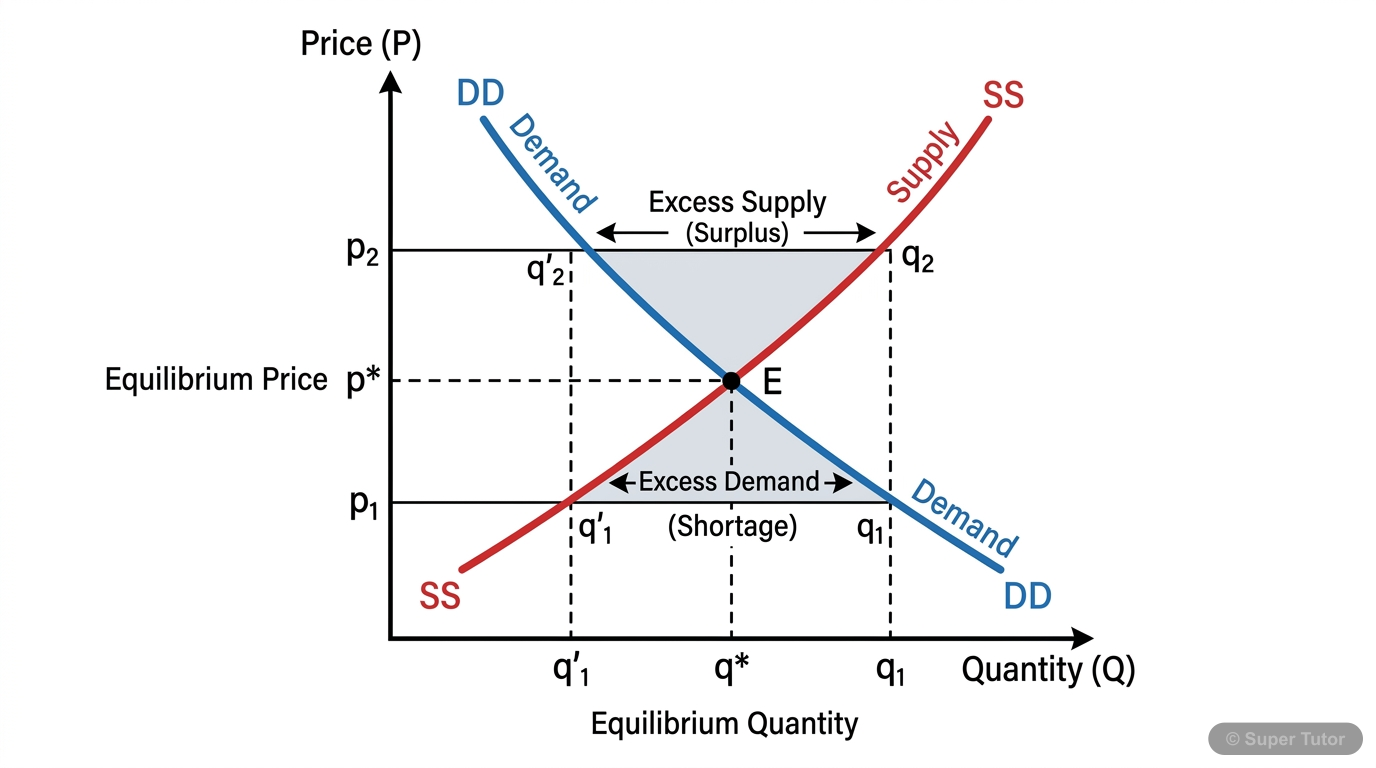
One of 6 illustrations for Equilibrium Price in Super Tutor — alongside flashcards, concept maps and practice questions.
Quick Quiz: Equilibrium Price
0/4Tap an answer to check it instantly. No sign-up needed for these 4.
Equilibrium price is the price at which:
According to Marshall, demand and supply are like two blades of a pair of scissors. This comparison means:
In Table 9.1 from the chapter, if the price of commodity X is ₹3 per unit, what happens in the market?
When there is excess supply in the market, what will happen to the price?
Sample Questions
When demand increases (demand curve shifts rightward) and supply remains unchanged, what happens to equilibrium price and quantity?
Show answer
Both price and quantity rise
Step 1: An increase in demand means the demand curve shifts to the right (from DD to D1D1). Step 2: At the original equilibrium price, demand now exceeds supply, creating excess demand. Step 3: Excess demand pushes the price upward. Step 4: As price rises, suppliers are willing to supply more (extension of supply along the same supply curve). Step 5: A new equilibrium is reached at a higher price AND higher quantity. Therefore, both equilibrium price and equilibrium quantity increase. Option A is wrong — quantity doesn't fall when demand increases. Option B is the opposite effect (seen when su
When supply increases (supply curve shifts rightward) and demand remains unchanged, the equilibrium price will:
Show answer
Fall and equilibrium quantity will rise
Step 1: An increase in supply shifts the supply curve rightward (from SS to S1S1). Step 2: At the original equilibrium price, supply now exceeds demand — this creates excess supply. Step 3: Excess supply puts downward pressure on price, so price falls. Step 4: As price falls, more consumers are willing to buy (extension of demand). Step 5: A new equilibrium is reached at a lower price but a higher quantity. This is the key result: increase in supply → price falls, quantity rises. Option A and D describe price rising, which is incorrect here. Option B is partly correct about price but wrong abo
Price ceiling (maximum price) is fixed by the government:
Show answer
Below the equilibrium price to protect poor consumers
Step 1: The government intervenes in markets when the free market price is considered too high for poor consumers. Step 2: Price ceiling (maximum price policy) means fixing a maximum price that sellers cannot exceed. Step 3: This maximum price is set BELOW the equilibrium price — otherwise it would have no effect on the market. Step 4: The objective is to make essential goods like wheat, rice, sugar affordable for poor people. Step 5: However, this creates excess demand (shortage) in the market as a side effect. Setting price above equilibrium (Option A and C) would be irrelevant as the market
What is the main consequence of price ceiling (maximum price policy) in the market?
Show answer
Excess demand (shortage) of the commodity
Step 1: Price ceiling is fixed below the equilibrium price. Step 2: At this lower price, consumers want to buy MORE of the commodity (because it's cheaper) — so quantity demanded increases. Step 3: At the same lower price, producers are willing to supply LESS (because they earn less profit) — so quantity supplied decreases. Step 4: Since Qd > Qs, there is a shortage or excess demand in the market. Step 5: This shortage may lead to black marketing, where goods are sold illegally at prices higher than the ceiling. Option A (excess supply) is the effect of price floor, not price ceiling. Option B
+41 more questions on Equilibrium Price (ICSE Class 12 Economics)
Practise AllFrequently Asked Questions
What are the important topics in Equilibrium Price for ICSE Class 12 Economics?
How many practice questions are there for Equilibrium Price?
Sources & Official References
Content is aligned to the official syllabus. Refer to the board website for the latest curriculum.
More resources for Equilibrium Price
Important Questions
Exam-style questions with answers
Revision Notes
Key points for last-minute revision
Chapter Summary
Understand the chapter at a glance
Concept Maps
See how topics connect
Study Plan
Step-by-step plan for this chapter
Flashcards
Quick-fire cards for active recall
Syllabus
What topics to cover
For serious students
Get the full Equilibrium Price chapter — start free.
Quizzes, flashcards, an AI doubt solver and a study plan for ICSE Class 12 Economics. Free to start, no card needed.