Concepts Of Cost And Revenue — Practice Quiz
ICSE · Class 12 · Economics
Try a 4-question quiz on Concepts Of Cost And Revenue for ICSE Class 12 Economics: tap an answer to check it and see why. Covers Producer’s Equilibrium.
Interactive on Super Tutor
Studying Concepts Of Cost And Revenue? Get the full interactive chapter.
Quizzes, flashcards, AI doubt-solver and a step-by-step study plan — built for practice quiz and more.
Free trial, no card needed.
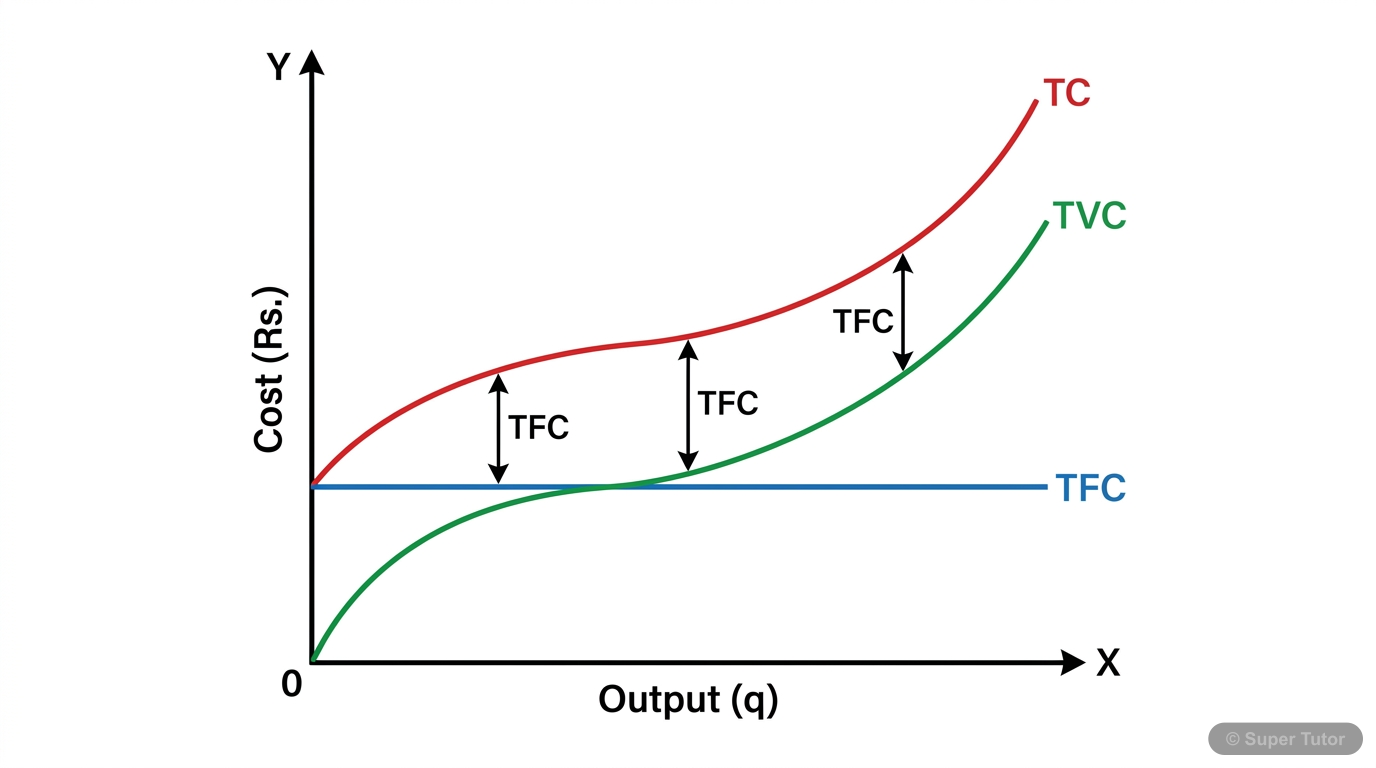
One of 3 illustrations for Concepts Of Cost And Revenue in Super Tutor — alongside flashcards, concept maps and practice questions.
Quick Quiz: Concepts Of Cost And Revenue
0/4Tap an answer to check it instantly. No sign-up needed for these 4.
Which of the following best describes 'Economic Cost' of production?
A farmer uses his own land to grow wheat instead of renting it out for ₹10,000 per year. This ₹10,000 is an example of:
Total Fixed Cost (TFC) of a firm is ₹500. What will be the TFC when the firm produces 10 units of output?
If TFC = ₹200, TVC = ₹350 at 5 units of output, what is the Average Total Cost (ATC)?
Sample Questions
The shape of the Average Fixed Cost (AFC) curve is:
Show answer
Rectangular hyperbola (continuously falling curve)
Step 1: AFC = TFC ÷ Q. Since TFC is constant, as Q increases, AFC keeps falling. Step 2: The product of AFC × Q always equals TFC (a constant). This is the mathematical definition of a rectangular hyperbola. Step 3: The AFC curve falls steeply at first and then gradually flattens but NEVER touches the X-axis (since AFC can never be zero). Step 4: U-shaped describes AVC, ATC, and MC curves — not AFC. Step 5: A horizontal line describes the TFC curve, not AFC. An upward sloping line does not describe any cost curve studied in this chapter.
The Total Variable Cost (TVC) curve starts from the origin because:
Show answer
When output is zero, variable costs are also zero
Step 1: Variable costs are incurred on variable factors like raw materials, temporary labour, fuel, etc. Step 2: If a firm produces zero output, it does not need to employ any variable factor. Step 3: Therefore, TVC = 0 when Q = 0. This is why the TVC curve starts from the origin (0,0). Step 4: This is different from TFC, which starts from above the origin (TFC is positive even at zero output). Step 5: Option A is wrong — variable and fixed costs are independent concepts. Option C describes fixed costs, not variable costs. Option D is wrong because at zero output, TC = TFC (not TFC = TVC).
The Marginal Cost (MC) of the 5th unit of output is calculated as:
Show answer
TC of 5 units – TC of 4 units
Step 1: Marginal Cost is the additional (extra) cost of producing one more unit of output. Step 2: Formula: MC_n = TC_n – TC_(n-1), so MC of 5th unit = TC(5) – TC(4). Step 3: Alternatively, MC can also be calculated as TVC_n – TVC_(n-1) because TFC cancels out. Step 4: Option A (TC÷5) gives Average Cost, not Marginal Cost. Option C (TVC÷5) gives Average Variable Cost. Step 5: Option D is wrong because TFC never changes, so TFC(5) – TFC(4) = 0, not MC. MC has no relation with fixed costs.
When Average Cost (AC) is falling, the relationship between Marginal Cost (MC) and Average Cost (AC) is:
Show answer
MC < AC
Step 1: The relationship between MC and AC is similar to the relationship between a marginal value and an average value. Step 2: When a new (marginal) value is less than the average, it pulls the average down. Step 3: Therefore, when AC is falling, it means MC is below AC (MC < AC). Step 4: When AC is rising, MC > AC (MC is above and pulling AC up). When AC is at its minimum point, MC = AC (MC cuts AC from below at its lowest point). Step 5: This is a fundamental relationship — MC curve passes through the minimum point of the AC curve. Option A describes when AC is rising. Option B describes t
+41 more questions on Concepts Of Cost And Revenue (ICSE Class 12 Economics)
Practise AllFrequently Asked Questions
What are the important topics in Concepts Of Cost And Revenue for ICSE Class 12 Economics?
How many practice questions are there for Concepts Of Cost And Revenue?
Sources & Official References
Content is aligned to the official syllabus. Refer to the board website for the latest curriculum.
More resources for Concepts Of Cost And Revenue
Important Questions
Exam-style questions with answers
Revision Notes
Key points for last-minute revision
Formula Sheet
The chapter's formulas in one place
Chapter Summary
Understand the chapter at a glance
Concept Maps
See how topics connect
Study Plan
Step-by-step plan for this chapter
Flashcards
Quick-fire cards for active recall
Syllabus
What topics to cover
For serious students
Get the full Concepts Of Cost And Revenue chapter — start free.
Quizzes, flashcards, an AI doubt solver and a study plan for ICSE Class 12 Economics. Free to start, no card needed.