Supply And Elasticity Of Supply — Practice Quiz
ICSE · Class 12 · Economics
Try a 4-question quiz on Supply And Elasticity Of Supply for ICSE Class 12 Economics: tap an answer to check it and see why.
Interactive on Super Tutor
Studying Supply And Elasticity Of Supply? Get the full interactive chapter.
Quizzes, flashcards, AI doubt-solver and a step-by-step study plan — built for practice quiz and more.
Free trial, no card needed.
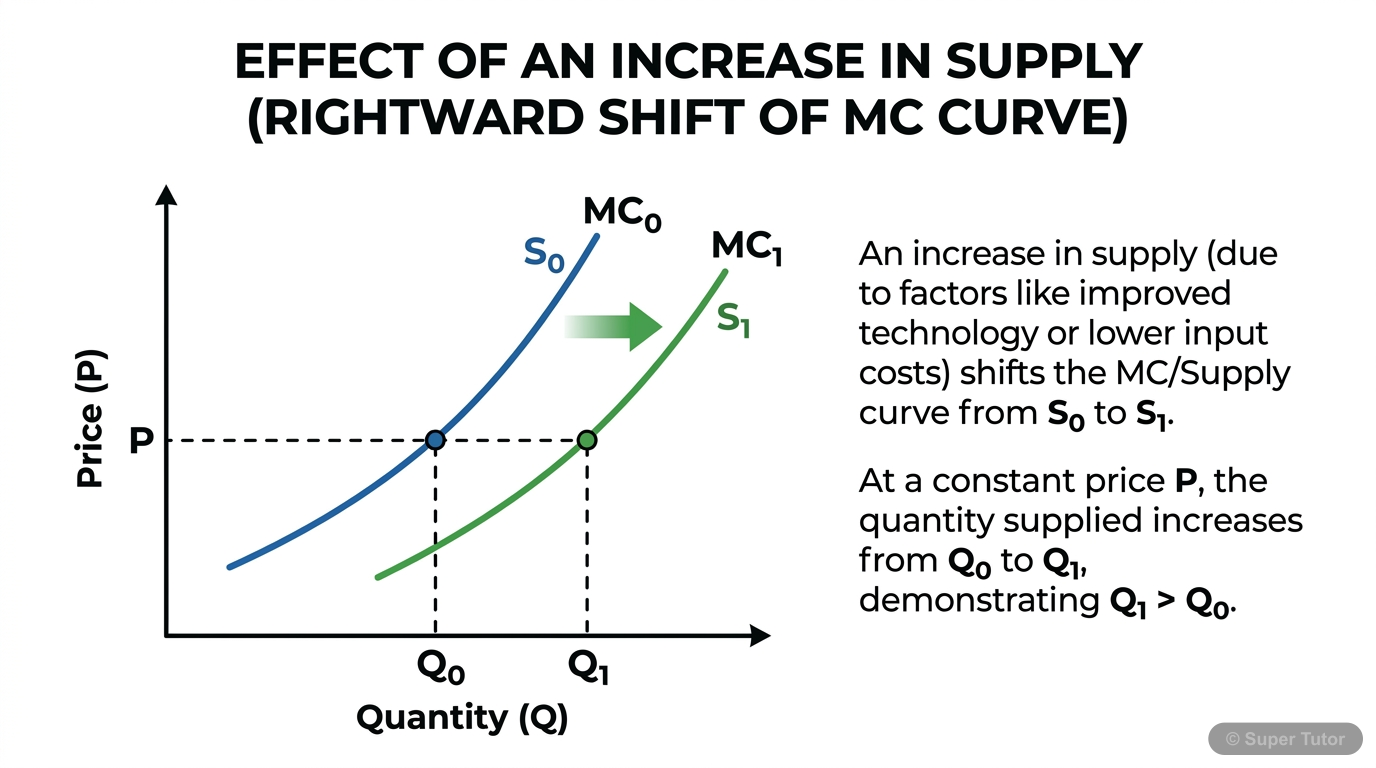
Learn better with visuals Super Tutor pairs illustrations like this with notes and quizzes for Supply And Elasticity Of Supply.
Quick Quiz: Supply And Elasticity Of Supply
0/4Tap an answer to check it instantly. No sign-up needed for these 4.
Which of the following best defines 'Supply' in Economics?
According to the Law of Supply, what is the relationship between price and quantity supplied?
The supply curve is upward sloping because:
Market supply is obtained by:
Sample Questions
If the price of a commodity rises from ₹20 to ₹30, and a producer increases supply from 100 units to 150 units, what is this called?
Show answer
Expansion (Extension) of supply
Step 1: When supply changes due to a change in the commodity's own price, it is called 'change in quantity supplied.' Step 2: When price rises and supply increases as a result, it is specifically called 'expansion' or 'extension' of supply. Step 3: This is shown as an upward movement along the same supply curve (from point A to point B). Step 4: 'Increase in supply' (Option A) occurs due to factors other than price and shifts the entire supply curve to the right – that is different. Step 5: Options C and D are incorrect in this context. Therefore, Option B is correct.
Which of the following factors will cause a RIGHTWARD SHIFT of the supply curve (Increase in Supply)?
Show answer
Improvement in technology of production
Step 1: A rightward shift of the supply curve means that more quantity is supplied at the same price – this is called 'increase in supply.' Step 2: Improvement in technology lowers the cost of production, which increases the profit margin of producers. Step 3: As profits rise, producers are willing to supply more at the same price, causing the supply curve to shift rightward. Step 4: Option A (increase in wages) raises cost of production and reduces supply – leftward shift. Step 5: Option C (increase in excise duty) also raises costs – leftward shift. Option D (expectation of future price rise
The formula for Price Elasticity of Supply (Es) is:
Show answer
Es = % Change in Quantity Supplied / % Change in Price
Step 1: Elasticity of supply measures the responsiveness of quantity supplied to a change in price. Step 2: The correct formula is: Es = (% Change in Quantity Supplied) ÷ (% Change in Price). Step 3: Option A has the numerator and denominator reversed – it gives the inverse of elasticity. Step 4: Options C and D use absolute changes, not percentage changes – these are incorrect. Step 5: Remember: Supply is in the numerator and Price is in the denominator. This formula helps us find the degree of response of supply to a price change. Therefore, Option B is correct.
If Price Elasticity of Supply (Es) = 0, the supply is said to be:
Show answer
Perfectly inelastic
Step 1: Price Elasticity of Supply (Es) measures how much supply changes in response to a price change. Step 2: When Es = 0, it means that even if price changes, the quantity supplied does not change at all. Step 3: This is called 'Perfectly Inelastic Supply.' The supply curve is a vertical line parallel to the Y-axis. Step 4: Examples include rare goods like antique paintings or postage stamps whose supply cannot be increased. Step 5: Perfectly elastic (Es = ∞) means infinite response; Unit elastic (Es = 1) means equal % changes. Therefore, Option C is correct.
+38 more questions on Supply And Elasticity Of Supply (ICSE Class 12 Economics)
Practise AllFrequently Asked Questions
What are the important topics in Supply And Elasticity Of Supply for ICSE Class 12 Economics?
How many practice questions are there for Supply And Elasticity Of Supply?
Sources & Official References
Content is aligned to the official syllabus. Refer to the board website for the latest curriculum.
More resources for Supply And Elasticity Of Supply
Important Questions
Exam-style questions with answers
Revision Notes
Key points for last-minute revision
Formula Sheet
The chapter's formulas in one place
Chapter Summary
Understand the chapter at a glance
Concept Maps
See how topics connect
Study Plan
Step-by-step plan for this chapter
Flashcards
Quick-fire cards for active recall
Syllabus
What topics to cover
For serious students
Get the full Supply And Elasticity Of Supply chapter — start free.
Quizzes, flashcards, an AI doubt solver and a study plan for ICSE Class 12 Economics. Free to start, no card needed.