Agriculture — Important Questions
ICSE · Class 6 · Geography
98 important questions from Agriculture for ICSE Class 6 Geography, with answers. Includes multiple choice, multiple correct and true false questions.
Interactive on Super Tutor
Studying Agriculture? Get the full interactive chapter.
Quizzes, flashcards, AI doubt-solver and a step-by-step study plan — built for important questions and more.
Free trial, no card needed.
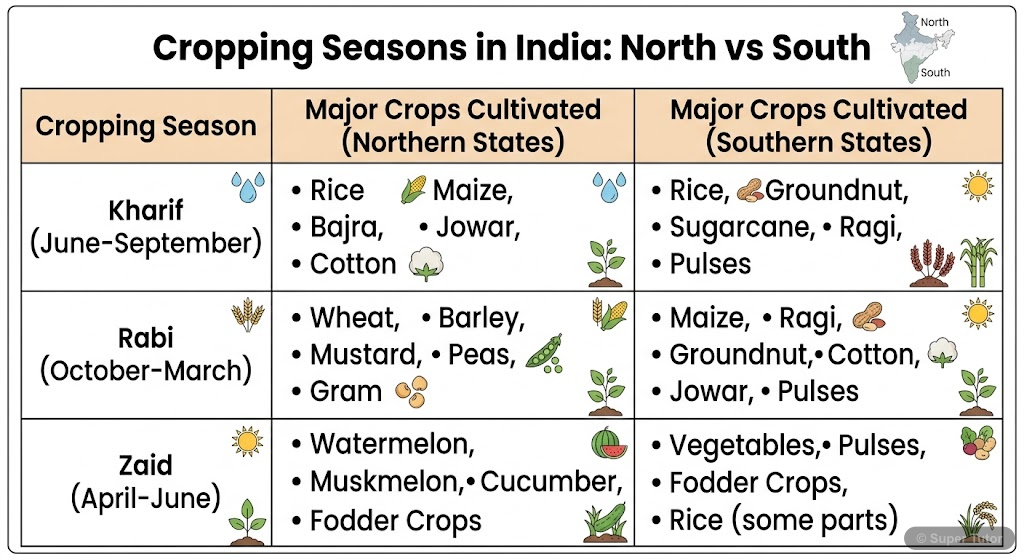
One of 4 illustrations for Agriculture in Super Tutor — alongside flashcards, concept maps and practice questions.
Important Questions from Agriculture
Which of the following statements CORRECTLY identifies the soil and topography requirements that DIFFERENTIATE wheat cultivation from cotton cultivation?
Show answer
Wheat grows best in well-drained loamy alluvial soil on plains; cotton grows best in deep black (regur) soil that retains moisture
Step 1: Different crops have different soil requirements, which is an important geographical factor affecting agriculture. Step 2: WHEAT grows best in well-drained, fertile, friable loamy alluvial soil. It is grown on plains (e.g., Indo-Gangetic Plain) as plains provide the flat terrain needed for large-scale wheat cultivation. Step 3: COTTON grows best in deep black soil, also called regur or black lava soil (found in Maharashtra and Gujarat). Black soil has the special quality of RETAINING MOISTURE, which is essential for cotton as it needs water throughout its long growing season of about 6
In the Japanese Method of rice cultivation, which combination of practices makes it produce THREE TIMES higher yields compared to traditional methods?
Show answer
Use of fewer but high-quality seeds, sowing in raised nursery beds, transplanting in rows, and heavy use of manure
Step 1: The Japanese Method of rice cultivation was developed to maximise yield from limited land. Step 2: It has four key features: (a) Use of FEWER but GOOD QUALITY seeds – reducing waste and ensuring stronger plants, (b) Seeds are sown in RAISED NURSERY BEDS – protecting young plants and allowing careful management, (c) Seedlings are TRANSPLANTED IN ROWS – making it easier to weed between plants and apply fertiliser efficiently, (d) HEAVY USE OF MANURE – providing nutrients to the soil to boost productivity. Step 3: These four practices together ensure that every plant grows optimally, resu
Brazil is the world's leading exporter of coffee, while Thailand is the world's leading exporter of natural rubber. Which of the following CORRECTLY identifies the PRIMARY geographical reason why each country leads in these specific crops?
Show answer
Brazil has well-drained volcanic highland soils ideal for coffee; Thailand has hot, wet equatorial climate with heavy rainfall ideal for rubber
Step 1: Different crops require very specific geographical conditions. Step 2: COFFEE requires temperature of 18°C to 27°C, rainfall of 125-200 cm, and WEATHERED VOLCANIC SOIL on well-drained hillsides rich in humus. Brazil's highlands (especially São Paulo state) have exactly these conditions – volcanic basalt soils on well-drained slopes. This is why Brazil is the world's largest producer and exporter of coffee. Step 3: RUBBER is a native plant of equatorial forests and needs HOT and WET climate – temperature 21°C to 35°C and HEAVY RAINFALL of 200 to 400 cm. Thailand, located in tropical Sou
The Drilling Method of sowing seeds is considered better than the Broadcasting Method. Which of the following BEST explains the PRIMARY advantage of drilling AND correctly identifies where it is mostly used in India?
Show answer
Drilling reduces wastage of seeds by placing them in furrows through a bamboo shaft attached to the plough; mostly used in Tamil Nadu
Step 1: The Broadcasting Method involves throwing or scattering seeds by hand over the entire field. This leads to wastage as seeds fall unevenly, some on hard soil, some in clumps. Step 2: In the DRILLING METHOD, seeds are dropped through a BAMBOO SHAFT attached to the plough directly into the furrows (grooves) made by the plough in a straight line. Step 3: This ensures seeds go into the prepared soil at the correct depth and location, significantly REDUCING WASTAGE. Step 4: However, drilling is very TIME-CONSUMING, which is a disadvantage. Step 5: According to the textbook, the Drilling Meth
+94 more questions on Agriculture (ICSE Class 6 Geography)
Practise AllFrequently Asked Questions
What are the important topics in Agriculture for ICSE Class 6 Geography?
How many important questions are there in Agriculture?
Sources & Official References
Content is aligned to the official syllabus. Refer to the board website for the latest curriculum.
More resources for Agriculture
For serious students
Get the full Agriculture chapter — start free.
Quizzes, flashcards, an AI doubt solver and a study plan for ICSE Class 6 Geography. Free to start, no card needed.