Water Bodies — Important Questions
ICSE · Class 6 · Geography
91 important questions from Water Bodies for ICSE Class 6 Geography, with answers. Includes multiple choice, multiple correct and true false questions.
Interactive on Super Tutor
Studying Water Bodies? Get the full interactive chapter.
Quizzes, flashcards, AI doubt-solver and a step-by-step study plan — built for important questions and more.
Free trial, no card needed.
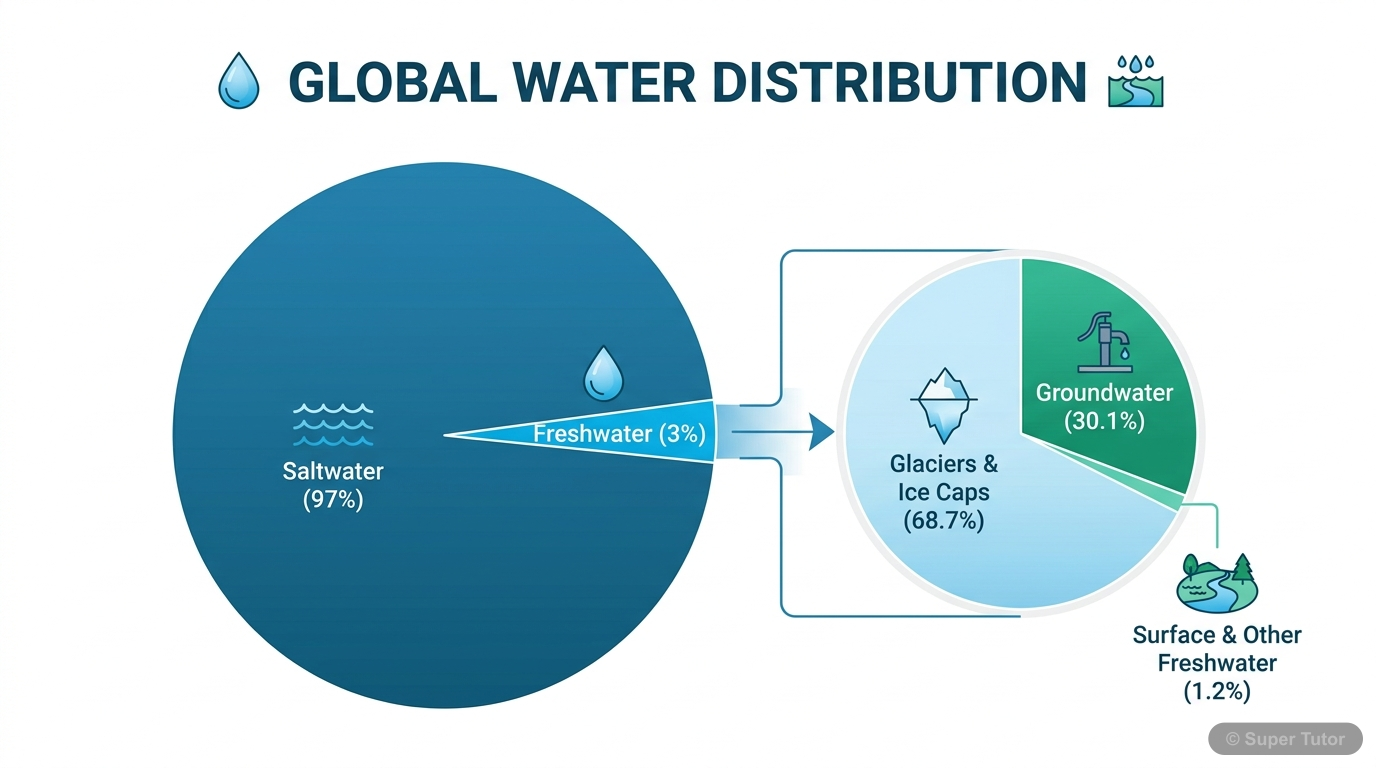
An illustration from Super Tutor's Water Bodies chapter — alongside flashcards, concept maps and practice questions.
Important Questions from Water Bodies
Which of the following is a characteristic of the Arctic Ocean that makes it different from other oceans?
Show answer
It is the smallest ocean and has the lowest salinity
Step 1: Recall the characteristics of the Arctic Ocean from the chapter. Step 2: The Arctic Ocean is the smallest of all the five oceans. Step 3: It has the lowest salinity (saltiness) among all major oceans because of low evaporation and heavy freshwater inflow from rivers and streams. Step 4: Option A is wrong — the Pacific is the largest. Option B is wrong — the Atlantic is the saltiest. Option D is wrong — the Arctic Ocean is around the North Pole, not the South Pole (which is surrounded by the Southern Ocean). The correct answer is C.
A sea that is partially enclosed by land and is located between the open ocean and the coastal zone is called a ________.
Show answer
Marginal sea
Step 1: The question describes a sea that lies between the open ocean and the coast — partially enclosed by land. Step 2: According to the textbook, a marginal sea is a partially enclosed body of water located between the open ocean and the coastal zone. Step 3: Examples of marginal seas include the Bering Sea, Caribbean Sea, North Sea, and Arabian Sea. Step 4: An inland sea is a large lake fully surrounded by land (like the Caspian Sea). A salt lake and bay are different types of water bodies. The correct answer is Marginal sea.
Which of the following seas is classified as an INLAND sea?
Show answer
Caspian Sea
Step 1: We need to differentiate between marginal seas and inland seas. Step 2: The textbook classifies seas into two types — marginal and inland. Step 3: The list of inland seas includes: Black Sea, Caspian Sea, Aral Sea, Red Sea, and Dead Sea. These are large lakes in continental areas that are termed 'inland seas.' Step 4: The Arabian Sea, Bering Sea, and North Sea are all marginal seas — they are connected to open oceans. The Caspian Sea is completely surrounded by land (between Europe and Asia), making it an inland sea. Correct answer is Caspian Sea.
Lake Baikal is one of the world's most famous lakes. On which continent is it located?
Show answer
Asia
Step 1: Identify where Lake Baikal is located from your chapter knowledge. Step 2: Lake Baikal is located in Russia (Siberia), which is part of the continent of Asia. Step 3: It is known as the world's deepest freshwater lake and holds about 20% of the world's unfrozen surface fresh water. Step 4: The Five Great Lakes are in North America. Lake Victoria is in Africa. Lake Titicaca is in South America. Lake Baikal is in Asia (Russia). Correct answer is Asia.
+87 more questions on Water Bodies (ICSE Class 6 Geography)
Practise AllFrequently Asked Questions
What are the important topics in Water Bodies for ICSE Class 6 Geography?
How many important questions are there in Water Bodies?
Sources & Official References
Content is aligned to the official syllabus. Refer to the board website for the latest curriculum.
More resources for Water Bodies
For serious students
Get the full Water Bodies chapter — start free.
Quizzes, flashcards, an AI doubt solver and a study plan for ICSE Class 6 Geography. Free to start, no card needed.