Sets — Important Questions
ICSE · Class 6 · Mathematics
90 important questions from Sets for ICSE Class 6 Mathematics, with answers. Includes multiple choice, multiple correct and true false questions.
Interactive on Super Tutor
Studying Sets? Get the full interactive chapter.
Quizzes, flashcards, AI doubt-solver and a step-by-step study plan — built for important questions and more.
Free trial, no card needed.
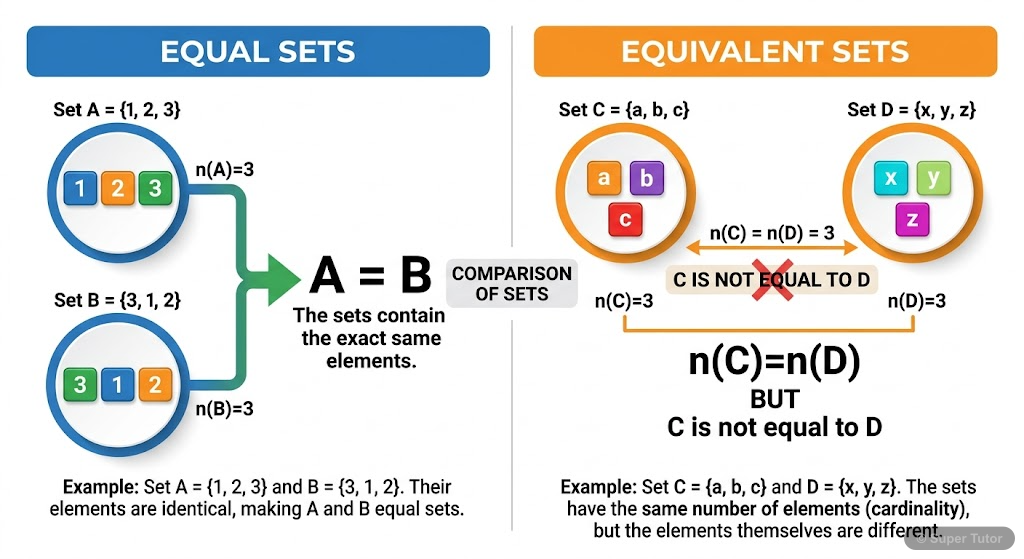
Learn better with visuals Super Tutor pairs illustrations like this with notes and quizzes for Sets.
Important Questions from Sets
Sets A = {1, 2, 3} and B = {a, b, c} are best described as:
Show answer
Equivalent sets
Step 1: We need to compare sets A = {1, 2, 3} and B = {a, b, c}. Step 2: Equal sets have exactly the same elements. A and B have different elements (numbers vs letters), so they are NOT equal sets. Step 3: Equivalent sets have the same NUMBER of elements (elements can be different). Step 4: n(A) = 3 and n(B) = 3 — both sets have 3 elements each. Step 5: Since the number of elements is equal (but elements themselves are different), A and B are equivalent sets. Also note they are disjoint (no common element), but the best description is 'equivalent sets' as it captures the key relationship.
What is the cardinal number of set B = {letters used in the word 'MATHEMATICS'}?
Show answer
8
Step 1: Find the set of letters used in the word MATHEMATICS. Step 2: List all letters: M, A, T, H, E, M, A, T, I, C, S. Step 3: Remove repeated letters — M appears twice, A appears twice, T appears twice. Step 4: Unique letters are: M, A, T, H, E, I, C, S. Step 5: Count the unique letters: M, A, T, H, E, I, C, S = 8 letters. So n(B) = 8. A common mistake is to count all 11 letters in the word without removing repetitions.
Which of the following is an INFINITE set?
Show answer
Set of odd natural numbers
Step 1: An infinite set has an unlimited number of elements that cannot be fully counted. Step 2: 'Natural numbers less than 100' = {1, 2, 3, ..., 99} — this has exactly 99 elements, so it is FINITE. Step 3: 'Students in a school' is a limited, countable number — so FINITE. Step 4: 'Days in a week' = {Monday, Tuesday, ..., Sunday} — only 7 elements, so FINITE. Step 5: 'Odd natural numbers' = {1, 3, 5, 7, 9, ...} — the dots (…) show it goes on forever with no end. This is an INFINITE set.
Which of the following is an EMPTY set (Null set)?
Show answer
{ }
The empty set has no elements. In the chapter, the empty set is shown by { } or by the symbol ∅. So the set with no elements is the null set.
+86 more questions on Sets (ICSE Class 6 Mathematics)
Practise AllFrequently Asked Questions
What are the important topics in Sets for ICSE Class 6 Mathematics?
How many important questions are there in Sets?
Sources & Official References
Content is aligned to the official syllabus. Refer to the board website for the latest curriculum.
More resources for Sets
Practice Quiz
Test yourself with a quick quiz
Revision Notes
Key points for last-minute revision
Formula Sheet
The chapter's formulas in one place
Chapter Summary
Understand the chapter at a glance
Concept Maps
See how topics connect
Study Plan
Step-by-step plan for this chapter
Flashcards
Quick-fire cards for active recall
Syllabus
What topics to cover
For serious students
Get the full Sets chapter — start free.
Quizzes, flashcards, an AI doubt solver and a study plan for ICSE Class 6 Mathematics. Free to start, no card needed.